


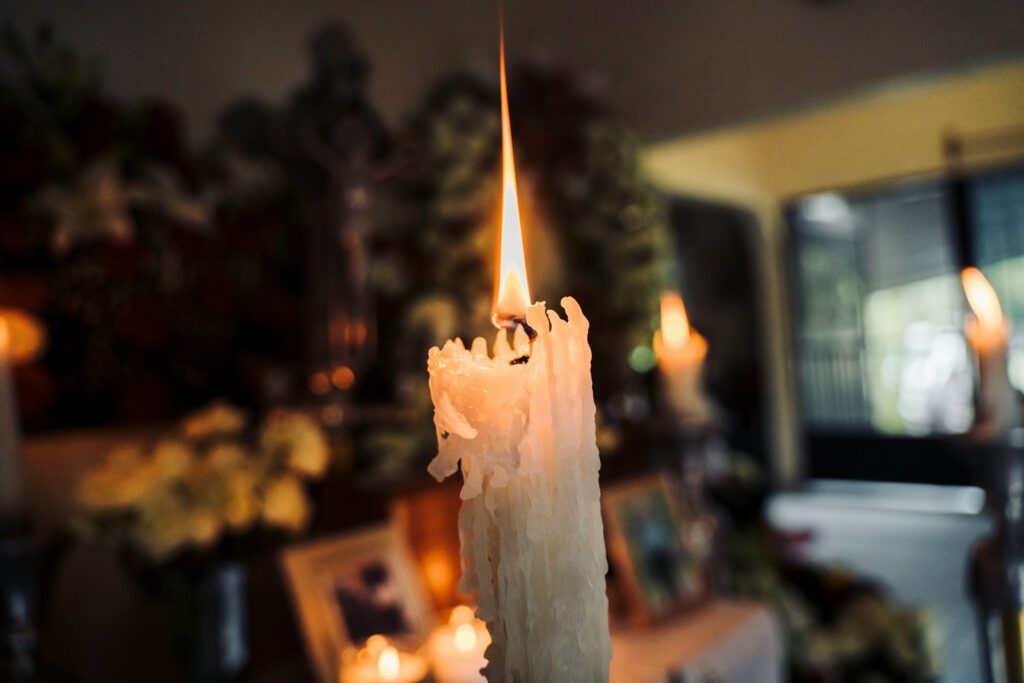
More than 14,000 residential fires in the United States start with a candle every year, killing an estimated 170 people and causing roughly $350 million in property damage annually, according to Consumer Product Safety Commission data compiled ahead of this year’s holiday decorating season. Halloween ranks among the top five days of the year for candle-related home fires, largely because the same open flame that makes a carved pumpkin glow sits a few feet from paper decorations, dry hay bales, and polyester costumes.


Nearly Half of All Candle Fires Start in the Bedroom
The single most common place a candle fire ignites isn’t the dining room table where the candle was probably meant to sit decoratively — it’s the bedroom. CPSC data shows close to half of home candle fires originate there, typically after a lit candle is left near or on a mattress, bedding, upholstered furniture, or window coverings. Tealights and taper candles, the two styles cheapest and easiest to buy in bulk for fall decorating, show up disproportionately often in these incident reports, in part because their small size makes them easy to set down and forget.
The Death Toll Climbed 750% in Under Two Decades
Candle fires weren’t always this common a hazard. Federal fire data tracked a 750% increase in candle-related deaths between 1980 and 1998, a period that lines up almost exactly with decorative candle use becoming a mainstream home decor category rather than an occasional-use item for blackouts or birthdays. The hazard grew as the product shifted from utilitarian to aesthetic — more candles burning in more rooms, for longer stretches, often purely for ambiance rather than necessity.
Young Children Face More Than Double the Risk
Children under age 5 die in home fires, including candle fires, at a rate more than double the national average. Fire safety researchers attribute part of that gap to behavior: young children who wake to smoke or flames often hide — under a bed, in a closet — rather than heading for an exit, the opposite of what evacuation drills teach older kids and adults to do. That instinct turns a fire that might otherwise be survivable into one where a child isn’t found in time.
Halloween’s Specific Risk Factors Stack Up
Halloween combines several candle-fire risk factors that don’t usually overlap on an average night. Jack-o-lanterns are typically lit with a votive or tealight candle placed directly inside a hollowed-out, increasingly dry pumpkin — a natural fire starter once its walls thin out under heat. Those pumpkins are frequently positioned on porches and stoops flanked by paper decorations, dried cornstalks, and fake cobwebs, all of which ignite easily. Add costumes, many of them polyester or another synthetic fabric that melts and sticks to skin rather than simply burning, worn by kids and adults walking past open flames on strangers’ porches for hours, and the holiday concentrates candle-fire risk factors that are normally spread across the calendar.
What Actually Reduces the Risk
- Swap real tealights inside jack-o-lanterns for battery-operated LED candles, which have gotten close in appearance to real flame without the ignition risk.
- Keep any lit candle at least 12 inches from anything that can burn, including decorations, costumes, and bedding.
- Never leave a burning candle unattended in a bedroom, and blow out all candles before leaving a room or falling asleep.
- Place jack-o-lanterns away from doormats, dried leaves, hay bales, and other decorations sitting directly next to a home’s entrance.
None of these steps require giving up the aesthetic that made candles a decorating staple in the first place. They just require treating an open flame indoors, or on a porch full of trick-or-treaters, with the same seriousness fire officials have been documenting in the data for decades — especially on the one night of the year when candles, costumes, and heavy foot traffic all show up on the same porch at once.
Why the Timing Catches People Off Guard
Most candle-safety messaging arrives around winter holidays, when tree lights and menorahs dominate the conversation, leaving Halloween’s own candle risk comparatively under-covered even though it ranks among the calendar’s worst days for these fires. That gap in awareness, more than any single behavior, is why the same preventable mistakes — an unattended jack-o-lantern, a tealight too close to a costume hem — keep showing up in incident reports year after year.