


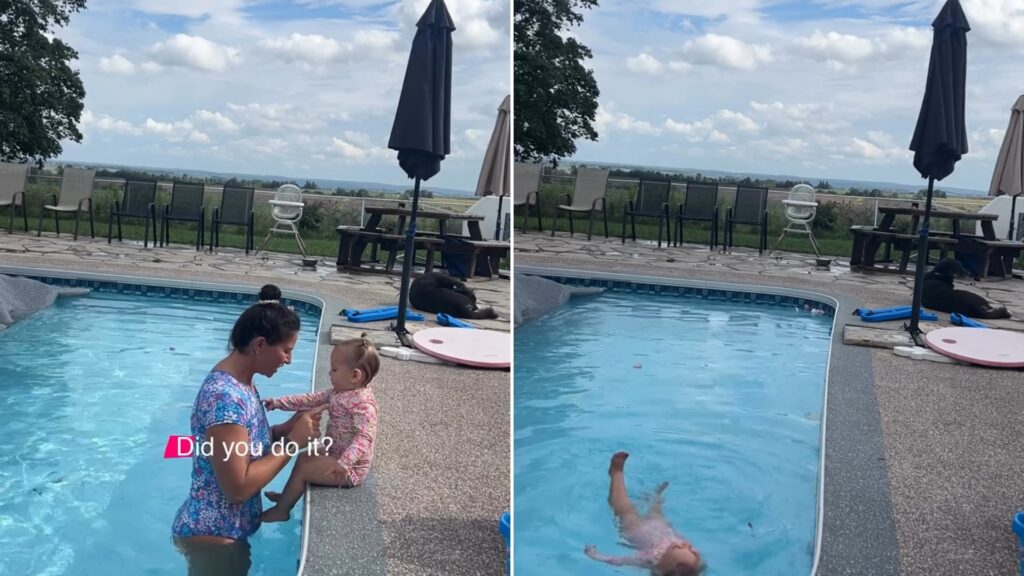
A video of a 15-month-old being guided through a controlled fall into a pool is circulating as a real example of what an infant swim lesson actually looks like in practice, according to the swim-safety account’s own Instagram post. The account, built around infant and toddler water safety and followed by roughly 16,000 people, posted the clip specifically to explain why the fall is staged the way it is rather than left as an incidental moment. The technique lines up with what the American Academy of Pediatrics calls water competency, which it defines as a child’s ability to get back to safety if they end up in water unexpectedly.
The fall is practiced on purpose, not filmed by accident. Instructors stage a controlled version of a fall-in so a child’s real reaction, if it ever happens outside a lesson, is a rehearsed response instead of a first-time panic. A toddler who has practiced the sequence dozens of times in a supervised setting is far more likely to default to it than one experiencing the sensation of unexpected water for the first time near an unsupervised pool.
“Water competency” is the actual goal, not swimming laps. At 15 months old, no instructor is teaching a child to swim in the traditional sense. The goal is narrower and more specific: get the child to the surface, get them breathing, and get them oriented toward safety, whether that’s a wall, steps or an adult’s arms. The AAP notes that research has found swim lessons beneficial starting around age 1, which is younger than many parents assume lessons can start.
Age 1 isn’t an arbitrary starting point. Drowning is the leading cause of death for children ages 1 to 4 in the United States, according to the CDC, which tracks more children in that age range dying from drowning than from any other single cause. That statistic is part of why swim-safety instructors push to start this young rather than waiting until a child is older and, in theory, more capable of taking instruction.
A controlled fall-in follows a specific sequence for a reason. The general method taught by infant water safety programs has a child enter the water clothed, so the practice matches a real accidental fall, with an instructor positioned close enough to guide but not immediately catch. The child is coached to reorient, get their face clear of the water, and move toward the instructor or the pool wall, building the muscle memory that would need to fire automatically in a real fall.
None of it replaces supervision. Every major water safety group, including the AAP, frames swim lessons as one layer of protection, not a substitute for constant adult supervision, secure pool fencing and knowing CPR. A child who has been through lessons like the one in this video can still drown; the training narrows the odds, it doesn’t erase them.
The CDC’s numbers explain why this content spreads among parents of toddlers specifically. Roughly 4,000 fatal unintentional drownings happen in the United States each year, an average of about 11 deaths a day, according to CDC data, and children ages 1 to 4 make up a disproportionate share of that total. For parents in that exact window with a child who’s newly mobile and drawn to water, a video breaking down the mechanics of a lesson reads less like entertainment and more like a walkthrough of something they may need to understand quickly.
What a video like this can’t show is repetition. A single clip captures one fall-in, but instructors who teach this method typically repeat the sequence many times across multiple sessions before treating the skill as reliable. A parent watching the video should take it as a demonstration of the technique, not a one-time inoculation, and should ask any instructor they hire how many repetitions and sessions it typically takes before a child’s response becomes consistent.
Accounts like this one pull parents in less for the drama of watching a toddler fall into water than for the explanation that follows it, the part that tells them why a moment that looks alarming out of context is actually the point of the lesson.