Cookware takes a beating, which is exactly why so much of it ends up donated or scrapped without a second thought. Dented pots and scorched pans just don’t look like anything worth saving.
Yet certain vintage cookware brands and materials are genuinely collectible, precisely because they were built to outlast the trends around them. Check for these marks before your old pots and pans leave the house for good.
Cast Iron With Early Manufacturer Logos
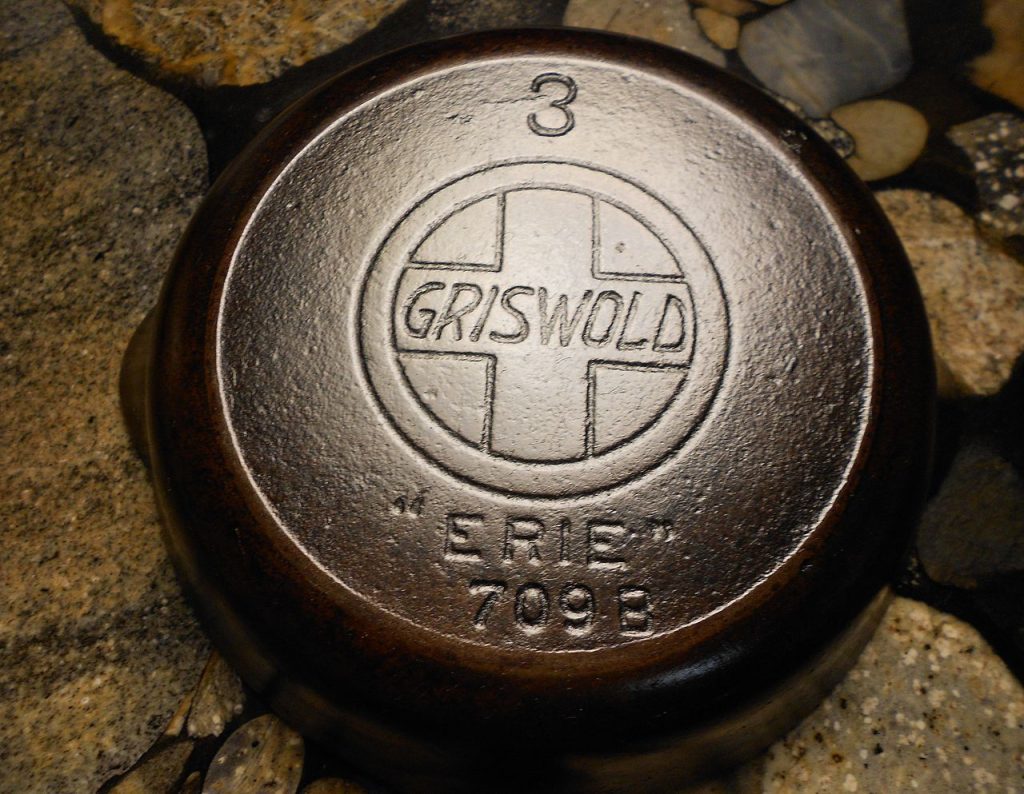
Skillets and pans bearing specific early logos from well-known American foundries can be worth significantly more than a similar-looking modern piece, according to cast iron identification resources. The raised marking on the underside, along with a size number and sometimes a pattern number, is the key to identifying which era and maker produced the piece.
The big number is not the diameter in inches. That guide explains that sizes matched the “stove eye” openings on wood-burning stoves, so a No. 8 from one foundry can measure slightly differently from another’s. Griswold also cast pattern numbers such as 704 into its pans.
Logos date a pan. The site’s Griswold trademark timeline puts the slant logo at roughly 1906 to 1929 and the large block logo at about 1920 to 1940, and calls the large block perhaps the most attractive to collectors. Surface rust and baked-on grime are usually cosmetic issues that restoration can fix, so don’t judge a pan by its current appearance.
Enamelware and Graniteware
Speckled blue, gray, or white enamel-coated pots and coffee pots, often chipped from decades of use, are collected specifically for their farmhouse charm and history. Certain colors and shapes are considerably rarer than the common gray speckled pattern, and even pieces with noticeable chipping can still have display value, according to enamelware collecting guides.
That guide lists white, navy, gray, red, blue, and aqua as the common colors and green, yellow, purple, pink, brown, and black as the rare ones. To tell old from new, it says antique pieces are heavier and have handles that were riveted, soldered, or screwed on.
Keep expectations realistic. The guide’s own price examples for everyday pieces run from about $8 to $10 for a spattered pie plate up to $35 for a large gray coffee pot. It also advises against eating from antique enamelware. Look at the color, pattern, and overall shape rather than dismissing a piece because of surface damage, since collectors often display these pieces as decor.
Copper-Bottom Stainless Cookware
Stainless steel pots with a distinctive copper-colored bottom are frequently found in family kitchens, and certain vintage lines are still sought after for their durability and retro appeal. Original bakelite handles, an intact copper bottom without heavy pitting, and manufacturer stamps on the underside all help identify an authentic vintage set, according to cookware identification guides.
For Revere Ware, the stamp does most of the work. That guide says the common vintage mark, used from 1946, is a circle containing the words “Process Patent” or “Pat. Pend.” Pieces made after 1968 carry a simpler logo with no circle and no patent wording.
Handles narrow the date further. According to the same guide, pieces from 1939 to 1947 have two screws close together at the front of the handle, while 1947 to 1968 handles have the screws at opposite ends. Replacement handles are available for the later style. A complete matched set with lids tends to be worth more than individual pieces sold separately.
Heavy Cast Aluminum Cookware
Lightweight but sturdy cast aluminum pots and roasters from mid-century cookware brands are often mistaken for cheap, disposable cookware. In reality, certain aluminum lines with distinctive lid designs and manufacturer stamps have their own collector niche.
Three names are worth knowing. The Cast Iron Collector’s page on vintage cast aluminum dates Wagner Ware Magnalite to the 1930s through the 1970s and describes its original form as having domed lids and mission-style handles. Guardian Service Ware, made by Century Metalcraft until 1957, is recognizable by its hammered finish and distinctively shaped handles. Griswold also made aluminum, including its Aristocraft line in the 1940s.
The same page notes that aluminum pieces usually share the markings and design of the maker’s cast iron. Check the handle and lid knob shape along with any stamped brand name. Staining and oxidation can be cleaned up and are not a reason to scrap a piece.
Cast Iron Dutch Ovens With Lid Loops
A lidded cast iron pot found in a barn or basement might look too far gone to bother with, but Dutch ovens are among the most durable and restorable pieces of vintage cookware around. Look for a heat ring on the bottom, a self-basting lid with condensation drip points, and a maker’s mark, all of which help identify age and manufacturer.
The lid tells you which kind you have. According to the Cast Iron Collector’s guide to camp ovens, a Dutch oven lid is domed and typically has drippers for self-basting. A camp oven lid is thick, mostly flat, and has a ridge around the top edge to hold hot coals. Camp ovens also usually have feet, a bail handle, and sometimes a lid loop.
Even heavily rusted examples can often be fully restored, so a rough appearance shouldn’t be the deciding factor. Structural damage is different. The site’s page on cast iron damage says cracks drastically reduce collectible value and deep rust pitting cannot be repaired.
Cast Iron Cornbread and Muffin Pans
Novelty-shaped cast iron pans, like cornbread molds shaped like ears of corn or small individual muffin pans, are a specific niche within cast iron collecting. Certain molds can be more sought after than a full-size skillet from the same manufacturer.
Collectors call the older muffin-style pieces gem pans. The Cast Iron Collector’s history of gem and muffin pans traces the classic design, separate cups joined with cut-outs between them so heat circulates, to an 1859 patent by Nathaniel Waterman of Boston. It says Griswold made roughly 50 different gem pan patterns and that Wagner sold corn stick pans in three sizes.
Values vary widely. That page describes some scarce early pans as rare enough to bring hundreds of dollars, but those are the exceptions. Checking for a legible maker’s mark and pattern number, and evaluating whether all the individual mold cavities are undamaged, will tell you whether a piece is worth cleaning up rather than passing along to a scrap bin.