


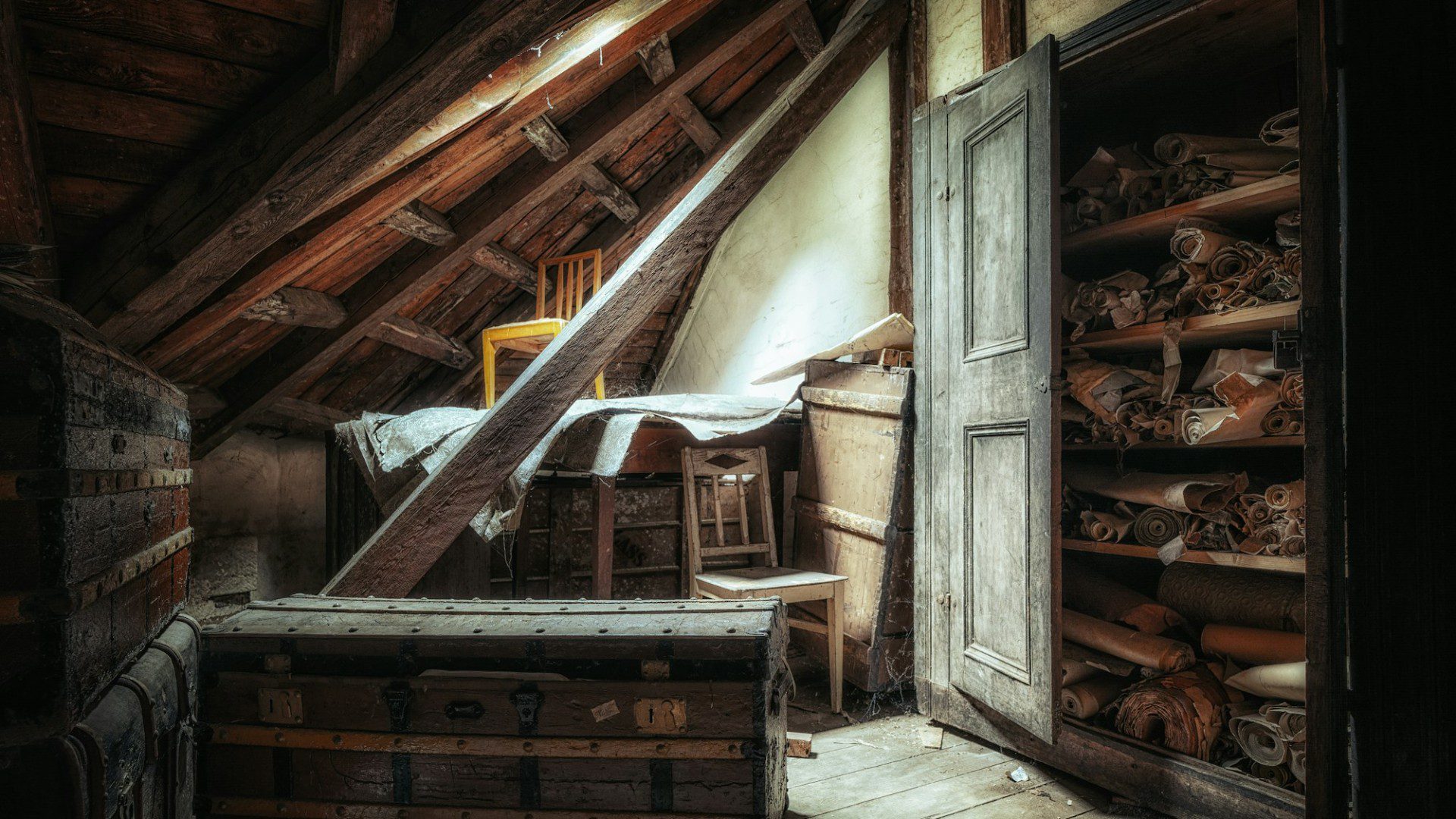
Attics are easy to ignore precisely because they’re out of sight, which is exactly how they end up packed with boxes nobody’s opened in a decade. It’s also, often, the space that ends up as someone else’s overwhelming project down the line if it isn’t dealt with sooner.
Here are six categories worth tackling now, while you’re still the one who knows what’s actually in every box.
Boxes You Can’t Remember Packing
If you genuinely don’t know what’s inside a box without opening it, there’s a good chance it hasn’t been touched in years for a reason. Set aside time to open every unlabeled box and sort quickly into keep, donate, and toss piles.
Carry the boxes down to a room with good light instead of sorting under the rafters. You will make faster decisions standing at a table than crouching in the heat, and nothing gets shoved back into a corner. Do a few boxes per session so the job stays manageable.
Watch for the things that hide in mystery boxes: tax records, old photos, jewelry, cash in envelopes and anything with an account number on it. Shred the paperwork you no longer need, and put documents worth keeping in one clearly marked container.
Label anything you keep on two sides with the contents and the date, so this doesn’t happen again.
Holiday Decorations You Never Actually Use
Holiday storage tends to grow every year without ever getting smaller, since new decorations get added but old ones rarely get removed. Go through your decorations before the next holiday season, and be honest about what you’ve actually displayed in recent years versus what’s just riding along in a bin.
The easiest time to sort is right after you decorate. Whatever is still in the bin once the house is done is what you skipped this year, and probably last year too. Plug in every light string before you store it again, and toss the ones with dead sections or cracked cords.
Ask grown children now whether they want the ornaments they made or the stockings with their names on them. If they do, hand those over this year.
Donate in the fall, when shoppers are looking for decorations, and not in January. Keep what fits in a set number of bins and let that number be the limit.
Extreme-Temperature-Damaged Items
Attics experience some of the most intense temperature swings in a house, and items like old photographs, VHS tapes, vinyl records, or candles stored up there for years may have already suffered heat or cold damage. The National Archives tells families to keep papers and photos below 75 degrees Fahrenheit, below 65 percent relative humidity, and out of hot attics, damp basements and garages.
Check on anything temperature-sensitive. Look for photos stuck together or curled, records that no longer lie flat, tapes with white or fuzzy residue on the reel, and candles that have slumped or fused to their wrapping. Warped records and melted candles can go. Stuck photos should not be pulled apart by force, because the image layer tears.
Relocate genuinely valuable items to a more climate-stable part of the house, such as an interior closet, and keep them on a shelf instead of the floor. If the family videos matter to you, having the tapes digitized is a better use of money than storing them longer.
Baby Gear From Kids Who Are Grown
Cribs, high chairs, and baby clothes saved for grandchildren who may be years away, or who may use entirely different gear by the time they arrive, can take up significant attic space. Safety rules also move on. The Consumer Product Safety Commission’s current crib standard applies to cribs made or imported after June 28, 2011, so a crib from the 1990s was built to older rules. Look for the date on the label before offering it to anyone.
Car seats need the same scrutiny. The National Highway Traffic Safety Administration’s used car seat checklist says a second-hand seat should have no crash history, no open recalls, all its parts, its instruction book, and labels showing the model number and date of manufacture.
If there’s no concrete near-term plan for these items, donating them to a family who needs them now is often more useful than storing them indefinitely. Call first, since many charities do not accept cribs or car seats.
Furniture You’re Storing Out of Guilt
A piece of furniture that belonged to a family member, or an item you spent good money on but never liked, often ends up stored rather than used or released. If it’s not adding value to your life and isn’t being actively used by anyone, it’s fair to let it move on to someone who will use it.
Start by asking the family directly. Send a photo to siblings, children and cousins with a date by which someone needs to claim it. A deadline turns “someday” into a decision.
Check its condition before you promise it to anyone. Attic heat dries out glue joints, lifts veneer and cracks finishes, and upholstery can pick up a musty smell. Wobbly but solid wood furniture is still worth donating or selling. Pieces with broken frames or mold are not.
If letting go of the object feels like letting go of the person, keep something small from it, such as a drawer pull, or take a good photo first.
Old Insulation or Building Materials From a Renovation
Leftover insulation, drywall scraps, or other construction materials from a past renovation project rarely get used for anything after the project wraps. These materials can also degrade or become less safe to handle over time. Check with your local waste management service for proper disposal, since some materials require special handling.
One material should not be touched at all. The Environmental Protection Agency describes vermiculite insulation as a pebble-like, pour-in product that is usually gray-brown or silver-gold, and says to assume it contains asbestos. Its advice is to leave it undisturbed, not to store boxes in an attic that has it, and to hire a professional asbestos contractor for removal.
Leftover paint, cleaners and oils are a separate problem. The EPA classes products like these as household hazardous waste and directs people to local collection programs instead of the regular trash or the drain. Unopened flooring, tile and lumber can often go to a building-materials reuse store.