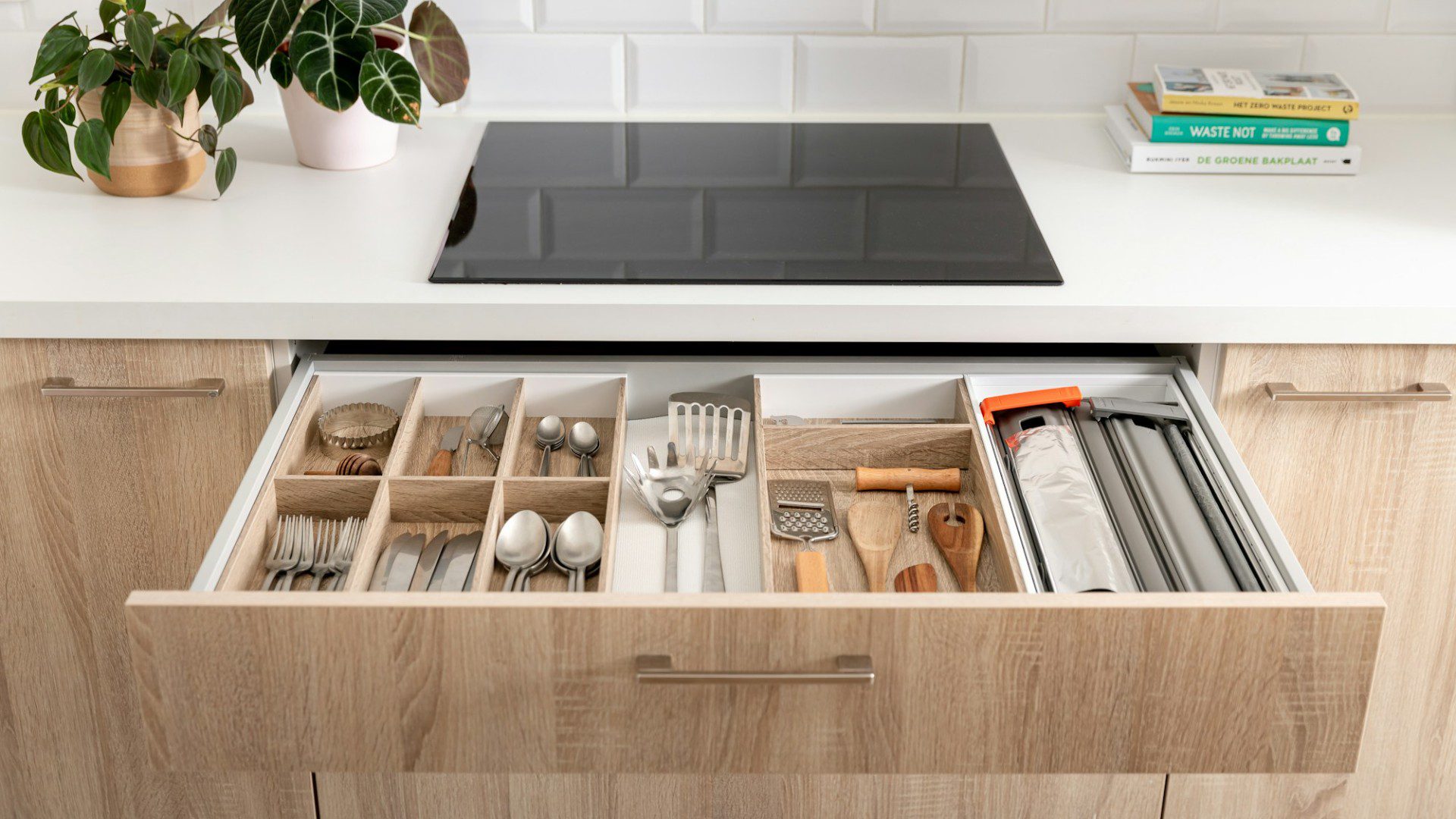
Every house has one: the drawer that holds a little bit of everything and a lot of nothing in particular. It’s not a bad thing to have a catch-all spot, but when that drawer starts requiring a shove to close, it’s a sign it’s holding more than it should.
Here are seven common junk drawer offenders worth clearing out before the drawer wins the battle entirely.
Dead Batteries
A junk drawer battery stash is rarely sorted by whether the batteries actually work, which means you’re often grabbing a handful and testing them one by one in frustration. Test everything at once with an inexpensive battery tester, or by trying each one in a flashlight you know works. Anything leaking, bulging, or crusted with white residue goes straight into the discard pile.
How you get rid of them depends on the type. The EPA’s guidance on used household batteries says alkaline and zinc-carbon batteries can go in household trash in most communities, though it recommends recycling them where a program exists. Button cells, coin cells, single-use lithium batteries, and all rechargeables should stay out of the trash and the curbside bin. The agency advises taping the terminals or bagging each one separately, because lithium batteries can spark if the ends touch. Take those to a hardware store drop-off or a household hazardous waste collection, and keep only a working supply going forward.
Twist Ties, Rubber Bands, and Loose String
These small items multiply fast and rarely get used in any meaningful quantity. Every loaf of bread, bunch of produce, and bundle of mail adds another one, and nobody ever takes one back out. Loose in a drawer, they knot around scissors, tape, and charging cables, and that tangle is what makes the drawer hard to dig through.
Pull them all out and sort by type. Keep a small handful of each, roughly what you would use in a month, and store them contained: rubber bands in a small tin, twist ties in a snack-size zip bag, string wound around a piece of cardboard and held with one of the rubber bands. Toss twist ties with exposed or rusted wire, scraps of string too short to tie anything, and bands that have gone sticky. If you bake or garden, move a few extras to where you actually use them, and let go of the excess that’s just adding bulk to the drawer.
Random Keys You Can’t Identify
A loose key with no idea what it opens is more clutter than convenience. Before giving up on any, spend ten minutes trying each one in every lock you own: front and back doors, the garage, the shed, padlocks, the mailbox, luggage, filing cabinets, and the fire safe. Label the ones you identify with a tag or a strip of tape and hang them on a hook or ring.
Put the mystery keys in an envelope with today’s date on it. If nothing turns up locked in the next few months, it’s probably safe to let them go, since an unidentified key is rarely worth the drawer space it takes up indefinitely.
If an old key fob or garage remote surfaces with the keys, deal with its coin battery right away. The National Capital Poison Center warns that a swallowed button battery stuck in the esophagus can cause severe damage in just two hours, so a loose one should never sit in a drawer children can reach.
Old Restaurant Menus and Takeout Flyers
With most restaurants easily searchable online, paper menus tucked in a junk drawer serve little purpose anymore. They also go out of date quickly. Prices change, dishes get dropped, hours shift, and some of the places in that stack may have closed.
Go through the pile and recycle it with the rest of your paper, pulling off any attached magnets or plastic sleeves first. If there are one or two places you call regularly that do not keep a current menu online, keep those and clip them inside a cabinet door, where they stay flat and visible. For everything else, save the restaurant’s phone number in your contacts or bookmark its ordering page on your phone, and rely on apps or a quick search the next time you’re ordering takeout. Check the coupons and delivery flyers mixed in with the menus too, since most have an expiration date printed in small type and many will already be past it.
Broken Rubber Bands or Hair Ties
Snapped hair ties and brittle rubber bands that have lost their stretch aren’t doing anything useful anymore. Rubber breaks down with age, heat, and light, so a band that has sat for a few years in a drawer near the stove will often crack, or turn gummy and stick to whatever is next to it.
A quick test of each one — does it still stretch and hold? — will clear out the ones that are just dead weight. Pull each band to about twice its length. If you see small cracks, if it stays stretched out, or if it snaps, throw it away. Do the same with hair ties: an elastic that now needs four loops to hold a ponytail, or one with the fabric cover fraying off the core, is done. These belong in the trash rather than the recycling bin. Wipe up any sticky residue left on the drawer liner, and move the working hair ties to the bathroom, where someone will actually look for them.
Pens That No Longer Write
It’s remarkably common for a junk drawer to hold more dead pens than working ones. Do a quick test-write on scratch paper. Give each pen a few seconds of scribbling in circles before you judge it, because a ballpoint that has sat for months may need a moment to get the ink flowing. If nothing comes out after that, it is finished. Check the dried-out markers, faded highlighters, and mechanical pencils with no lead while you’re at it.
Pens are a mix of plastic, metal, and ink, so check with your local program before putting them in the curbside bin. TerraCycle sells a mail-in recycling box for pens and markers that accepts pens, caps, markers, highlighters, and mechanical pencils, though not wooden pencils. It was listed at $138 when we checked, so it makes more sense for a school or office than for a dozen dead pens. A pen cup with a handful of reliable pens is far more useful than a drawer full of unknowns.
Miscellaneous Screws and Hardware With No Known Match
Loose screws, nuts, and small hardware pieces without an obvious matching project tend to sit in junk drawers indefinitely just in case. Start by separating what you can identify. Spare parts that came with furniture, such as cam locks, dowels, extra shelf pins, and the little hex key, are worth keeping only if you know which piece they belong to. Put them in a small bag, write the furniture’s name on it, and tape it to the back or underside of that piece.
Picture hooks, wall anchors, and a few common wood screws earn a place in a small labeled hardware organizer for the pieces you’re actually likely to need. What’s left is the truly unidentifiable: a single odd bolt, a stripped screw, a bent nail, a bracket from something you no longer own. Let those go. Rusted or stripped fasteners are not worth keeping even when you know what they are, because they can damage the next thing you drive them into.