Jewelry boxes tend to accumulate decades of pieces without much sorting, which means the genuinely valuable items often sit tangled up with dollar-store trinkets. When it comes time to clean one out, it’s easy to lump everything together as “just costume jewelry.”
But that assumption can cost you. Here are eight things worth separating out and researching individually before a jewelry box gets emptied into a donation bag.
Signed Designer Costume Pieces
Not all costume jewelry is created equal. Pieces stamped with a recognizable maker’s name on the clasp or back, from companies known for quality mid-century design, can be worth considerably more than unsigned pieces of similar style, according to jewelry appraisal guides. Look closely at clasps, pin backs, and earring clips with a magnifying glass, since these signatures are often small and easy to miss.
Trifari shows how much a mark can tell you. WorthPoint’s guide says the company’s crown-over-T stamp came into use after 1937 and is its most common mark, while “KTF” dates a piece to 1935 through 1937. It singles out sterling silver pieces from 1942 to 1947, Art Deco designs and “jelly belly” animal brooches as especially desirable, and rates later production lower.
Condition still counts. Check for worn plating, missing stones and bent pin stems, and keep matching sets together. A signed piece in good condition, even with obviously fake stones, can be a genuine find.
Bakelite and Celluloid Jewelry
Chunky bangles and carved brooches in warm, saturated colors are sometimes early plastics like Bakelite rather than ordinary costume plastic, and they carry their own dedicated collector market, according to vintage plastics collecting resources. That history notes Bakelite was announced in 1909 as the first fully synthetic plastic, and says collectors can ask as much as $1,500 for a piece, depending on rarity and condition.
A quick friction test can help identify Bakelite, though it isn’t foolproof. Rub the piece briskly with your thumb until it warms, then smell it. A faint chemical odor points to Bakelite. It also feels dense and heavy for its size, and two bangles knocked together make a low clunk instead of a light click.
Celluloid is older, thinner and much lighter, and it is flammable, so never test either plastic with a hot pin or a flame. Bold color, carved detail, and unusual shapes tend to be the most desirable traits within this category. Cracks and chips lower value sharply.
Sterling Silver Pieces
Tarnished silver-toned jewelry is easy to write off, but genuine sterling silver carries a hallmark, typically “925” or the word “sterling,” stamped somewhere discreet on the piece, distinguishing it from base metal costume jewelry, according to silver hallmark guides. Sterling is 92.5 percent pure silver. The same guide lists “925/1000” as another sterling mark, a lion with one raised paw for English sterling, and “coin” for 90 percent silver. “EPNS” means electroplated nickel silver, which is plate and not sterling.
Check ring shanks, brooch backs and the small tags near necklace clasps. A magnet helps with unmarked pieces, since silver is not magnetic and a piece that jumps to the magnet is steel underneath.
Because sterling carries real metal value beyond any collectible design, separate it from plated or base-metal pieces before deciding what stays and what goes. Do not scrub it bright before selling. Signed or handmade pieces can be worth more than their weight, and harsh polishing removes detail buyers want.
Gold-Filled Jewelry
Pieces marked “GF,” “1/20 12K,” or similar fraction markings are gold-filled rather than solid gold, meaning they have a genuine layer of gold bonded to a base metal core, which gives them real, if modest, intrinsic value beyond typical costume jewelry, according to jewelry hallmark references. The fraction is the gold’s share of the total weight: 1/20 means 5 percent and 1/10 means 10 percent. That reference describes the gold layer as 50 to 100 times thicker than gold plating.
Because gold-filled pieces resist tarnish and wear better than gold-plated items, many decades-old examples still look remarkably good. Look at high spots and edges, where heavy wear eventually exposes a darker base metal. “RGP,” for rolled gold plate, signals a similar but thinner layer.
Checking the inside of rings or the back of pendants for these small stamped fractions is worth the extra minute. Keep gold-filled items in their own bag, separate from pieces stamped only “10K” or “14K,” which are solid gold.
Real Pearl Necklaces
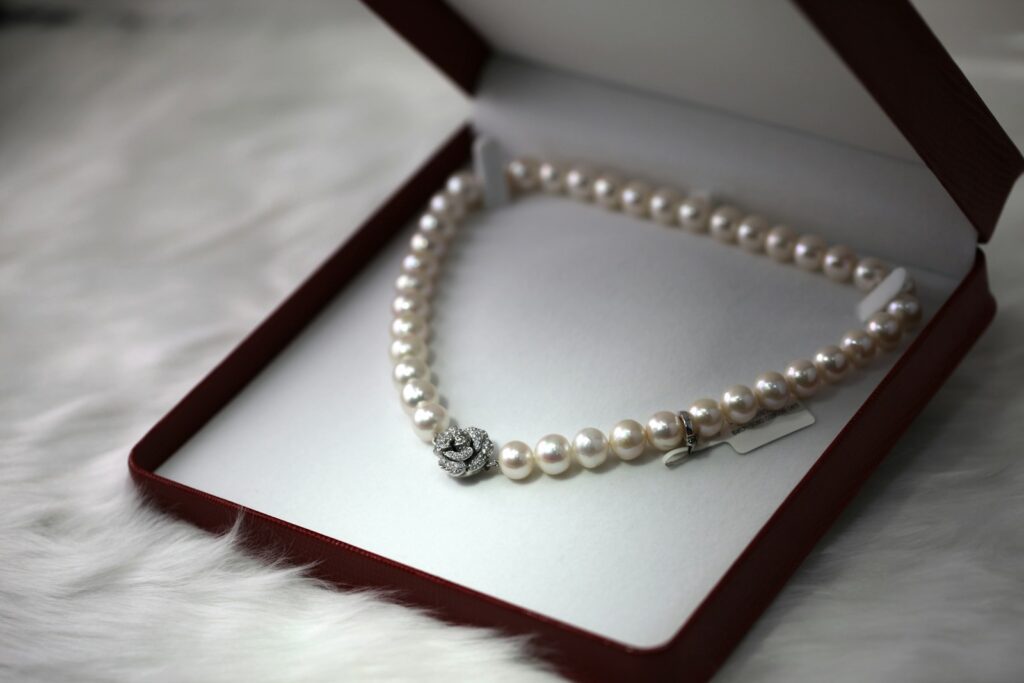
Distinguishing genuine pearls from faux glass or plastic beads isn’t always obvious at a glance. A simple test involves gently rubbing a pearl against the edge of a front tooth; genuine pearls typically feel slightly gritty due to their layered structure, while faux pearls usually feel perfectly smooth, according to jewelry identification guides. Weight also matters, since real pearls tend to feel heavier than similarly sized plastic imitations.
The same guide offers three more checks. Real pearls feel cool when you first pick them up and warm against the skin, while plastic feels warm right away. Their luster has depth, where fakes look flat. And a strand that matches perfectly, bead for bead, is more likely imitation, because real pearls vary slightly.
Look at the clasp as well. A clasp stamped “14K” or “sterling,” and a strand knotted between each pearl, suggest someone paid for quality. A strand that passes these checks is worth a professional appraisal before it’s donated alongside costume jewelry.
Rhinestone Statement Pieces
Large, sparkling rhinestone brooches and necklaces from certain mid-century designers are actively collected for their bold, theatrical style rather than any precious materials involved. Look for foil-backed stones set by hand in prong settings, a technique associated with higher-quality vintage pieces, as opposed to glued stones common in cheaper, later reproductions.
Turn the piece over. A well-made example is finished on the back, with smooth plating, sturdy pin hardware and often a signature on a small raised plaque. Rough, unplated backs and visible glue suggest a lower-end piece.
Then check every stone under a bright light. Stones that have turned gray, yellow or cloudy have damaged foil and will not come back with cleaning. A piece with many dark stones is worth much less. Never soak rhinestone jewelry or run it under the tap, because water gets behind the stones and ruins the foil.
A signed piece with intact, unclouded stones and no missing settings tends to command the most collector interest.
Vintage Wristwatches
An old wristwatch that no longer runs is easy to assume is worthless, but certain vintage watch brands and models are collectible regardless of working condition, since many buyers plan to service and restore them anyway. Check the case back and dial for a brand name and any model markings.
Look for metal marks too. A case stamped “14K” or “18K” is solid gold and has value even if the movement is beyond repair. “Gold filled,” “rolled gold plate” or “base metal” on the back tells you the case is not.
Leave the watch as it is. Do not force a stuck crown, pry open the case back, polish the case or wipe the dial. Collectors pay more for an untouched dial with honest wear than for one that has been cleaned or repainted.
Keep the original band even if it’s cracked or brittle, along with any box or papers, since a complete, original watch is worth more to collectors than one missing its band or crystal.
Lockets and Personalized Pieces
Engraved lockets, initial pendants, and other personalized jewelry are often assumed to have only sentimental value, but material still matters. A locket confirmed to be sterling silver or gold-filled, even with an old photo still tucked inside, carries genuine material worth beyond nostalgia.
Before removing and discarding any old photos or keepsakes inside, check the metal for hallmarks, since personalized pieces are frequently made from higher-quality materials than everyday costume jewelry. Marks hide on the bail, the loop the chain passes through, on the inside rim once the locket is open, and on the back near the hinge.
Open a locket with a fingernail at the seam, not a knife, since old hinges bend easily. If there is a photo, lift it out gently and look at the back for a name or date.
Engraved initials and dates put off some buyers and attract others, so do not have them polished off.