


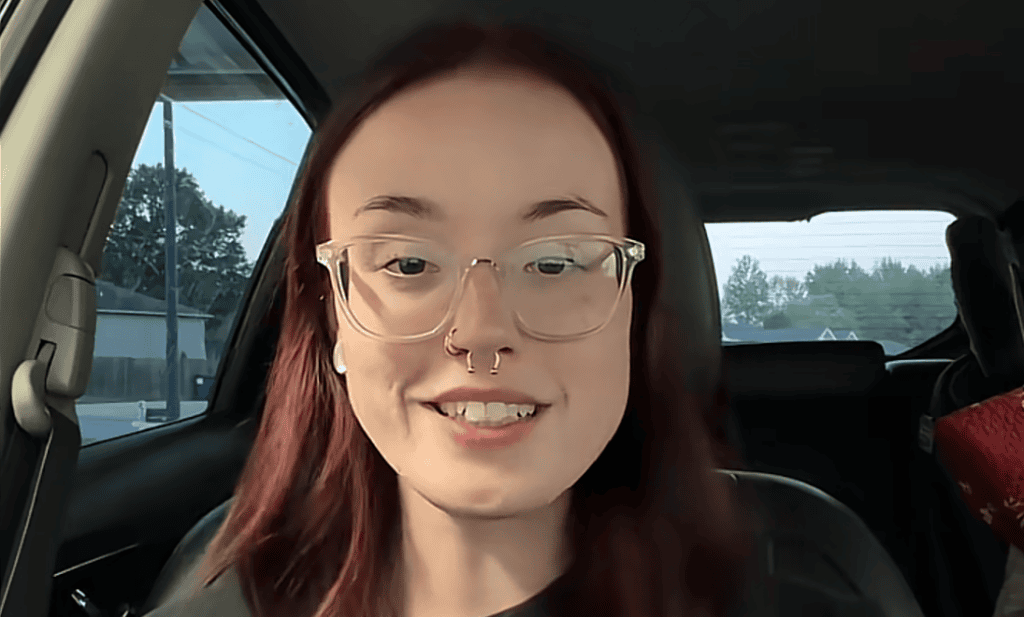
“Hi, my name is Serenity, and I co-parent with my child’s father,” @renwithoutcontext begins, in what she frames as just another entry in an ongoing series about her co-parenting arrangement. “On today’s episode, I thought I would give you guys just another little silly thing that has happened in the three or four years that we have co-parented.”
The story: she and her child’s father’s girlfriend used to be on decent terms — cordial, in her words, without getting into the full history. Then she got a Snapchat notification: the girlfriend had gotten her daughter Scarlett’s name tattooed on her own body, permanently.
@renwithoutcontext texted back honestly. “I don’t like that you did that,” she wrote, “but okay.” Her point, as she explains it in the video, wasn’t about the girlfriend’s role in her daughter’s life — she acknowledges the girlfriend has been around since Scarlett was in diapers. It was the permanence and the optics of the choice itself: “You don’t even got the man’s last name, but you have his daughter’s name tattooed on your body.” Her honest reaction to that specific detail, she says, made her “the bad guy” in the situation.
The video is short and pointed — more a snapshot of an ongoing co-parenting dynamic than a single dramatic event — but it captures something real about blended and co-parenting households: the strange etiquette questions that come up when a partner who isn’t a biological parent starts making permanent, symbolic gestures toward a child that isn’t theirs, and how those gestures land differently depending on who’s making them and why.
Why Co-Parenting Etiquette Gets Complicated Fast
Situations like this one come up more often than most co-parenting guides acknowledge: a new partner becomes genuinely, consistently present in a child’s life, and at some point wants to express that bond in a visible, permanent way. The instinct is often sincere — the girlfriend in this story has reportedly helped raise Scarlett since she was a toddler. But co-parenting counselors generally recommend that any major symbolic gesture involving a child, tattoos included, get a heads-up or at least an acknowledgment to the biological parent first, simply because it affects how that child’s identity gets represented by someone outside their immediate family.
@renwithoutcontext’s specific objection — that the tattoo outpaced even the couple’s own level of commitment to each other — points to a common tension in blended families: a new partner’s attachment to a child can sometimes outrun the stability of the adult relationship it depends on. It’s not that the affection isn’t real. It’s that a permanent tribute tied to a child’s identity carries different weight than one tied to a relationship that could, like many relationships, eventually end.
The bigger takeaway for co-parents navigating similar territory is that reactions like “I don’t like that, but okay” — honest, unescalated, and still ultimately accepting — tend to keep the peace better than either pretending to be thrilled or shutting the gesture down outright. Being labeled “the bad guy” for having a measured, honest reaction is one of the more common frustrations co-parents run into, especially when their reaction gets flattened into a simpler narrative by everyone else watching from the outside.
You can watch the full video and follow @renwithoutcontext on TikTok for more.