


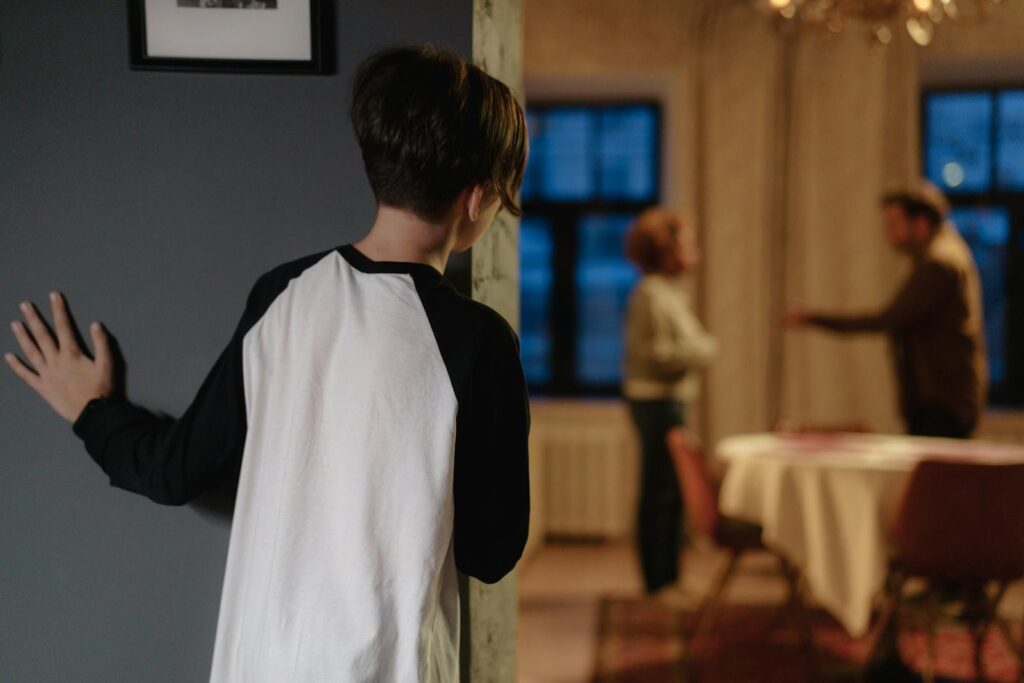
She was standing between her parents in the kitchen when her father said he would blow her mother’s head off. Dinner was cooling on the stove. She grabbed his arms and held on until the moment passed. Then the family sat down, picked up their forks, and ate as though nothing had happened.
The woman shared that memory in an online forum, and thousands of commenters said some version of the same thing: That was my house, too. For adults who grew up in volatile homes, the most disorienting part is rarely the explosion itself. It is the speed at which everyone pretends the explosion never occurred.
Clinicians have a name for what these children learn to do. They call it hypervigilance, a state of constant environmental scanning that can persist long after a person leaves the household. According to the National Child Traumatic Stress Network, children exposed to domestic violence frequently develop anxiety, difficulty trusting others, and a compulsive need to manage the emotions of people around them. Many describe learning to read a room before they could read a book: the set of a father’s jaw, the pitch of a mother’s voice, the sound of a glass hitting the counter.

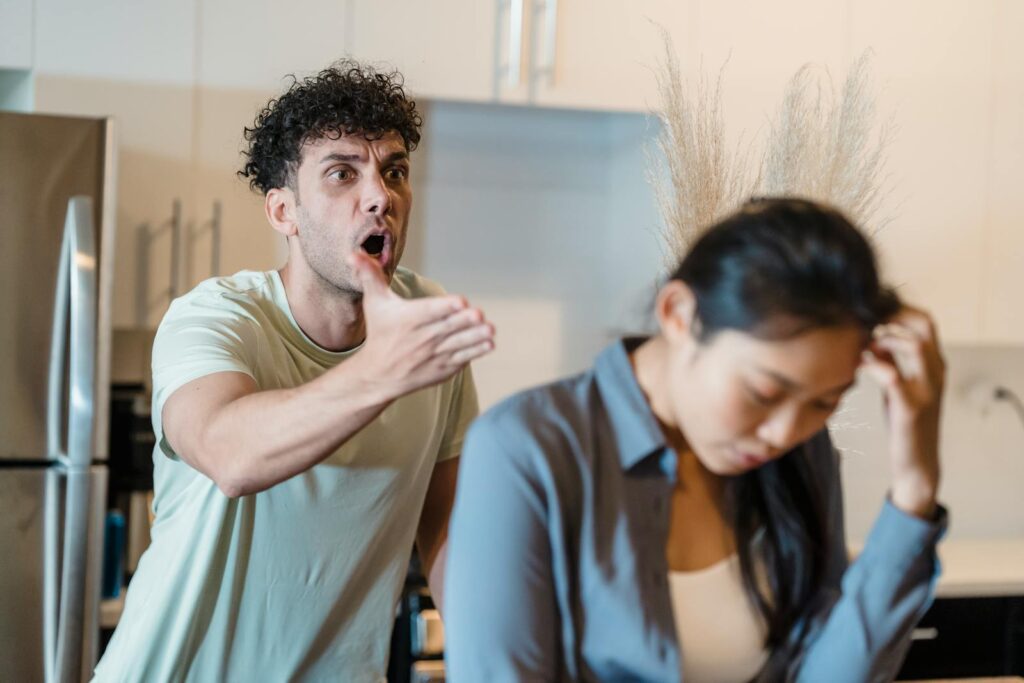
The night the child becomes the shield
In homes like the one that woman described, a child’s role quietly shifts from dependent to protector. The parent who should be keeping them safe becomes the source of danger, and the child steps into the gap, sometimes physically.
That pattern surfaced publicly in the 2025 HBO documentary Raquel!, which traces the life of actress Raquel Welch. In the film, Welch’s ex-husband Richie Palmer describes her father as a man whose rage could turn a dinner table into a war zone. Welch herself, in archival footage, recalls her mother being “reduced to a whimpering mess” at meals while her father’s temper went unchecked. One night, with tears running down her face, the teenage Welch picked up a fire poker and confronted him. “Someone had to step in,” she says in the documentary, “and that someone was me.”
The parallel to the anonymous woman who pinned her father’s arms is hard to miss. In both cases, a daughter physically intervened because no other adult would. And in both cases, the family carried on afterward as if the crisis had never happened.
The quiet cover-up around the dinner table
That “carry on” reflex is not accidental. Families living with domestic violence often develop what therapists call a conspiracy of silence, an unspoken agreement that the abuse will not be named, discussed, or acknowledged outside the home. Children raised inside that agreement learn that their job is not to be safe but to be convincing: to assure teachers, neighbors, and extended family that everything is fine.
The training can be so thorough that when survivors try to speak up as adults, they are met with the same minimization they absorbed at the table. One mother writing in a support group for adult children of abusive parents described arriving at what she thought was a casual family dinner, only to realize it had been staged as an intervention, not for the person who caused harm, but for her. Relatives took turns telling her she was exaggerating. “They thought they were putting me in my place,” she wrote. “What they didn’t understand was that I had been taking notes since the moment I walked in.”
The script is consistent across families and even across generations: keep the peace, keep the story tidy, and frame the person who speaks up as the problem.
When memory, denial, and healing collide
By the time children from these homes reach adulthood, the conflict is rarely about a single night. It is about whose version of that night gets to stand as truth.
Research by cognitive psychologist Elizabeth Loftus at the University of California, Irvine, has shown that memory is not a fixed recording. It shifts each time it is recalled, and people can unconsciously edit out details that cast them in a harsh light. That finding cuts in every direction: it means a parent may genuinely not remember throwing a plate, and it means a survivor’s account of the same evening may emphasize emotional truth over precise chronology. But as one writer reflecting on her own family put it, the goal is not to get her parents to agree on every detail. The goal is to get them to stop telling her it never happened at all.
That distinction matters clinically. According to the Substance Abuse and Mental Health Services Administration (SAMHSA), invalidation of a person’s traumatic experience can reinforce the psychological harm of the original event. When a family insists that a survivor is “making things up” or “being dramatic,” it replicates the same power dynamic the child endured at the table: sit down, be quiet, and pretend this is normal.
What recovery can look like
Therapists who specialize in complex trauma say that healing does not require the abusive parent to confess or apologize, though that can help. What it does require, according to the International Society for Traumatic Stress Studies, is a safe environment in which the survivor can name what happened without being punished for it.
For some people, that environment is a therapist’s office. For others, it is an online forum where strangers say, That was my house, too. For Raquel Welch, it was a documentary camera rolling decades after the fact. The medium varies. The need does not: to be believed, and to stop performing normalcy at a table where nothing was ever normal.
If you or someone you know is affected by domestic violence, the National Domestic Violence Hotline can be reached at 1-800-799-7233 or by texting START to 88788.
More from Decluttering Mom: