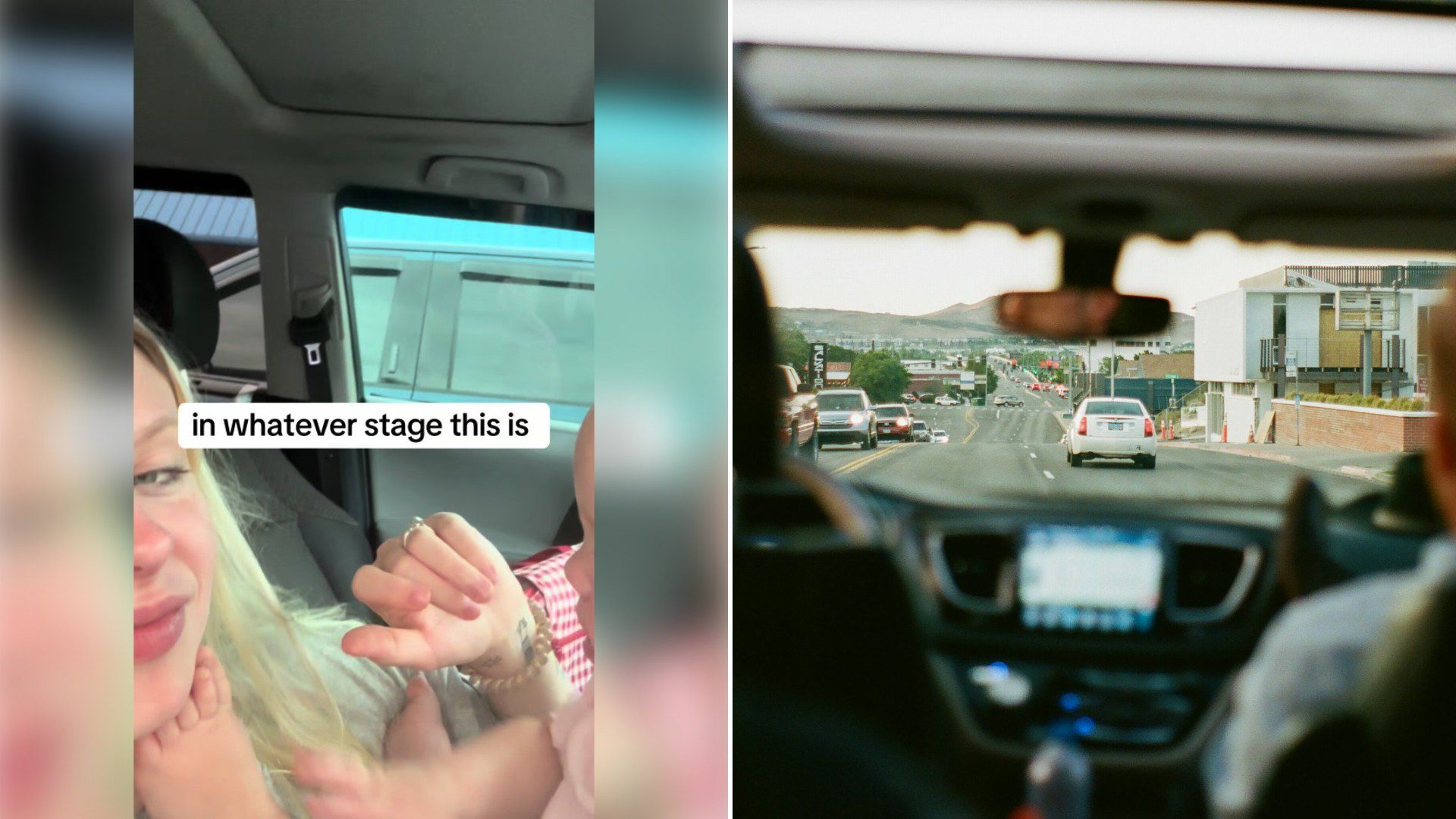
A creator posting under the handle summerhylton captured her baby gripping a fistful of her hair and pulling it tight across her neck during a car ride, causing a visible wince, followed by a small, gentle bit of payback: a light pinch at one tiny strand of the baby’s own sparse hair in return.
@summerhylton And she thinks it’s hilarious 😵💫with her little peach fuzz 😭
The whole exchange lasts just a few seconds, but it’s a genuine, unscripted bit of physical comedy between mother and baby — a real reaction to real discomfort, followed by a harmless, proportionate little joke back, rather than anything staged for effect.
Hair-pulling is one of those universally recognizable baby-stage hazards, right alongside grabbing glasses and poking at faces — an unavoidable side effect of being held constantly by someone whose hair happens to be right within grabbing distance. Most parents have a version of this exact wince stored somewhere in their memory.
What makes this one stand out is the tiny, good-natured retaliation — a moment that’s really more about shared silliness than any real grievance, and exactly the kind of small, everyday interaction that ends up being more memorable than most of the bigger, planned moments.
There’s something worth appreciating about how instinctive baby hair-grabbing actually is, rooted less in mischief than in raw motor development. Babies at this stage are still figuring out how their own hands work, and a fistful of hair right at eye level is an irresistible, endlessly interesting object to grip, tug, and generally experiment with, completely without any sense that the grip might hurt the person attached to it. It’s exploration, not malice, even when it lands as a genuinely painful yank at an inconvenient moment like a car ride with no easy escape.
The car ride setting adds its own specific flavor of comedy to the moment, since a parent strapped into a driver’s seat has far fewer options for managing a surprise hair-pull than one standing with both hands free. There’s no quick pivot, no easy redirect — just a few seconds of genuine discomfort while keeping eyes on the road, which is exactly the kind of mildly absurd parenting predicament that tends to make for the most relatable clips.
The retaliatory pinch, gentle and proportionate to a baby’s tiny wisp of hair, works as comedy specifically because of the scale mismatch. A full fistful of adult hair yanked hard is a real, noticeable discomfort; a single strand of peach fuzz barely qualifies as anything at all. That gap between the “crime” and the “punishment” is the entire joke — not real payback in any meaningful sense, just a tiny, affectionate gesture that mirrors the baby’s own action back at a scale appropriate to a baby who still barely has any hair to speak of.
Parents of babies in this exact hair-pulling phase know it tends to resolve itself the same way most physical baby quirks do: not through correction, since a baby this young has no real capacity to understand cause and effect around pulling hair, but simply through time, as fine motor skills develop and grip strength gets redirected toward other, less painful targets. In the meantime, most parents develop their own workarounds — hair up, hair tucked away, hair simply accepted as a small hazard of holding a baby who hasn’t yet learned to be gentle.
There’s also something charming about how much genuine amusement the caption attributes to the baby over the whole exchange. Babies at this age often find the strangest things funny, well before they can understand jokes in any real sense, and a parent’s wince followed by a light tug back apparently registered as pure comedy from the baby’s side of things — proof that shared physical play, even accidental and slightly uncomfortable, can become its own small source of delight for a baby still learning how cause and effect, action and reaction, actually work.
By the end of the clip, nothing has really been resolved — the baby’s grip strength hasn’t improved, the hair-pulling phase presumably continues, and the parent will likely find herself in the exact same predicament again before long. But that lack of resolution is beside the point; the moment was never really about fixing anything, just about capturing one small, funny, slightly painful exchange between a parent and a baby who hasn’t yet learned her own strength.
Content like this also does something quietly useful for parents currently deep in this exact stage, wondering if their own baby is unusually rough or if the constant hair-grabbing is ever going to let up. Seeing another baby doing the exact same thing, filmed with humor rather than frustration, offers a small reassurance that this is simply a universal, temporary feature of babyhood rather than a sign of anything unusual — every baby with functioning hands eventually discovers hair, and every parent holding that baby eventually pays the price for it more than once.
There’s also a broader pattern in how quickly parents learn to laugh at these small physical indignities rather than treating them as genuine grievances. A hair pull that might have startled a first-time parent into real concern tends to become, by the time a second or third round of it rolls around, just another mildly funny occupational hazard of holding a baby — met with a wince, maybe a small joke in return, and then simply moved past without much further thought.