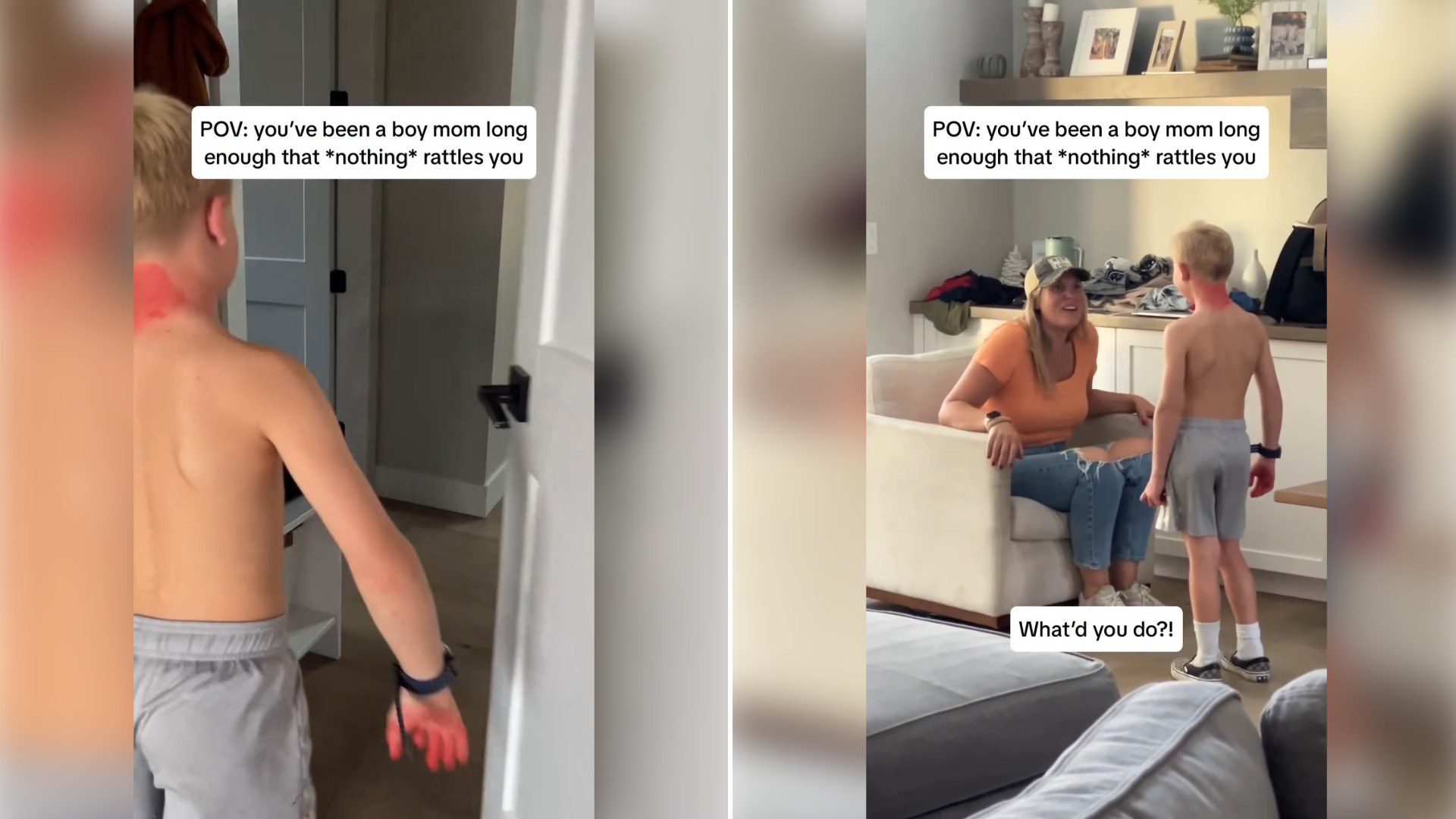
A creator posting under the handle tasteslovely caught her son mid-prank, walking into the living room shirtless with red marker smeared across his neck and legs, claiming he’d fallen hard on his bike. Lounging in a chair, she barely reacts, instantly recognizing the marker for what it is and calmly asking what he actually did.
Within seconds, he’s laughing and admitting the whole thing was a prank, showing off the marker “injuries” to the camera like it’s a badge of honor. The whole exchange plays out real-time and unscripted — no reaction shot, no gasp, just a mom who’s clearly seen enough to know exactly what she’s looking at.
That unbothered calm is really the entire joke. Years of raising a kid prone to exactly this kind of theatrical stunt tends to wear down a parent’s alarm reflex until almost nothing registers as a genuine emergency anymore — which, ironically, makes moments like this one land as funnier than a big reaction ever could.
For parents living something similar, it’s a familiar rite of passage: the day you realize your default response to a dramatic claim is a raised eyebrow and a follow-up question, rather than actual panic, is usually the day you know you’ve officially adjusted to this particular stage of parenting.
There’s a particular kind of confidence that comes from having genuinely seen it all before, and that confidence is exactly what’s on display here. A first-time parent, or even a parent a few years into the job, might still flinch at the sight of red streaks across a kid’s neck, at least for a half-second before logic kicks in. By the time a parent has weathered enough false alarms, though, that half-second of panic gets replaced almost entirely by a kind of practiced skepticism — the instinct to ask a clarifying question before reacting to anything at all.
Kids, for their part, tend to escalate their pranks in direct proportion to how well the last one worked, which means a parent’s unbothered reaction here is likely the result of a whole history of smaller stunts that build toward this one. A kid who once got a big reaction out of a minor scrape eventually learns that a bigger, more dramatic claim might get an even bigger reaction — until, somewhere along the way, a parent catches on to the pattern and stops rewarding the theatrics with anything more than a raised eyebrow.
The choice of red marker specifically says something about how seriously kids take the production side of a prank like this. It’s not enough to just claim an injury happened; there has to be visual evidence, applied carefully enough to look at least plausible from across a room, which takes a certain amount of planning and commitment for a kid who presumably could have just walked in and said he fell. That extra effort is part of what makes these moments so entertaining to watch play out — a kid fully invested in the bit, undercut almost instantly by a parent who’s simply seen the trick before.
There’s also something worth noting in how quickly the prank collapses once a single clarifying question gets asked. Rather than escalating the drama or doubling down on the story, the interaction dissolves into laughter within seconds, which suggests the whole thing was never really about convincing anyone so much as it was about the performance itself — the fun of pulling off the bit, briefly, before getting caught. Kids often seem to enjoy the moment of getting caught almost as much as the moment of nearly getting away with something, and that dynamic is clearly on display here.
For parents who recognize this exact scenario from their own households, there’s a certain comfort in watching someone else navigate the same territory with this level of ease. Every stage of parenting comes with its own version of this skill — staying calm through toddler meltdowns, staying calm through school-age exaggerations, presumably staying calm through whatever teenage version of theatrical storytelling comes next — and each one requires building up a tolerance that simply didn’t exist before kids arrived in the picture.
It’s also a small reminder of how much trust gets built into a household through repeated, low-stakes interactions like this one. A kid who feels safe enough to attempt an elaborate, obviously fake injury prank, fully expecting to get caught and laughed at rather than scolded, is a kid who has learned that his parent’s reactions are predictable and safe, even when he’s deliberately trying to provoke a big one. That kind of predictability, built up over years of exactly this kind of interaction, tends to matter a lot more in the long run than any single prank ever could.
There’s a broader category of content built entirely around this specific comedic beat — kid attempts dramatic stunt, parent remains completely unmoved, stunt collapses under its own weight — and it resonates widely because so many parents have lived some version of it themselves, usually more than once. The appeal isn’t really about the marker or the fake injury at all; it’s about the deadpan, been-there-before quality of the parental response, which reads as far funnier than any amount of feigned alarm would have.
By the end of the clip, nothing dramatic has actually happened — a kid got caught, laughed about it, and the whole household moved on within a matter of seconds. But that quick, low-stakes resolution is really the entire appeal: a reminder that most of the small dramas kids manufacture at home are exactly that, small, and that a parent’s calm, unhurried skepticism is often the most effective response available, far more effective than any amount of urgency the moment might seem to call for at first glance.
There’s also something quietly reassuring, for parents watching this from the outside, in seeing a household where humor clearly runs both directions. A kid who feels comfortable enough to attempt this kind of elaborate joke on a parent, and a parent who clearly finds it funny enough to film and share rather than shut down immediately, points to a family dynamic built on a fair amount of shared mischief. That kind of playful back-and-forth tends to set the tone for how a household handles bigger stuff too, not just marker pranks but real setbacks, with the same instinct to find the humor in a situation before jumping straight to worry.