


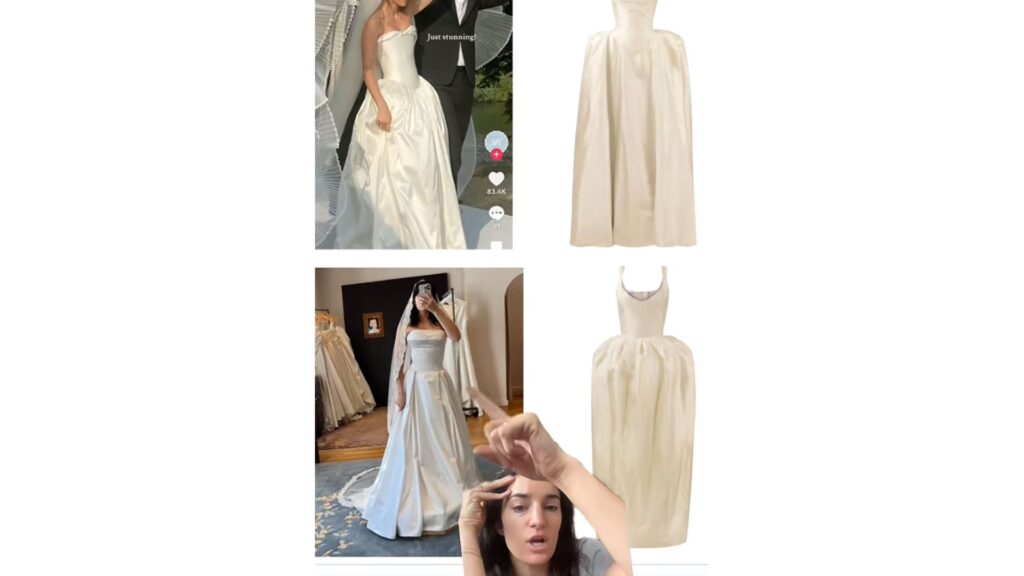
A custom wedding dress is supposed to be one of the most personal, exciting purchases a bride makes. For Alexander Mae, it became a series of TikTok videos describing what she called a nightmare experience, and for designer Kate March, it became a public dispute that she says spiraled into harassment and threats against her business.
Mae, who posts as @itsalexandermae, laid out her side first. In a series of videos, she described commissioning a custom gown for her wedding and said the process fell apart well before the big day. According to Mae, the dress she received did not match what had been discussed, fittings did not go the way she expected, and requested changes were not handled to her satisfaction. She framed the experience as one that left her scrambling, stressed, and out of pocket in the lead-up to her wedding, and she said as much in detail to her followers.
The videos spread quickly, and with them came a wave of sympathy for Mae along with sharp criticism directed at the designer behind the gown. That designer, Kate March, who posts as @undonebykate, responded publicly once the backlash reached her business. March said the dress in question was, by her account, unfinished at the point Mae is describing, and she said a refund was issued in connection with the order. In her telling, the story circulating online did not reflect the documented timeline of the transaction: the consultation, the fittings, the requests for changes, and the payments and refund that followed.
March has said she felt she had little choice but to respond with her own records once the criticism escalated. She described going public with receipts and correspondence in an effort to show her side of what happened, arguing that the full picture of the transaction told a different story than the one viewers had already formed an opinion on. Neither bride nor designer has released every detail of their exchange, and the two accounts diverge on key points, including what exactly was promised at each stage of the process and how the requested changes were communicated and handled.
What both women agree on is that the online reaction moved far beyond a disagreement about a dress. March has said the backlash against her business escalated into direct threats, a consequence she says was wildly disproportionate to a commercial dispute, however upsetting it was for the bride involved. She has asked that critics separate frustration with a business transaction from personal attacks on the people behind it, noting that a small design business, unlike a large retailer, is often just one or a handful of people absorbing the full weight of a viral moment.
Mae, for her part, has continued to describe the experience as deeply stressful and has stood by her account of how the process unfolded for her personally, even as March’s response circulated widely. Neither woman has publicly claimed the other is lying outright; rather, each has presented her own documentation and her own memory of a transaction that clearly went sideways somewhere between the initial consultation and the final gown. What caused that breakdown, whether it was a miscommunication about design changes, a timeline that didn’t hold up, or something else entirely, remains a matter of dispute between the two parties rather than a settled fact.
What This Dispute Says About Booking Custom Work
Whatever actually happened between Mae and March, their public back-and-forth is a useful reminder of how quickly a custom order, especially for something as emotionally loaded as a wedding dress, can go from exciting to contentious when expectations aren’t pinned down in writing. A few habits can help protect both clients and small business owners in similar situations.
- Get every design change in writing. A quick recap email or text after each fitting, listing exactly what was discussed and agreed to, creates a paper trail that protects both sides if memories diverge later.
- Ask about the refund and cancellation policy up front. Before any deposit changes hands, both parties should know exactly what happens if the final product isn’t finished, isn’t approved, or needs to be scrapped.
- Build in a realistic timeline with milestones. Custom garments, especially for a fixed date like a wedding, benefit from scheduled check-ins rather than one big reveal close to the deadline.
- Keep receipts and correspondence, always. Both Mae and March have leaned on documentation to tell their side; whichever side of a transaction you’re on, saved messages and payment records are what turn a he-said-she-said into a clear record.
- Remember that online outrage isn’t accountability. A business dispute deserves scrutiny and honest reviews, not threats against the people running a small operation, a distinction March has asked her critics to keep in mind.
The dispute between Mae and March remains unresolved in the court of public opinion, with each woman standing by her own account. What’s clear is that a wedding dress meant to mark one of the happiest days of a bride’s life instead became a cautionary tale about how fast a customer service dispute can spin far outside the shop where it started.