


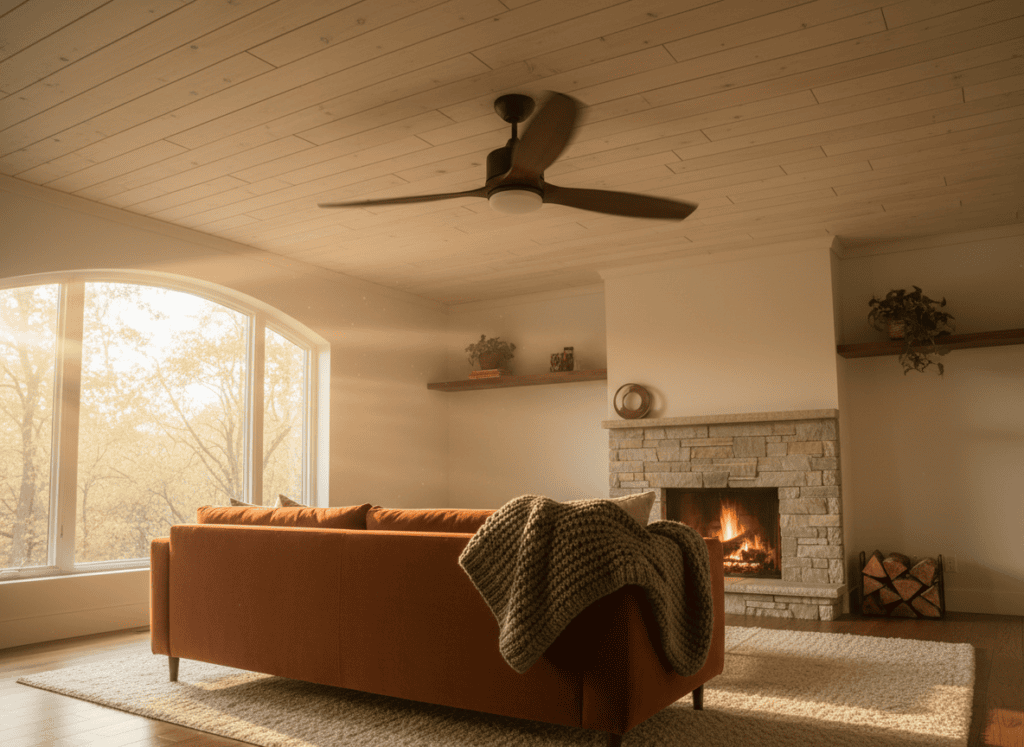
Most ceiling fans in American homes have spent the entire summer spinning counterclockwise, pushing air straight down to create the breeze that makes a room feel cooler. That’s the correct setting for July. It’s also the exact wrong setting once fall temperatures set in, and ENERGY STAR’s own usage guidance says fixing it takes about ten seconds and a small switch most homeowners have never touched.
The Switch Nobody Talks About
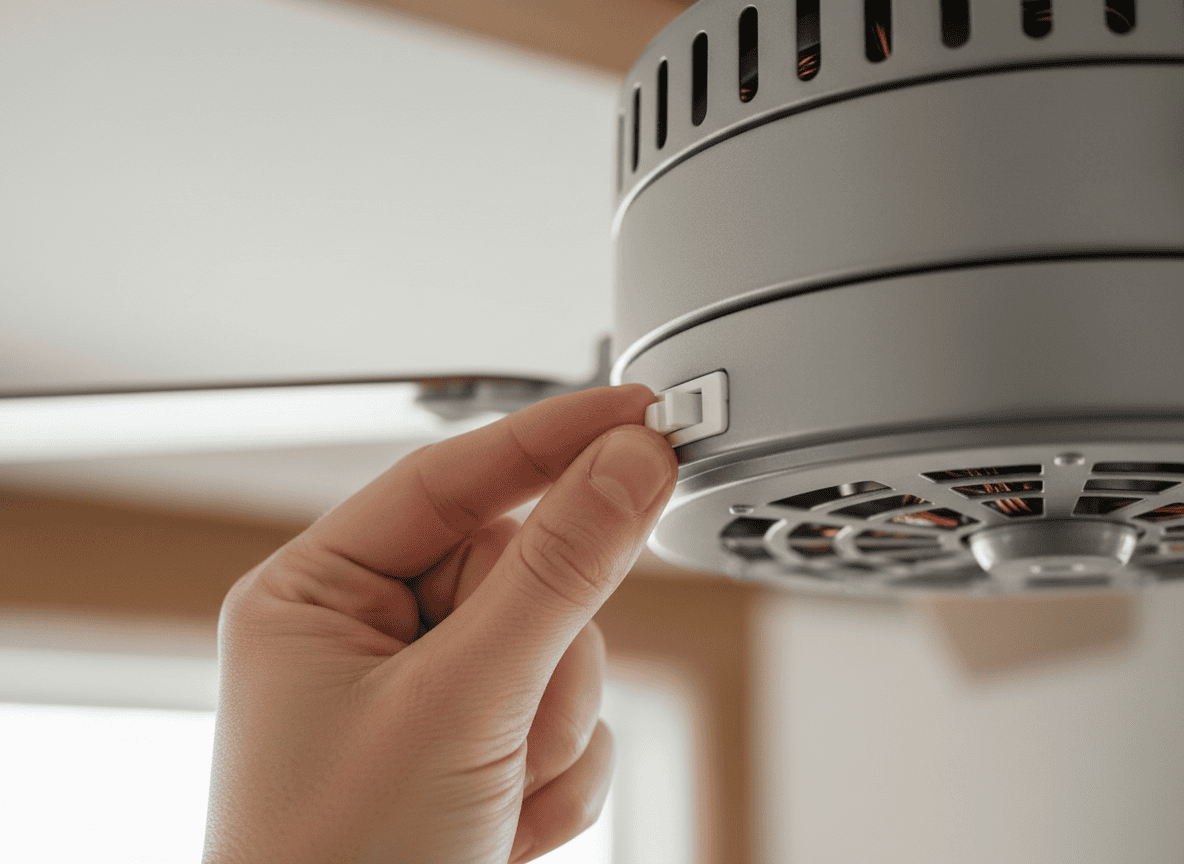
Almost every ceiling fan built in the last few decades has a small toggle on the motor housing, usually tucked on the side facing down, that reverses the direction the blades spin. In summer mode, the blades tilt to force air downward, generating the wind-chill effect that makes skin feel several degrees cooler than the room’s actual temperature. Flip that switch and the fan spins the opposite direction — clockwise, when viewed from below — which does the opposite job: it pulls the cool air near the floor up toward the ceiling and pushes the warm air that’s been collecting up there back down along the walls.
Warm air rises and pools near the ceiling regardless of the season, which means in any room with more than about eight feet of vertical space, there’s a layer of heated air sitting above head height doing nobody any good. A fan running in reverse at low speed redistributes that trapped heat back into the space people are actually occupying, according to the ENERGY STAR guidance, rather than letting a furnace or heat pump work to warm air that immediately floats out of reach.

Why This Matters More Than It Sounds Like It Should
The efficiency case here isn’t about the fan generating any heat itself — it doesn’t, and ENERGY STAR is explicit that “ceiling fans cool people, not rooms.” The mechanism is entirely about redistribution: moving heat a furnace already paid for out of a dead zone near the ceiling and back into the living space, so the thermostat doesn’t have to work as hard to reach a comfortable reading at chair height.
That distinction matters because it changes what actually saves money. Simply flipping the switch and leaving the thermostat exactly where it was accomplishes very little on its own — the room feels a bit warmer near head level, but the furnace still cycles based on wherever the thermostat sensor sits. The real savings only show up when that redistributed warmth lets a homeowner lower the thermostat setting by a couple of degrees and still feel just as comfortable. ENERGY STAR’s guidance is direct about this sequencing, noting that homeowners should “adjust your thermostat when using your ceiling fan” to actually realize the “additional energy and dollar savings” the setting change makes possible.
Separate reporting on the practice has put a number on what that combination can be worth: up to roughly 15% off a monthly heating bill when the reversed fan setting is paired with a real thermostat adjustment rather than run alongside an unchanged setting. That range will vary by home, insulation quality and climate, but the direction of the effect — lower perceived need for heat, lower thermostat setting, lower bill — is consistent across the guidance.
Getting the Direction Right Without Guessing
Standing directly under a running fan and looking up is the simplest way to check which way it’s spinning. If the blades appear to move clockwise, the fan is already set for cooler months and pushing warm air back down toward the room. If they’re moving counterclockwise, that’s still the summer setting, actively working against a furnace by helping warm air escape upward instead of holding it in reach.
The reversal switch is typically located on the side of the motor housing just below the mounting point, sometimes recessed slightly, sometimes flush with the surface. Some newer models handle this through a remote control or a smart-home app rather than a physical toggle, in which case the same clockwise/counterclockwise principle applies — it’s just accessed digitally instead of by hand. Either way, the fan should be turned off and allowed to stop completely before switching direction, since reversing a spinning motor can strain the mechanism over time.

The Part That Gets Skipped
Low speed matters as much as direction. Running a reversed fan at high speed in winter creates enough of a draft to counteract the comfort benefit entirely, making a room feel cooler rather than warmer even though the air being pushed down is technically the warm layer from the ceiling. ENERGY STAR’s guidance also flags the most commonly ignored piece of the whole equation: turning the fan off when a room is empty. A fan running in an unoccupied room isn’t heating or cooling anything — there’s no one there to feel the redistributed air — so it’s pulling electricity for zero comfort benefit.
None of this requires a technician, a new fan, or a single dollar spent. It requires walking over to a switch most homeowners installed years ago and have never once touched since the day the fan went up.