


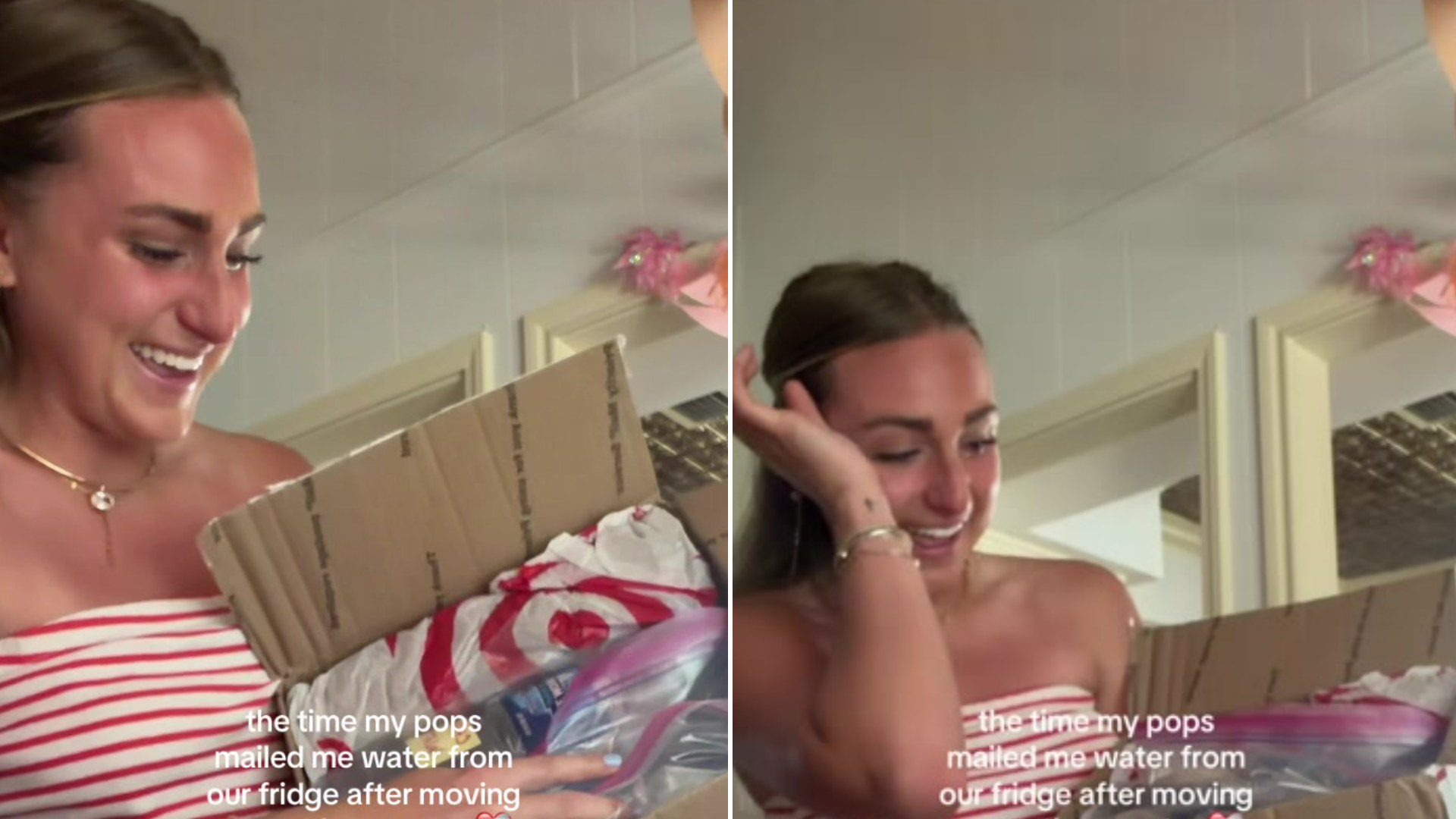
A TikTok posted by @isabellelahl captures the moment college student Isabelle Lahl opens a care package from home and discovers her father sent her something almost nobody would think to mail: water from the family’s own refrigerator.
@isabellelahl never will get over this
♬ original sound – ⋆.ೃ࿔*:・
According to Lahl, she had mentioned to her father that the water where she’s attending school in Texas just didn’t taste the same as it did back home in Minnesota. Rather than brushing off the comment, her dad reportedly packed bottles filled with water from their home refrigerator and mailed them to her, turning an offhand remark into a surprisingly literal gesture.
The video shows Lahl’s reaction as she unpacks the box and realizes what’s inside, and her response is what has resonated with viewers: a mix of disbelief and emotion at the specificity of the gesture. It’s not a generic care package filled with snacks or dorm supplies; it’s a direct, if unusual, answer to something small she’d said about missing the taste of home.
As with any family story shared primarily through the family’s own telling, the explanation for why the water mattered so much, that it simply reminded her of home in a way her new city’s tap water didn’t, is being presented here exactly as Lahl and her father have described it, without additional embellishment about the backstory.
Care-package content built around hyper-specific requests, rather than generic comfort items, has become one of the more reliable formats in family and college-life corners of TikTok, largely because it rewards close listening rather than money spent. A box of snacks says a parent cares; a bottle of tap water from a specific refrigerator says a parent was paying close enough attention to remember one passing sentence and act on it days or weeks later. That gap between effort and cost is often exactly what makes these clips resonate far beyond the families involved.
The story fits into a broader, familiar genre of care-package content that performs well specifically because it centers small, thoughtful details rather than expensive gifts. A parent listening closely enough to remember an offhand comment, and then acting on it in a slightly absurd but deeply sincere way, is the entire emotional core of the clip.
Small, hyper-specific gestures like mailing water from a home refrigerator tend to say more about a parent’s attentiveness than almost any purchased gift could. The gesture works precisely because it required no money and no special planning, just remembering one offhand comment and treating it as worth acting on. That’s a big part of why care-package content built around this kind of detail continues to perform well across platforms: it reframes homesickness not as something to be fixed with generic comfort items, but as something that can be addressed directly, however unconventional the solution turns out to be. Lahl’s reaction on camera, somewhere between disbelief and genuine emotion, is the clearest evidence of just how much that specificity mattered to her in the moment.
Care packages that lean into a family’s specific inside knowledge, rather than generic dorm-room staples, tend to circulate widely because they invite viewers to think about their own version of the gesture: what small, easily overlooked detail about home might someone they love actually be missing right now. Lahl’s video works as a kind of prompt in that sense, even though its own content is limited strictly to the one gesture her father made.
It’s also worth pointing out how much this story relies on distance to make its point. Had Lahl still lived at home, a comment about the water tasting different wouldn’t have carried the same weight or led to the same gesture; it’s precisely because she was hundreds of miles away, adjusting to an unfamiliar place, that her father’s response felt significant enough to document and share. That context, a first real stretch of distance between a parent and a college-age child, is part of what gives an otherwise small, almost silly gesture its emotional charge, and it’s likely part of why so many other families away from home for the first time found the clip relatable.
In the end, what makes the clip worth watching isn’t the water itself, but the fact that a parent took a passing, half-joking comment seriously enough to act on it days later, across state lines, without being asked twice.
The Takeaway
Homesickness in college often isn’t about missing anything dramatic, it’s about missing the small, specific textures of daily life: a particular meal, a smell, or in this case, the way the water tastes. Parents looking for ways to support a student living away from home for the first time don’t need a grand gesture; they need to pay attention to those small comments.
For students themselves, moments like this are a good reminder that voicing the little things you miss, rather than assuming they’re too trivial to mention, gives the people who love you something concrete they can actually act on. Sometimes the smallest requests turn into the most memorable gestures.
Staying connected to someone far from home doesn’t require solving a big problem; sometimes it’s as simple as remembering one small comment and following through on it later. That kind of attentiveness, more than the size or cost of any gift, tends to be what people remember.