


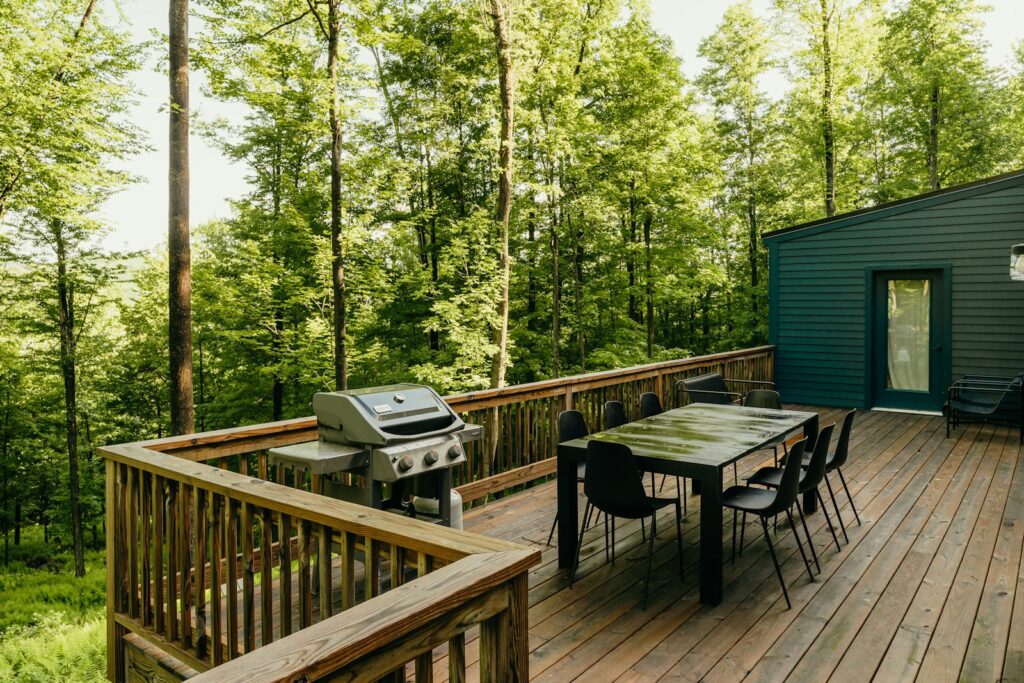
The average backyard deck now costs $8,318 to build from scratch, according to Angi’s 2026 deck cost data, with total project costs ranging from $4,340 to $12,653 depending on size and material. Material choice is doing most of the work in that spread. Pressure-treated wood starts as low as $2 to $5 per square foot, while composite decking runs $25 to $54 per square foot fully installed — often three to ten times the up-front cost of basic wood, per the same Angi data. That gap isn’t a pricing quirk; it’s two genuinely different products solving two different problems, and the cheaper one keeps costing money long after the receipt is paid.


What Wood Actually Costs
Pressure-treated lumber is the most economical decking material available, priced at $2 to $5 per square foot before installation, according to Angi. Higher-grade or hardwood species push the wood category up to $30 to $60 per square foot installed, closing some of the gap with composite for homeowners chasing a premium look. But wood’s real cost shows up after the build: Angi estimates homeowners should budget $700 to $1,600 a year for power washing and resealing, a recurring expense composite decking largely eliminates.
What Composite Actually Costs
Composite decking installed runs $25 to $54 per square foot in Angi’s deck-building breakdown, or $15 to $32 per square foot in Angi’s dedicated composite decking guide, which splits that into $5 to $18 for materials and $10 to $14 for labor. For a typical 360-square-foot deck, that guide puts total cost at $5,400 to $11,500. The material blends recycled plastic with wood fibers, which is what gives composite its resistance to the rotting, warping, and splintering that plagues untreated or poorly sealed wood over time.

Where the “Triple the Price” Gap Actually Comes From
Line up the cheapest wood option against composite and the multiple is closer to five or ten times, not three — pressure-treated lumber at $2 to $5 per square foot versus composite at $25 to $54 installed. The “triple” comparison holds more precisely once wood’s ongoing costs are added in: a wood deck that costs $2,500 to build can easily add another $1,000-plus a year in maintenance within a few seasons, while a composite deck at three or four times the upfront price carries close to zero recurring cost by comparison.
Why Homeowners Are Paying the Premium Anyway
Composite’s appeal isn’t really about matching wood’s look — it’s about not thinking about the deck again for a decade or more. Angi’s guide notes composite boards are less likely to crack or splinter and require comparatively little upkeep, a meaningful selling point for homeowners who’ve already lived through a few seasons of sanding and resealing a wood deck. For a family with young kids running around barefoot, or an owner planning to stay in the house a decade or more, the maintenance-free case tends to outweigh the sticker shock.
The Long-Term Math Rarely Gets Run Up Front
Most deck-cost comparisons stop at the installed price, which is exactly where wood looks cheapest and composite looks expensive. Run the numbers ten years out, though, and the picture shifts: a $3,000 wood deck at even $700 a year in upkeep adds up to $10,000 in a decade before a single repair is needed, while a $9,000 composite deck built at the same time can still land within a few hundred dollars of its original cost. Angi’s own figures make the upfront gap easy to see and the long-term gap easy to miss.
What This Means for the $8,318 Average
That national average blends both material categories together, along with size, railing choices, and labor rates that vary widely by region. A homeowner building a modest wood deck can land well under the $8,318 mean; a homeowner going full composite on the same footprint, with premium railing and multiple levels, can push well past $12,653 without much trouble. The average is real, but it disguises just how differently two homeowners with the same square footage in mind can end up spending, based entirely on which material they pick before a single board goes down.
Deck material has quietly become one of the biggest either/or decisions in a home renovation budget — not because one option is objectively better, but because wood and composite are actually selling two different products: a cheaper deck that asks for yearly upkeep, or a pricier one that mostly asks to be left alone.