


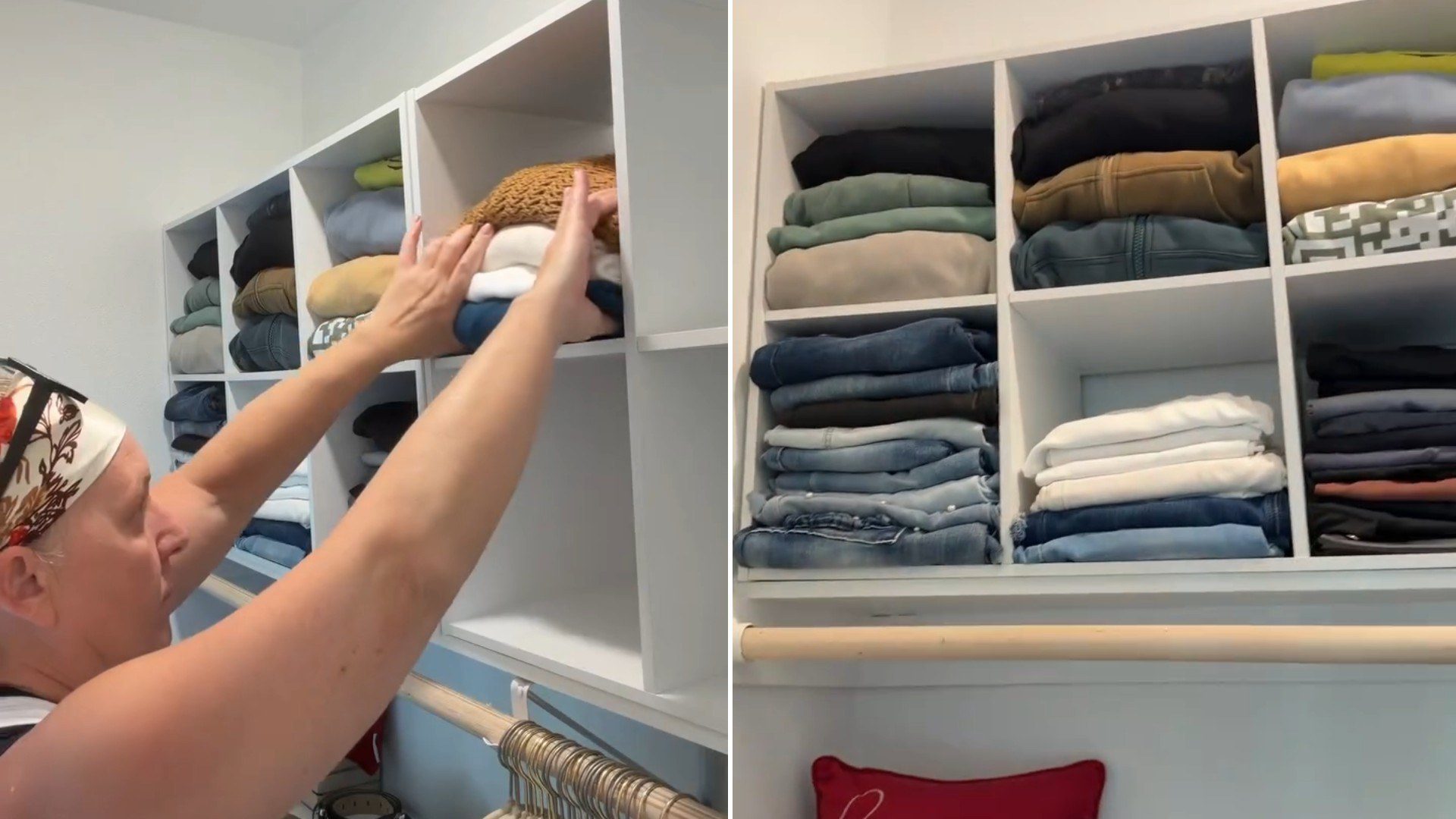
Closet chaos is one of the most universally dreaded corners of home organization, and a woman posting under the handle donna.found.it recently offered a solution that turned out to be far simpler than most people assume is possible: instead of gutting her closet or investing in a full renovation, she solved her storage problem entirely with cube storage organizers.
Her video walks through the transformation step by step, showing exactly how reorganizing her existing space with modular cube units eliminated the clutter and chaos that had been building for who knows how long. The caption gets straight to the point, noting that she didn’t need a bigger closet — just smarter organizing — tagged with #closetorganizer, #storage, and #organization, a clear signal of exactly who her intended audience is.
The response confirmed just how badly people needed to hear that message. The video pulled in roughly 4.4 million views from an account with about 57,000 followers, a substantial jump in reach that suggests a huge number of viewers are silently struggling with the exact same closet problem and searching for a solution that doesn’t involve knocking down a wall.
There’s a persistent myth in home organization culture that clutter is fundamentally a space problem — that the solution to a messy closet is always more square footage. In reality, as this video demonstrates, most closet chaos is a systems problem rather than a size problem. Without a clear structure for where categories of items belong, even a spacious closet devolves into disorganized piles, while a smaller closet with the right modular system can feel remarkably functional and calm.
Cube storage organizers work so well for exactly this reason: they impose visible structure on a space that previously had none, breaking down what feels like one overwhelming mess into a series of small, contained, manageable sections. Each cube becomes its own micro-category — folded sweaters here, shoes there, accessories in another — which makes both putting things away and finding them again dramatically faster than digging through a single undifferentiated pile.
For anyone looking to replicate this kind of transformation in their own closet, the process doesn’t require a full weekend or a big budget. Starting with a full removal of everything currently in the closet, sorting items into clear categories, and then assigning each category its own cube or section — rather than trying to fit an existing disorganized system into new furniture — tends to produce far better, longer-lasting results than simply adding storage on top of an already chaotic setup.
What makes videos like donna.found.it’s so satisfying to watch isn’t just the visual transformation, though that certainly helps. It’s the underlying message that real, lasting organization is almost always more achievable than it feels from inside the mess — a reminder that the fix for closet chaos usually isn’t a bigger space, but a smarter, more intentional way of using the space already there.
Professional organizers consistently point to the same underlying principle behind successful projects like this one: a category-based system, where every item has one clearly assigned home, outperforms a spatial system built around simply having more room to spread things out. Cube storage works specifically because it forces that categorization decision upfront, rather than allowing items to drift back into loose, undifferentiated piles.
There’s also a financial angle that makes this kind of solution especially appealing compared to a full closet renovation: modular cube units are widely available at a fraction of the cost of custom closet systems, and because they’re modular, they can be reconfigured or expanded as a family’s storage needs change over time, rather than requiring a full redo down the line.
For anyone tackling their own closet project, the biggest predictor of long-term success isn’t the specific product chosen but the willingness to fully empty the space first and make honest decisions about what actually deserves to go back in — a step that’s tempting to skip but that ultimately determines whether the new system sticks or slowly reverts back to the same chaos a few months later.
It’s also worth noting that a successful closet system tends to need periodic revisiting rather than a single one-time setup, since a household’s needs — seasonal wardrobe shifts, growing kids, changing routines — rarely stay static for long. Building in a quick seasonal check-in to reassess whether the current cube assignments still make sense tends to keep a system like donna.found.it’s functioning well years down the line, rather than slowly drifting back into the same disorganized piles it was designed to replace.
There’s also a broader mindset shift worth naming here: treating organization as an ongoing practice rather than a one-time fix tends to produce far more durable results than any single product purchase. Cube organizers help, but it’s the habit of returning items to their assigned spot consistently that actually determines whether a closet stays functional six months later.
In practice, that willingness to periodically revisit and adjust a system is often the single biggest difference between an organizing project that lasts and one that quietly reverts back to clutter within a season.