


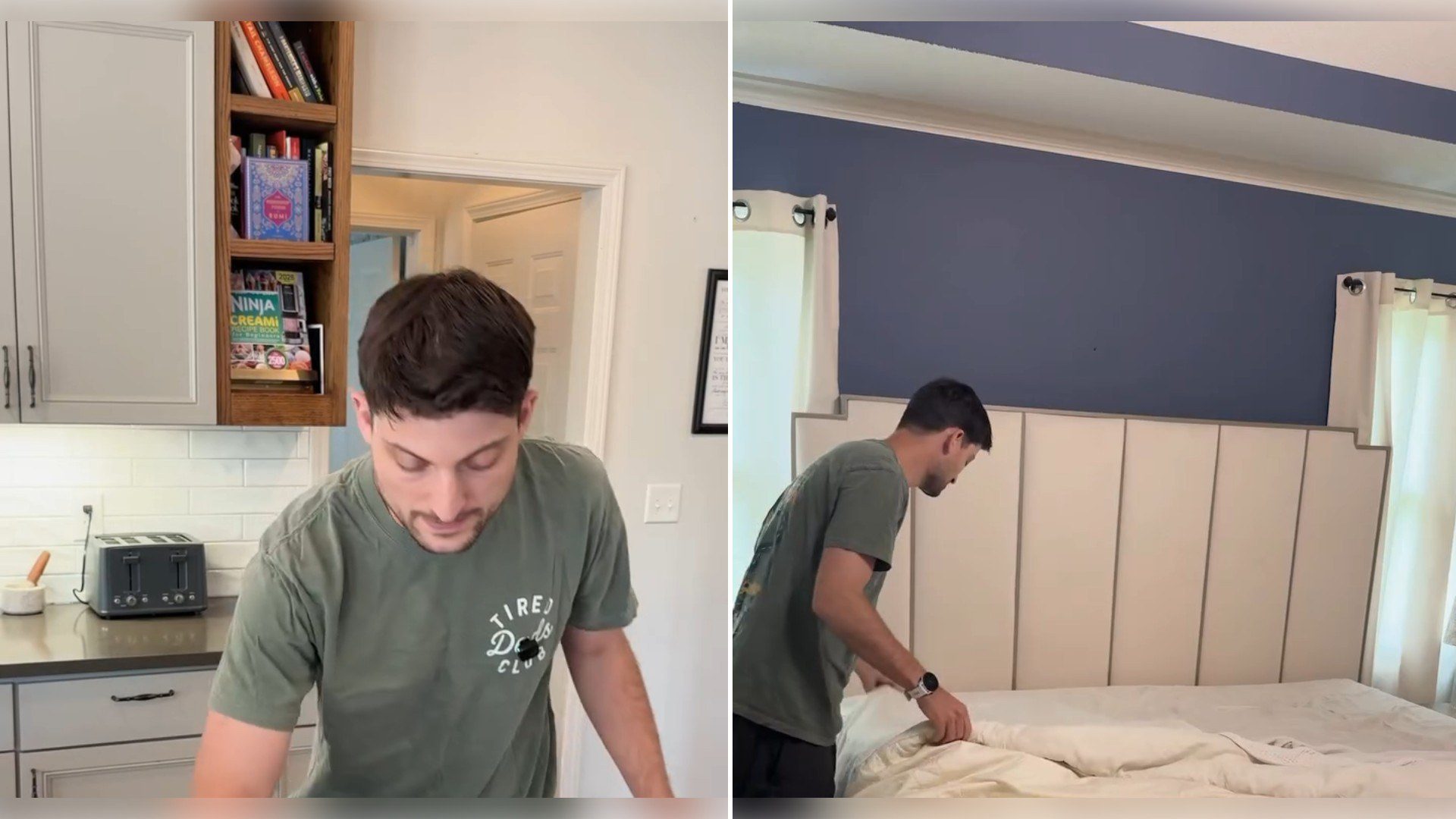
A dad who posts on Instagram as @dobetterjonathan fits his whole housekeeping system into under 20 seconds. The reel opens with the words “why our house is always tidy (even with kids)” and then delivers what the on-screen title calls “the 4 mantras that keep our house tidy.” Each one is a single sentence, and each is shown with him doing exactly what the sentence says.
The first mantra is “Don’t put it down, put it away.” He walks in the door with his sunglasses and wallet in his hand. He does not set them on the counter. He opens a drawer that is already organized and puts both inside, then takes off his shoes and slides them onto a rack under a console table. The voiceover cheers him on: “Good job, now let’s keep it going and see what else we can do.”
The second is “See a mess, clean the mess.” The scene moves to the kitchen, where he is opening food packages on the counter. As soon as he is done he wipes down the island with a paper towel. “Doing great,” the voiceover says.
The third is “Never leave a room empty-handed.” He picks up a stuffed tiger and a book that have ended up in the kitchen and carries them out with him. The tiger goes onto the rocking chair in a child’s room. The book goes on a nightstand in a bedroom. The voiceover keeps time with “Bop bop bop” and finishes with “Ba-da-bing, ba-da-boom.”
The fourth is “If it takes less than two minutes, just do it.” His example is the bed. He pulls up the sheets, sets the pillows, adjusts the window covering and smooths the duvet. “We can make a huge difference in just two minutes,” the voiceover says. “We got this!”
That is all four, and the reel ends there. His caption carries the same message, saying these small habits turned their home into one that rarely gets messy and encouraging viewers to build the habits themselves.
None of the four is a cleaning session. Nothing in the video involves a mop, a vacuum or a block of time set aside on a Saturday. Every example is something he does on the way to doing something else: coming home, making food, walking to another room, getting out of bed. That is the useful part for a house with children in it, because it does not depend on finding a free hour.
Here is how each mantra works in practice, going by what he shows.
“Don’t put it down, put it away” only works if “away” exists. In the reel the wallet and sunglasses have a drawer and the shoes have a rack, both a few steps from the door. A parent who wants this habit to stick should start by picking the spot. If keys, bags, shoes and mail have no assigned place near the entry, they will land on the nearest flat surface no matter what anyone resolves to do. One drawer and one rack are enough to start.
“See a mess, clean the mess” is about timing. He wipes the island right after he opens the food, while the paper towel is within reach and the crumbs are still loose. The same wipe an hour later means coming back to the kitchen, and by the next morning it means scrubbing. Keeping a roll of paper towels or a cloth where the mess happens removes the one excuse for waiting.
“Never leave a room empty-handed” is the one that deals with children’s things. Toys and books travel. The stuffed tiger in his kitchen did not start there. His answer is to treat every trip through the house as a delivery run. Before walking out of a room, look for one thing that belongs wherever you are headed and take it along. Nobody has to make a special trip, and the pile on the counter never gets a chance to form. This is also the easiest of the four to hand to a child, since “take one thing with you” is a small enough request for a small person.
“If it takes less than two minutes, just do it” is a test for everything else. Making the bed passes it. So does hanging up a coat, putting a cup in the dishwasher or throwing a wrapper away. The point of setting a number is that it settles the question on the spot. A job that short costs more to remember and come back to than it does to finish now.
For a parent who wants to try this, the phrasing is worth keeping as he gives it. He calls them mantras, and each one is short enough to say out loud in the moment, to yourself or to a child holding a toy in the wrong room. A rule that takes one breath to say is easier to repeat than a chore chart is to enforce.
It also helps to notice the tone of the reel. The voiceover is all encouragement: “Good job,” “Doing great,” “We got this!” Nobody in the video is being told off for a mess. The four mantras are presented as small wins that stack up over a day, and that is how he says his family ended up with a house that rarely gets messy in the first place.