


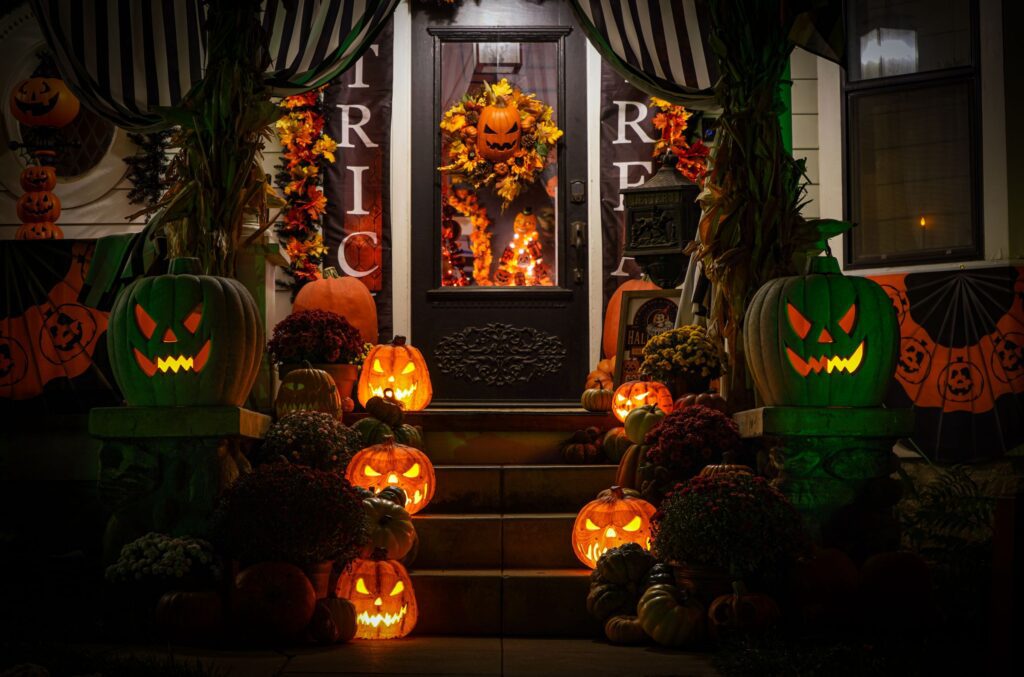
Decorating Your House for Halloween Is Now Just as Popular as Wearing a Costume
Here’s a number that stopped us mid-scroll: according to the National Retail Federation’s most recent annual Halloween Consumer Survey, conducted with Prosper Insights & Analytics, 51% of Americans planned to decorate their home or yard for Halloween, and 51% planned to wear a costume themselves. Those two numbers landing in a dead heat is not a small thing. For as long as most of us can remember, Halloween has been sold to us as a costume holiday first and everything else second. The survey, which polled 8,045 consumers between September 2 and 9, 2025, quietly suggests the opposite may now be true, and that your porch has become just as important as your outfit. If you’ve been eyeing the cobweb lights and giant inflatable skeletons at the garden center and wondering whether it’s worth the trunk space, the data says you’re in very good company, and this is the year to lean in.
The Stat That Changes How We Think About Halloween
It helps to sit with what “51% and 51%” actually means. Decorating a home or yard used to be the thing you did if you had extra time or extra kids in the house. Costumes, by contrast, felt mandatory, the one non-negotiable of the holiday. NRF’s data flips that assumption on its head: home and yard decorating is now statistically tied with personal costuming as a top Halloween activity, both trailing only handing out candy at 66%. Carving a pumpkin came in at 46%, hosting or attending a party at 32%, visiting a haunted house at 24%, and dressing up a pet at 23%. Katherine Cullen, NRF’s Vice President of Industry and Consumer Insights, put the broader mood this way in the official release: “Even with concerns about price increases due to tariffs, Halloween continues to resonate with consumers of all ages.” People aren’t cutting back on the holiday. They’re redistributing where their Halloween effort and dollars go, and a meaningful share of it is landing on the front lawn.
The spending totals back this up in a way that’s easy to overlook. Of the record $13.1 billion Americans spent on Halloween in 2025, costumes accounted for $4.3 billion and decorations for $4.2 billion, a gap of roughly a hundred million dollars across a national market of well over a hundred million shoppers. That’s essentially a tie. Your neighbor with the fog machine and the animatronic witch is not an outlier anymore. She’s the median.


Why Your Yard Might Matter More Than Your Costume This Year
Part of this shift is simple math: a costume gets worn for one evening, by one person, and often ends up in a landfill or a donation bin by November. A well-built yard display gets seen by every trick-or-treater, every passing driver, every neighbor walking the dog, for the entire back half of October. It’s also, increasingly, content. A porch that looks like it belongs in a magazine gets photographed, shared, and remembered in a way a single costume rarely is. Phil Rist, Prosper’s Executive Vice President of Strategy, noted in that same release that shoppers are managing costs by buying early and shopping discount retailers, while still staying committed to celebrating in a meaningful way. Translation: people aren’t asking whether to decorate, they’re asking how to do it well without overspending, which is exactly the conversation worth having.
Budget-Friendly Decor That Still Makes a Statement
You don’t need a four-figure budget to make your house the one kids remember. Start with layering instead of buying one big showpiece. A cluster of dollar-store pumpkins in graduated sizes, spray-painted matte black or deep charcoal, reads as intentional and cohesive rather than cheap. Cheesecloth “ghosts” made from wire frames or tomato cages draped in gauzy fabric cost almost nothing and look genuinely eerie when lit from below with a single warm spotlight. Black cardstock silhouettes, cats arching their backs, a witch on a broom, taped inside a lit window, create a striking effect from the street for the price of a craft-store trip.
Hay bales and mums are a florist-shop staple for a reason: they anchor a display and give it structure even before you add a single skeleton. Repurpose string lights you already own by swapping warm white for orange or purple bulbs, or simply drape black lights strategically for a fraction of the cost of a specialty fixture. And don’t underestimate what a can of chalkboard paint and an old picture frame can do as a “welcome, if you dare” sign at the front walk. The through line with every budget idea is restraint: pick one color story, in most cases black, orange, and one accent, and let it repeat across every element so the whole yard reads as a single composition instead of a pile of separate purchases.
Splurge-Worthy Pieces Worth the Investment
If you’re ready to put real money into this, spend it on the pieces that do the most visual work and that you’ll actually reuse for years. A quality animatronic, a rising ghost, a talking crypt keeper, a motion-activated crawling zombie, tends to be the single item people remember most, far more than a dozen small props combined. Fog machines with a timer function are worth it if your yard has any depth to work with; fog catches porch light beautifully and instantly ages a display by ten years, in the best way.
Projector systems have become the smart splurge of the past few seasons. A weatherproof outdoor projector throwing moving ghosts, bats, or spiderwebs onto your garage door or siding gives you a dramatically different look every night for the cost of one purchase, and you can swap the theme entirely by January for a completely different holiday. Commercial-grade inflatables, the oversized, well-lit kind rather than the flimsy variety, hold their shape in wind and last for many seasons if you store them properly. And if your budget allows, professional installation of permanent color-changing landscape lighting pays off twice: it does double duty for Halloween and for every other holiday, birthday party, or ordinary Tuesday evening you want the yard to feel a little special.
What’s Trending in Yards This Year
The look that’s dominating right now sits somewhere between “elevated” and “unhinged,” in the best way. Oversized scale is in, think a single twelve-foot skeleton rather than five small ones scattered around. So is a more sophisticated color palette that leans into deep charcoal, bone white, and muted sage alongside the traditional orange and black, giving displays a more designed, less costume-store feel. Projection mapping continues to grow because it lets people change their entire aesthetic in seconds without buying new physical props. There’s also a noticeable swing toward “harvest-meets-haunted” displays, corn stalks and pumpkins that lean spooky rather than purely cozy, letting the same decor bridge fall and Halloween without a hard reset in early October. And with pet costuming holding steady at 23% participation per the same survey, more households are decorating a small display just for the dog or cat to pose in front of, a low-cost, high-charm addition that photographs well.
Setting Up Safely: Extension Cords, Weatherproofing, and Timing
None of this is worth a fire hazard or a fall, so a few practical rules matter more than any aesthetic choice. According to the Electrical Safety Foundation International, any outdoor electrical decoration that could contact water should run through a Ground Fault Circuit Interrupter, either a GFCI outlet or a portable GFCI adapter plugged into a standard one. Before you plug anything in, inspect every cord and light strand for cracked, frayed, or exposed wiring, and discard anything that shows damage rather than patching it with tape. Only buy decorations and cords that carry certification from a recognized testing lab such as UL, Intertek, or CSA, and keep flammable materials, dried cornstalks, hay, paper decor, away from any bulb or heat source that could ignite them.
Timing matters almost as much as wiring. Most homes look best putting decorations up in the first one to two weeks of October, giving displays time to settle in and giving you daylight to fix anything that shifted in the wind, without so many weeks outside that fabric pieces fade or inflatables develop leaks. Run cords along the edges of walkways rather than across them, and secure them with cord covers or landscape staples so they aren’t a tripping hazard for the small ghosts and superheroes arriving after dark. Plan to take everything down within a few days after Halloween itself; leaving elaborate displays up into mid-November invites weather damage, and in many neighborhoods it also invites the kind of good-natured teasing nobody’s yard needs. If a storm is forecast, bring in anything that isn’t built to be permanent, better a bare porch for one night than a projector or animatronic ruined by rain that got past its rating.
What This Really Says About How We Celebrate
What’s genuinely interesting here isn’t just that decorating caught up to costuming in the numbers. It’s what that catch-up reveals about how people want to participate in a holiday. A costume is personal and temporary, worn by one person for one night. A decorated home is communal and lasting, built for an entire street to walk past over several weeks, and it says something about the people who live there whether or not anyone ever knocks on the door. Halloween used to ask “who are you going to be tonight.” Increasingly, it’s asking “what kind of house are you going to build,” and for half of American households, the answer now takes as much thought, and earns as much pride, as anything hanging in the costume closet.