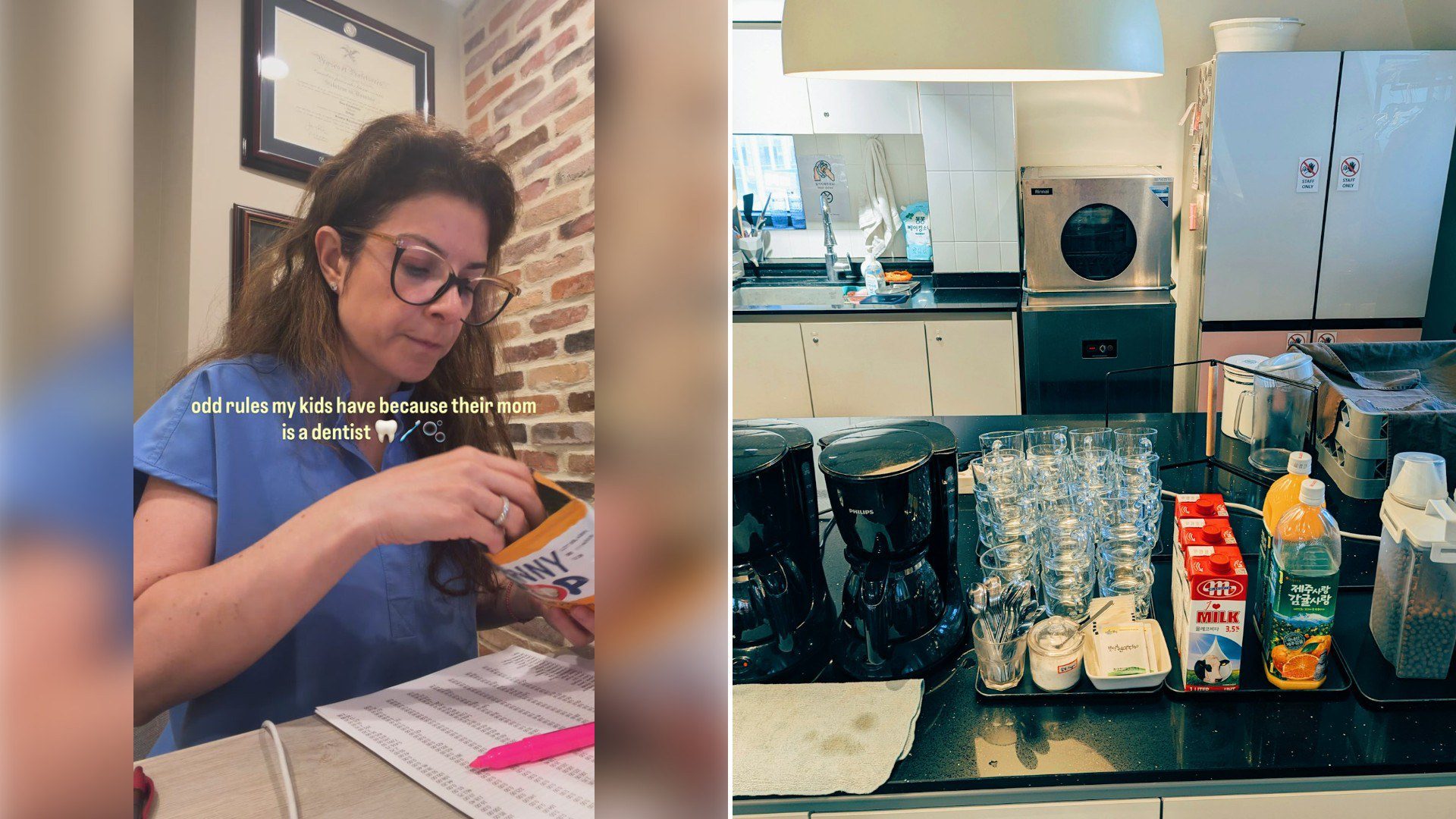
A creator posting under the handle dena.thedentist, who is also a practicing dentist, laid out the specific household rules her job has shaped at home — juice reserved for special occasions only, with water as the everyday default, and brushing done before breakfast rather than after, among others listed via caption over footage of her relaxing at her dental office desk.
What makes the list land is that it’s coming from someone who sees, professionally, exactly what sugar and inconsistent brushing habits do to teeth over time. These aren’t generic wellness tips repeated from somewhere else — they’re personal rules built directly from her own day-to-day experience treating patients.
The brushing-before-breakfast detail in particular tends to surprise people, since most households default to brushing afterward. Some dental guidance actually supports brushing first, on the logic that it clears bacteria and coats teeth with fluoride before acidic foods hit them, rather than brushing food debris in immediately after eating.
For parents outside the dental field, the value here isn’t necessarily copying every rule exactly, but taking the underlying logic seriously: someone who spends her workday looking at the long-term consequences of these habits has clearly decided they’re worth enforcing consistently at home, rules kids don’t love, but good tradeoff.
There’s a particular kind of credibility that comes from a parent enforcing rules based on what they see at work rather than what they read somewhere online. A dentist watching cavities form in real patients’ mouths week after week has a front-row seat to exactly how sugar exposure and brushing habits play out over years, not just theoretical knowledge but a running visual record of cause and effect. Rules built on that kind of direct evidence tend to carry more weight than generic advice handed down secondhand.
Juice in particular has earned a complicated reputation among dental and pediatric professionals over the past decade. Even the “100% juice” versions marketed as healthy are often packed with natural sugars that bathe teeth in the same kind of acidic, cavity-promoting environment as soda, just with better branding. Treating juice as an occasional treat rather than a daily staple is a small shift that a growing number of dentists recommend, even though it can be a hard sell to a toddler who’s used to juice boxes in every lunch.
Water as the household default, meanwhile, solves multiple problems at once: fewer sugar exposures throughout the day, better hydration, and one less daily negotiation over what’s allowed in a cup. Kids raised with water as the assumed norm, rather than an occasional substitute for something sweeter, tend to accept it without much fuss simply because they’ve never known a different default.
The brushing-before-breakfast detail is worth sitting with a bit longer, since it runs against what most people were taught growing up. The logic behind brushing first is that it removes overnight bacterial buildup and leaves a protective layer of fluoride on the teeth before acidic breakfast foods have a chance to soften enamel, which brushing immediately afterward can actually make more vulnerable to abrasion for a short window. It’s the kind of small, counterintuitive detail that only surfaces when someone with direct clinical exposure decides to share it.
None of this means every family needs to overhaul their routine overnight based on one dentist’s household rules. But there’s real value in hearing specifics from someone whose profession gives her an unusually clear view of the long game — what a decade of daily habits actually does to a mouth, well past the point where most parents are still paying close attention. Rules that feel oddly strict in the moment often make a lot more sense once you know exactly what they’re protecting against.
There’s also something reassuring for other parents in watching a professional apply the same imperfect, real-world logic to her own household that everyone else has to work with. A dentist still has to negotiate with her own kids over water versus juice, still has to enforce a rule that gets pushback, still has to pick her battles about which habits matter most. Professional knowledge doesn’t make parenting easier in any magical way — it just sharpens which hills are worth dying on, which is arguably the most useful takeaway from a list like this.
It’s worth noting, too, how much of pediatric dental health comes down to habits formed early and repeated consistently, rather than any single dramatic intervention. A family that treats water as the default and sugar as the exception, starting young, tends to avoid a whole category of dental problems that show up later simply through accumulated exposure. By the time a child is old enough to understand why the rule exists, the habit is usually already locked in, which is really the whole point of enforcing it early rather than trying to correct course later.
For parents who watched this and felt a flicker of guilt about the juice boxes in their own fridge, the more useful reaction might be picking one small piece of the list to adopt rather than trying to overhaul the whole household overnight. Small, consistent shifts — swapping out one juice serving a day for water, moving up brushing by fifteen minutes — tend to stick better than a total reset, and they carry the same underlying logic a dental professional is quietly modeling for her own kids every single day.