


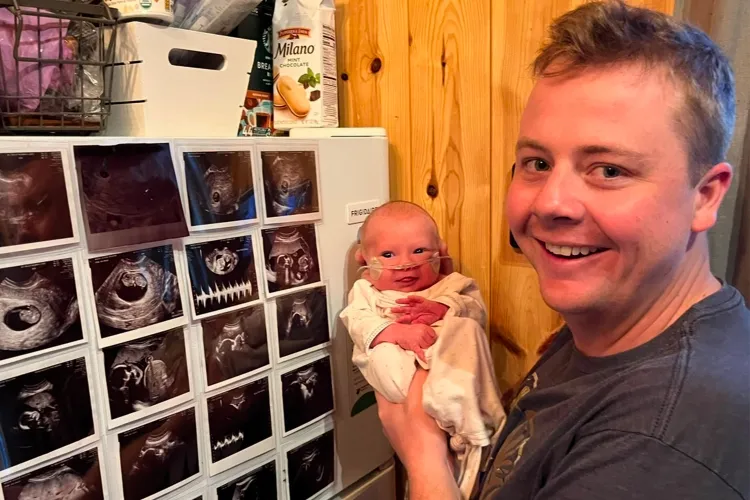
When Allison Wilcox was told she was losing her pregnancy, she was also told to prepare for the worst. Instead, she quietly decided she was not ready to say goodbye. What followed was a months-long odyssey through exam rooms and waiting areas, 36 ultrasounds, and a final twist that ended with a healthy baby in her arms.
Her story is not a tidy medical miracle so much as a messy, human one: a mix of gut instinct, imperfect science, and a woman who refused to sign off on a diagnosis that did not match what her body and her heart were telling her.
The positive test, the bleeding, and a shattering verdict


Allison Wilcox’s pregnancy started the way so many do, with a simple test and a rush of joy. That feeling barely had time to settle before it was replaced by fear. The day after she learned she was pregnant, she began what she later described as heavy, alarming bleeding, the kind that makes every newly pregnant person think of the worst-case scenario. Within days, she was in a clinic, being told that what she was experiencing looked like a miscarriage in progress, and that she should brace for the loss of the baby she had only just discovered.
Clinicians explained that the bleeding, combined with what they were seeing on early imaging, pointed toward a pregnancy that was not going to continue. In those first visits, she heard the kind of language that tends to shut down hope, the clinical shorthand that treats a wanted pregnancy as a set of failing measurements. Yet even as she tried to absorb that news, Wilcox felt something in her balk at the finality of it. That tension between what she was being told and what she felt would become the throughline of her journey, as later detailed in early coverage of her case.
Refusing to accept “miscarriage” as the final word
Plenty of patients, especially in the fog of grief, would have stopped there, gone home, and tried to heal. Wilcox did not. Refusing to accept the diagnosis as the last word, she started looking for second and third opinions, and then kept going. She and her husband crisscrossed Colorado, booking appointments with anyone who would see them, from small practices to larger centers, trying to find one person who would tell them there was still a chance. That determination is captured in reporting that describes her as literally Refusing to accept what she had been told.
Over the next stretch of her pregnancy, that search turned into a marathon of imaging. By the time her baby arrived, Wilcox had undergone a total of 36 ultrasounds, a number that would be eye-popping in any pregnancy, let alone one that had been written off at the start. Each scan was supposed to settle the question, yet the answers kept shifting, and so did the emotions. One visit might bring a sliver of hope, the next another warning. Accounts of her journey note that she kept moving between providers across Colorado, chasing reassurance that never quite came.
Thirty-six scans, mixed messages, and a fragile heartbeat
Those 36 scans were not just numbers on a chart, they were emotional whiplash in real time. At one point, imaging showed a yolk sac that looked unusually large, a detail that can be a red flag in early pregnancy and that several clinicians treated as one more sign that things were not going to end well. Yet in the middle of those worrying measurements, there was a turning point: the first time a provider picked up a heartbeat. That sound did not magically erase the risks, but it shifted the conversation from “this is over” to “this might still work,” a change captured in later summaries of the yolk sac and heartbeat.
Even then, the messaging from doctors was not unified. Some still warned that the odds were stacked against the pregnancy, pointing to the earlier bleeding and atypical measurements. Others were more cautiously optimistic, telling Wilcox to take things week by week. That back and forth is reflected in detailed accounts that describe how she kept returning for more imaging, each time hoping for a clearer picture. One report notes that she went through Months Later still hearing caveats about what might go wrong, even as the baby kept growing.
Living in limbo while the pregnancy quietly progressed
For Wilcox and her family, those months were a strange kind of limbo. They were technically expecting, but they were also braced for loss, because that is what so many professionals had told them to expect. Friends and relatives did not always know what to say. Do you throw a baby shower when the doctors are still using words like “nonviable” and “unlikely”? Do you buy a crib when you have already been told to prepare for a D&C? Reporting on her experience notes that she and her husband tried to hold both realities at once, celebrating small milestones while keeping their guard up, a tension that shows up in detailed write-ups of Wilcox’s pregnancy.
At the same time, the medical system around her kept doing what it does best: measuring, scanning, and documenting. Each new ultrasound added another layer of data, but not always more clarity. Some clinicians focused on the early bleeding and the atypical yolk sac, others on the steadily strengthening heartbeat and growth. That split is echoed in summaries that describe how she bounced between providers who were convinced she was Having a miscarriage and those who were willing to say, quietly, that maybe she was not.
The birth that proved everyone wrong
Eight months after that first terrifying bleed, Wilcox went into labor. By then, she had heard every warning in the book, but she had also watched her baby’s heartbeat flicker and then pound across dozens of screens. When her child finally arrived, healthy and crying, it felt less like a plot twist and more like the ending she had been stubbornly working toward all along. Accounts of the delivery describe it as a “miracle” in the plainspoken way families use that word when medicine has spent months telling them not to get their hopes up, a feeling captured in coverage that notes she ultimately did Gives Birth after all those dire predictions.
Her story has since ricocheted across social media and into news feeds, landing alongside other viral pregnancy sagas that blur the line between medical case study and modern parable. One Facebook community that rallies around complicated pregnancies and fragile newborns, for example, has highlighted similarly “Unexpected” turnarounds, with posts urging followers to keep praying when outcomes look bleak, as seen on a page titled Please. Wilcox’s experience slots neatly into that ecosystem of stories people cling to when they are looking for proof that statistics are not destiny.
More from Decluttering Mom: