


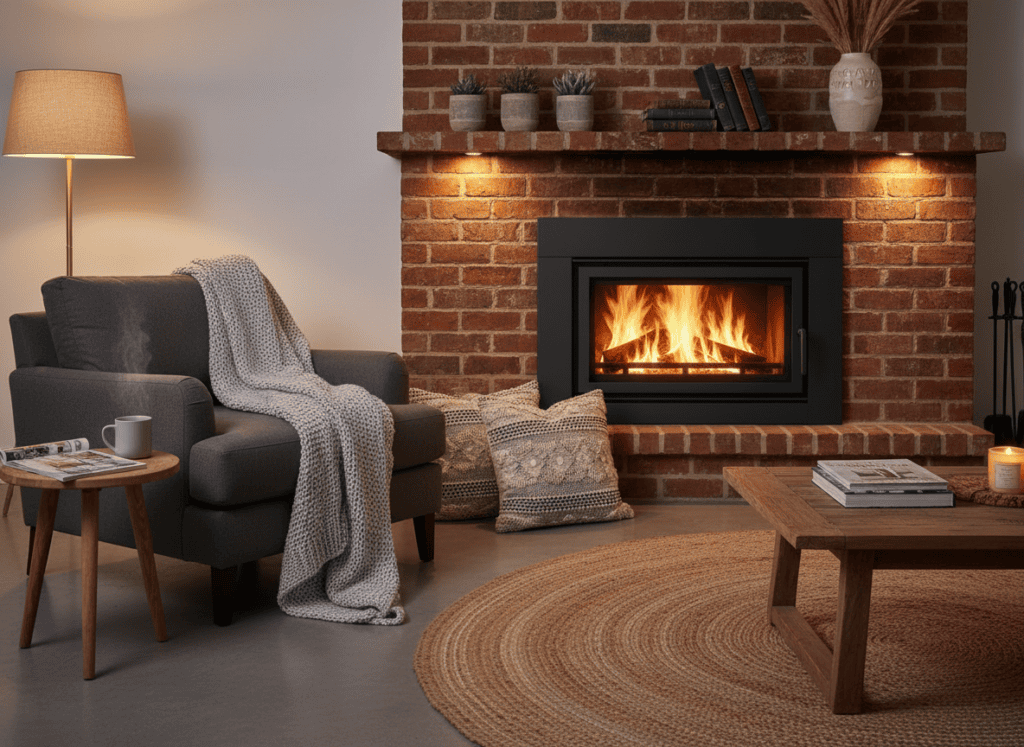
Most traditional open fireplaces lose more than 90% of a fire’s heat straight up the chimney, according to the U.S. Environmental Protection Agency, with much of the warm air already in the room pulled out along with it. That single number explains why fireplace inserts have become one of the fastest-growing categories in the hearth industry. Market research firm Grand View Research projects the insert segment to grow at a 7.4% compound annual rate through 2030, noticeably faster than the 4.8% growth forecast for the broader hearth market that includes new fireplace construction, and the efficiency gap is the reason contractors keep giving for the shift.
The Math an Open Fireplace Can’t Win
An open masonry fireplace can run as low as 10% efficient once that chimney heat loss is accounted for, meaning a homeowner is paying to heat the neighborhood as much as the living room. A fireplace insert changes the equation by sealing that opening behind glass doors and forcing combustion air and exhaust through a controlled path instead of an open flue. Grand View Research’s hearth market analysis notes that modern inserts can reach efficiency rates up to 99%, and that the category’s growth is being driven directly by “the increasing cost of conventional heating fuels and the desire for cost-effective and sustainable heating solutions.” That’s a difference too large for most homeowners to ignore once they’ve seen a winter heating bill.

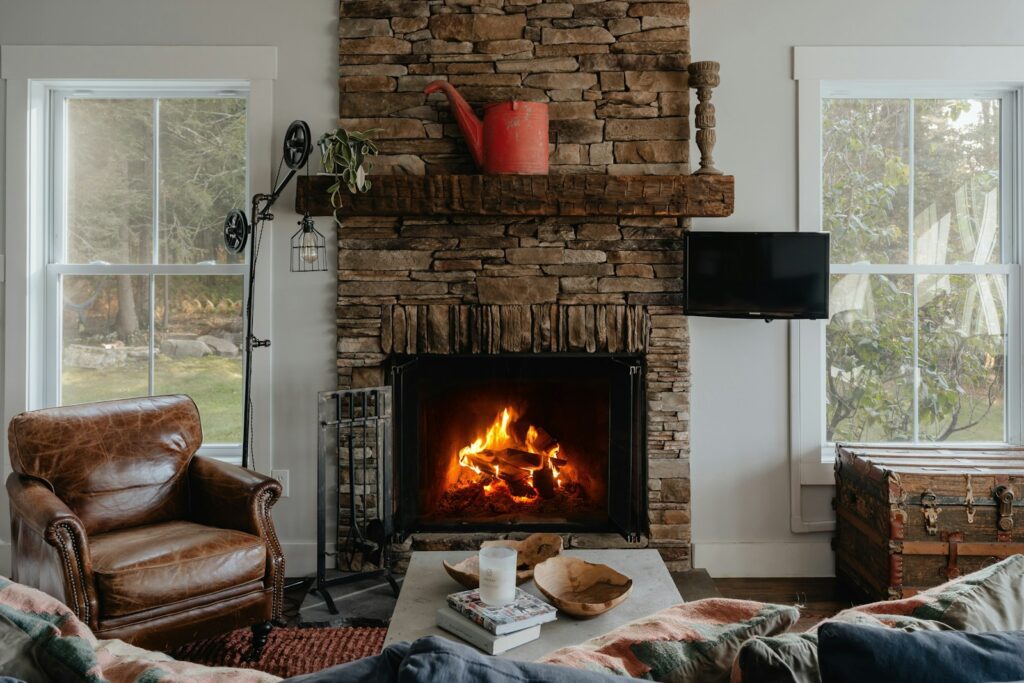
Why Retrofitting Beats Building New
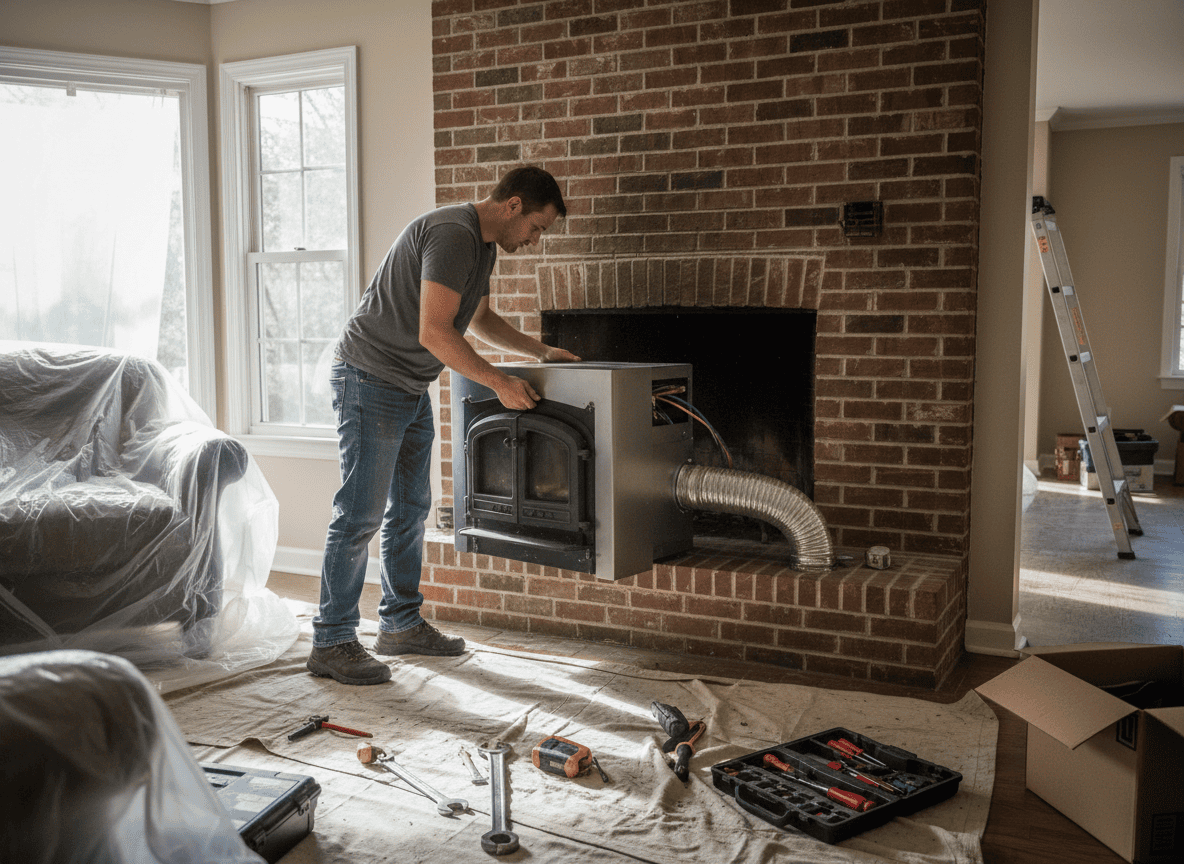
New fireplace construction requires framing, venting, masonry or a full chimney chase, and finish work that can run into the tens of thousands of dollars depending on the home. An insert, by comparison, uses the fireplace opening and chimney a house already has. According to cost data compiled by Angi, insert installation typically runs between $700 and $6,500 depending on fuel type, with wood-burning units on the lower end and pellet inserts running higher due to venting requirements. Angi describes an insert as “the most cost effective way to upgrade your fireplace,” precisely because it reuses infrastructure that’s already built into the walls rather than requiring new structural work.
Break the fuel types down and the price spread gets even clearer. Angi’s data lists gas inserts running $700 to $1,000 in equipment cost with roughly $1,500 in typical labor, electric inserts as low as $500 to $2,000 installed, wood inserts around $1,000 to $1,500 before roughly $2,200 in labor for chimney liner work, and pellet inserts at $2,000 to $3,000 given their more involved venting needs. Even at the high end of that range, a homeowner is still paying a fraction of what pouring a new masonry fireplace and building a matching chimney chase would cost from scratch.

What’s Pushing Homeowners to Act Now
Two pressures are converging at once. Heating fuel costs have climbed enough that a fireplace losing 90% of its heat has become a visible expense rather than a background inconvenience, and older open fireplaces are increasingly seen as a liability rather than a feature, since a drafty flue can pull conditioned air out of a house even when no fire is burning. An insert addresses both problems simultaneously: it turns a decorative or occasional-use fireplace into a heat source that can meaningfully offset a furnace’s workload during cold months, while also sealing off the draft that an open flue creates the rest of the year.
Reading the Trend Correctly
None of this means an insert always outperforms a brand-new, code-current fireplace build in every scenario — a new build can be engineered around modern venting and insulation from the start. But for the millions of homes with a functioning, existing fireplace opening that’s simply inefficient, the insert route lets a homeowner capture most of the efficiency gain of new construction without the excavation, permitting, and masonry costs that come with starting from scratch. That’s the calculation contractors say is showing up more often on service calls: not “should we build a fireplace,” but “why keep losing heat through the one we already have.”
A chimney doesn’t care whether the heat it’s pulling away came from an old fireplace or a new one; it removes it either way. The insert boom is really just homeowners finally pricing in what that heat loss has been costing them all along.