


A water stain the size of a dinner plate spreads across a basement wall, and most homeowners do the same thing: wait. Maybe it dries out on its own. Maybe it was just one bad storm. That instinct to wait is exactly what turns a manageable drainage fix into a five-figure foundation problem, and the pricing data on both sides of that decision is not close.
What a French drain actually costs
According to Angi’s 2026 cost data, installing a French drain runs $500 to $18,000, with a national average of $9,250, depending on the drain’s length, depth, and whether it’s a simple yard drain or a full interior perimeter system tied to a sump pump. Per linear foot, contractors typically charge $10 to $100, so a modest 50-foot drain along one side of a foundation can come in around $500 to $5,000 before labor complications. A drainage system installed specifically to protect a foundation, rather than just to dry out a soggy lawn, tends to land in the $2,800 to $6,500 range, per the same data.
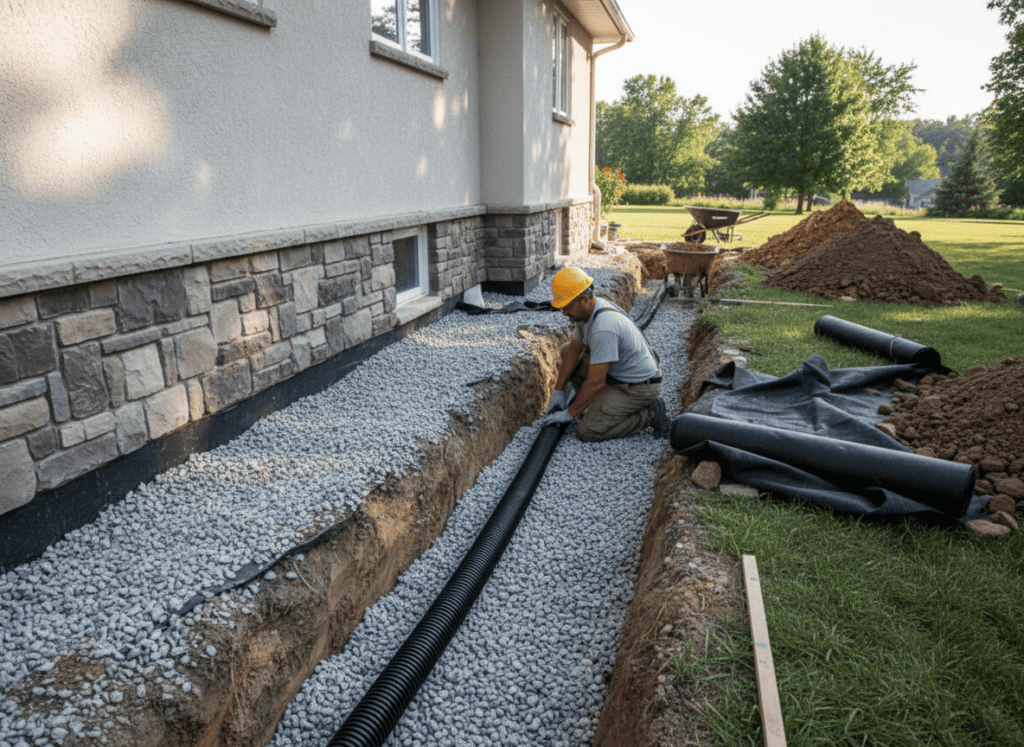
That’s the cost of being early. It’s a trench, gravel, perforated pipe, and an outlet that carries water away from the house before it ever gets near the concrete.


What foundation repair costs once water gets in
Angi’s foundation repair figures put the average repair at $5,175, with a typical range of $2,225 to $8,133 — but that number mostly describes minor crack sealing, the kind of job that happens before water has done real structural damage. Once moisture has been reaching a foundation wall long enough to cause settling, bowing, or heaving, the pricing moves into a different category entirely. Foundation lifting runs $20,000 to $23,000. Reinforcing a bowing wall costs $4,000 to $12,000. A home dealing with active settling can face $5,000 to $25,000 in repairs, and a full foundation replacement — the outcome when a foundation has been compromised for years — runs $20,000 to $100,000.
Line those figures up and the math is not subtle. A French drain at the high end of its range, $18,000, still costs less than the low end of a full foundation replacement. At the average end — roughly $9,250 for drainage versus $20,000-plus for foundation lifting — the drain runs less than half the price, and that’s before counting the mold remediation, drywall, and flooring most water-damaged basements also need.
Why homeowners wait anyway
Part of it is timing. A French drain is a project you choose to do, usually after noticing a damp patch, a musty smell, or slow puddling near the foundation after rain — none of which feel urgent yet. Foundation repair, by contrast, is a project that gets forced on you, typically after a home inspector, an appraiser, or a visibly cracking wall makes it impossible to ignore. By the time repair is unavoidable, water has usually been finding its way in for months or years, not days.
Part of it is also that drainage problems are easy to misread as cosmetic. A little standing water in the yard after a storm looks like a landscaping issue. It’s only once that water finds a path along the foundation footing, over repeated freeze-thaw cycles, that it starts working against the structure itself. Soil that saturates and dries out next to a foundation over and over again expands and contracts, and that movement is what eventually cracks, bows, or settles a wall that would otherwise have lasted decades.
The signs worth acting on before the wall does
Contractors who install drainage systems tend to flag the same early markers: water pooling within ten feet of the foundation for more than a few hours after rain, a musty basement smell that shows up specifically during wet weather, efflorescence — the chalky white mineral deposits — on concrete walls, and yard grading that slopes toward the foundation instead of away from it. None of those require a foundation specialist to diagnose. A drainage contractor, or in some cases a landscaper, can usually assess and quote a French drain installation in a single visit.
The real comparison isn’t drain versus no drain
It’s drain now versus repair later, and later almost always costs more, takes longer, and disrupts more of the house. A French drain installation is typically a one-to-three-day job that doesn’t touch the inside of the home. Foundation lifting or underpinning can take weeks, often requires temporarily relocating, and can complicate selling or refinancing a home until the work is documented and complete. The gap between those two experiences is exactly what the pricing data reflects: drainage is maintenance, and foundation repair is triage. One of them you schedule. The other one schedules you.