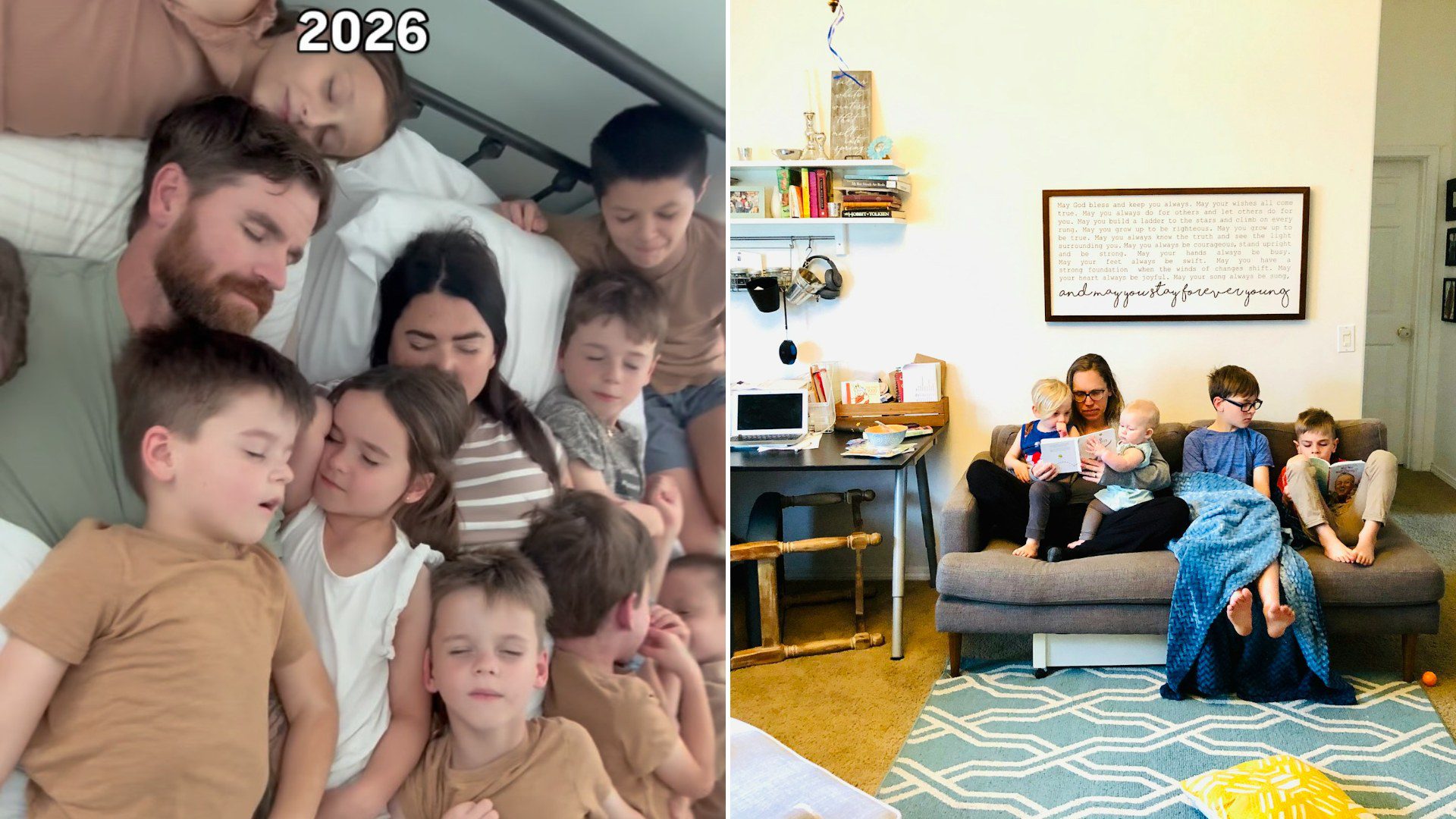
Most families grow gradually, one child at a time, over the course of a decade or more. Creator @maxinelee_y’s story is anything but gradual. Her caption lays it out plainly: “We went from a couple to 9 kids in less than two years. Henry- 2018, Adoption- 2019, Quads- 2020.” In the span of a timeline that most families would use to welcome a single baby, her household went from two adults to an entire household of nine children through a combination of biological birth, adoption, and the arrival of quadruplets, a sequence of events so dramatic it reads almost like fiction.
Large family content has carved out a durable and devoted corner of parenting social media, and it’s easy to understand why. There’s a genuine curiosity most people feel toward households that operate on a completely different scale than their own, logistics around meals, bedrooms, laundry, and transportation all shift dramatically once a family crosses from a handful of kids into double digits territory. But what makes this particular family’s story stand out isn’t just the number of children; it’s the specific, almost whiplash-inducing timeline in which that number was reached.
Adoption and quadruplets rarely appear together in the same family story, and the layering of those two very different paths to parenthood, one deliberate and often years in the making, the other a sudden multiplication delivered all at once, adds real emotional texture to this timeline. Adoptive parents often describe years of paperwork, waiting, and uncertainty before a placement finally happens, while parents of multiples describe an entirely different kind of whiplash: the sudden shift from preparing for one baby to preparing for four, often with far less lead time to adjust logistically or emotionally.
The compressed nature of this family’s growth also raises practical questions that large family content often gets asked repeatedly in the comments: how do you afford to feed, clothe, and house nine children built up so quickly? How do you manage school schedules, bedtime routines, and even just getting everyone’s shoes on to leave the house, when the family size essentially quintupled in under 24 months? These aren’t idle curiosities; they reflect genuine logistical puzzles that most large families have had years to gradually solve, one child’s addition at a time, while this family had to solve them nearly all at once.
There’s also something worth noting about how adoption fits into the broader narrative of family-building that large family content tends to showcase. Adoption stories, when shared publicly, carry an added layer of responsibility, since they involve a child’s origin story that isn’t solely the parents’ to tell. Creators who share adoption as part of their family’s journey, as this one does, often walk a careful line between celebrating the joy of welcoming a child and respecting that child’s own privacy and agency as they grow older and eventually have their own feelings about how their story gets told publicly.
Quadruplets, meanwhile, remain rare enough that their arrival alone would typically dominate a family’s story for years. The medical reality of carrying and delivering four babies at once involves significant risk, extended hospital stays, and often a NICU journey that can stretch on for weeks or months after birth. Folding that experience into a larger family narrative that also includes a biological child and an adopted child suggests a family that has weathered an enormous amount of change, uncertainty, and likely financial and logistical strain, all compressed into an astonishingly short window.
Audiences drawn to this kind of content often aren’t just seeking entertainment value from the sheer scale of the family; they’re looking for a sense of possibility and resilience. Watching a family navigate explosive growth and apparently come out the other side functioning, documenting their life with humor and warmth rather than visible despair, offers a kind of reassurance to any parent feeling overwhelmed by far more modest challenges. If this family can manage nine kids acquired in under two years, the logic goes, surely the rest of us can handle our own, comparatively smaller, chaos.
It’s also worth considering how content like this reshapes public perception of what family-building can look like. The traditional script, meet a partner, have one or two biological children spaced a few years apart, doesn’t reflect the reality for a growing number of families who build their households through some combination of adoption, fertility treatment, foster care, or blended family arrangements. Sharing a timeline as unconventional as this one helps normalize the idea that family growth doesn’t have to follow a predictable pattern to be loving, stable, and worth celebrating.
Whatever the day-to-day realities behind the scenes, this family’s documented timeline stands as a genuinely remarkable story of rapid, layered family growth. It’s the kind of content that stops the scroll not because of a clever hook or a trendy audio clip, but because the facts themselves, stated plainly in a caption, are simply astonishing enough to speak for themselves.