


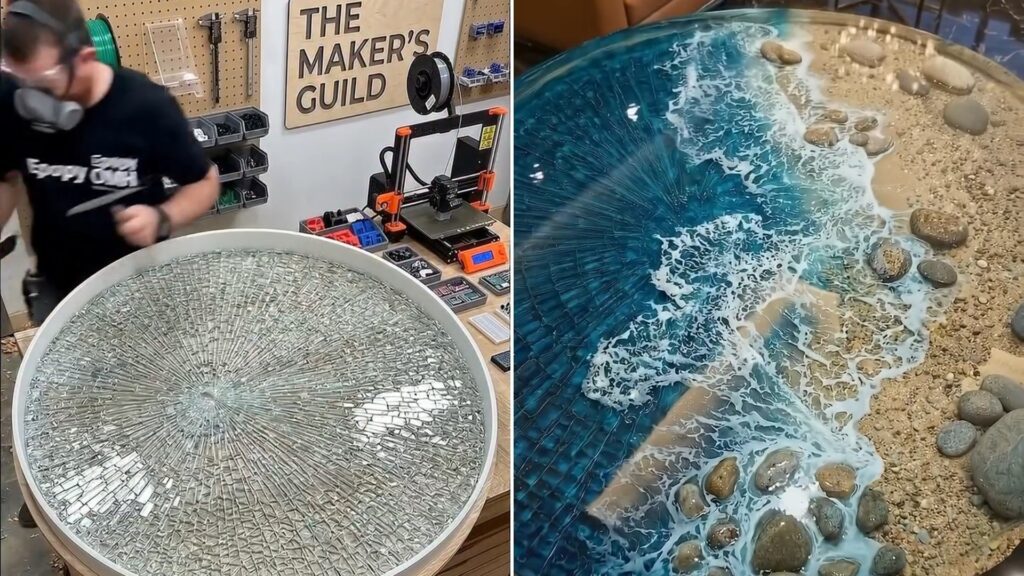
A furniture maker turned a pile of smashed glass into a custom coffee table that looks like real ocean waves frozen mid-motion under a clear resin surface, according to their own Instagram video. The account, with a following of 96,000 people built largely around resin and furniture content, documented the full process from broken glass to finished tabletop. The build stands out from the usual resin-art trend because the texture doing the work isn’t paint or pigment swirled through epoxy. It’s shattered glass, layered and set so the light catches it the way it would catch real water.
The glass does the work paint can’t. Most ocean-themed resin tables online rely on blue and white pigment swirled through clear epoxy to fake the look of moving water. This build skips that entirely and packs actual smashed glass shards into the resin itself. Broken glass catches and scatters light in a way flat pigment never fully replicates, which is what gives the finished surface its sense of depth and motion, closer to waves caught mid-break than a painted approximation of one.
Layering is what creates the illusion of depth. A single pour of tinted resin over a bed of glass would settle flat and look cloudy from above. Building the wave effect instead depends on pouring in stages, letting each layer partially cure before the next goes in, so glass shards end up suspended at different depths rather than sinking to the bottom of the mold all at once. That staged approach is what makes the finished surface read as three-dimensional from an angle instead of like a single sheet of tinted glass sitting on a tabletop.
Color placement follows how real water actually looks. Ocean water isn’t one uniform shade. It runs from near-white foam at the surface down to deep teal and navy the further below the waterline you look. Recreating that means placing lighter, more opaque resin near the top of each pour and progressively deeper blues underneath, rather than mixing a single color and letting gravity settle it however it lands.
The base material determines how the final piece reads. Building on a wood substrate, rather than pouring resin as a freestanding slab, gives the tabletop a visible edge where the “water” appears to meet solid ground, reinforcing the sense that waves are moving across a surface instead of just floating in clear liquid. It’s the kind of detail that separates a piece that reads as art from one that reads as a novelty item picked up at a craft fair.
Curing time is where most attempts at this fail. Deep-pour resin generates heat as it cures, and pouring too much at once, or moving to the next layer before the last one has properly set, is what causes cloudiness, cracking, or shards shifting out of place. Multi-layer ocean builds like this one typically take days rather than hours from first pour to finished surface, with each stage needing its own full cure before the next color goes in.
Smashed glass also solves a sourcing problem. Ocean-resin builds that depend on specialty pigments or imported glass beads can get expensive fast, and sourcing enough material to fill a full coffee-table mold adds up quickly. Using broken glass, the kind that would otherwise get swept up and thrown away, turns a disposal problem into free raw material. That’s part of why the build has resonated with an audience that follows resin content specifically for projects they could realistically attempt themselves rather than ones that require a specialty supply order first.
The final surface still needs sanding and polishing to disappear. A cured resin pour comes out of the mold with visible seams, high spots, and a dull finish rather than the glass-smooth look shown in the finished table. Getting there means working through progressively finer sandpaper grits by hand or with an orbital sander, then buffing the surface to a clear, glossy finish that lets the layered glass and color gradient underneath actually show through instead of hiding behind scratches.
What ties the build together isn’t any single technique. It’s that every choice, from the staged pours to the color gradient to the wood base, is working toward the same optical effect instead of leaning on one flashy step to carry the whole piece. That’s the difference between a resin project that looks like a craft experiment and one that looks like it belongs in a furniture showroom, and it’s why a table built out of what most people would call trash is getting attention as an actual design object.