


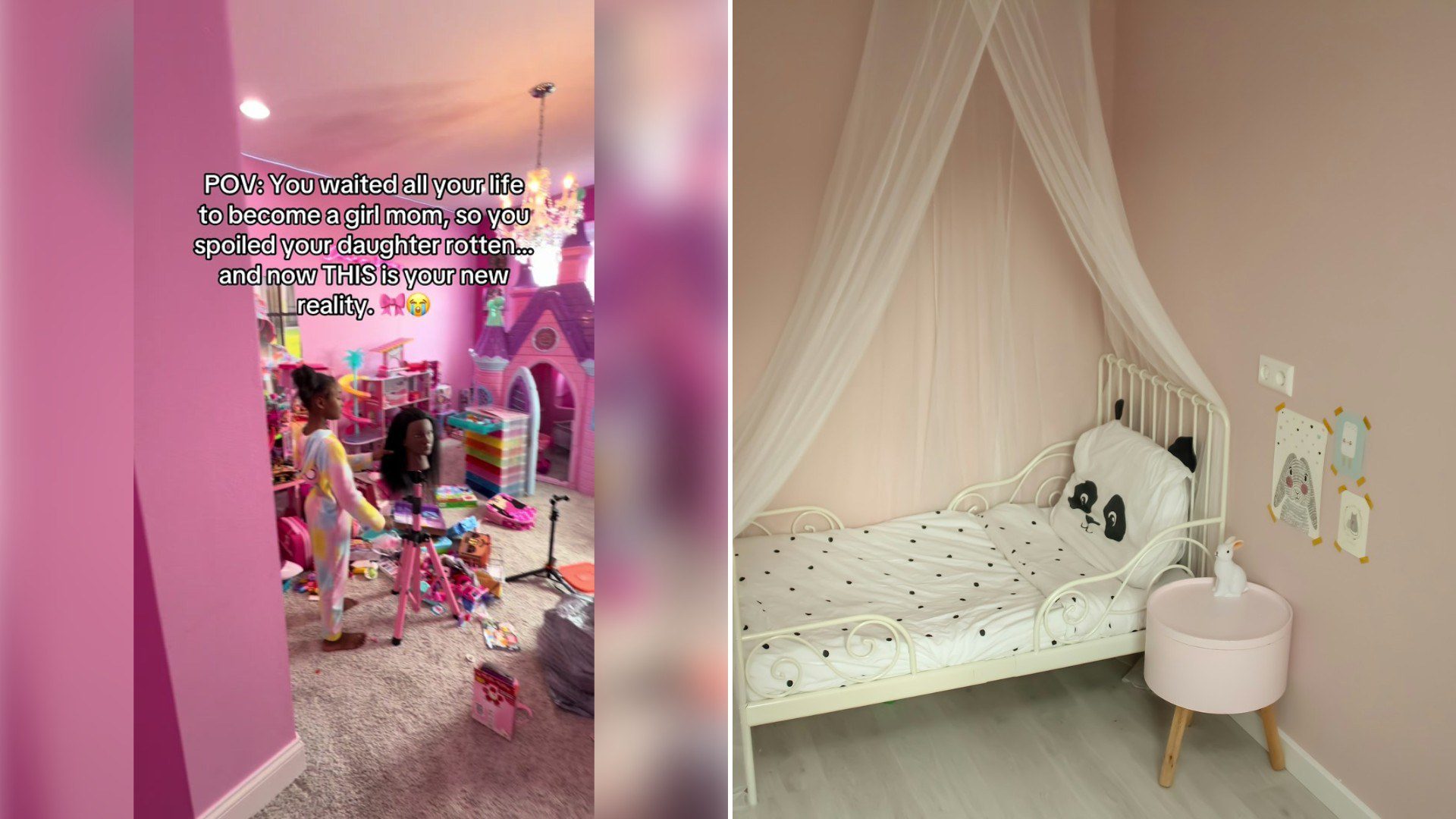
A creator posting under the handle msdollhouse gave a refreshingly honest tour of her daughter’s bedroom — overwhelmingly pink, packed wall-to-wall with toys — framing it as the real, unfiltered outcome of wanting a daughter and then, by her own admission, spoiling her rotten.
@msdollhouse It’s gonna take me 3 hours to clean this mess, and my daughter is supposed to be helping me… but instead, she’s servicing her client. 😩😭🎀 #girlmom #popularpage #explorepage #luxurylifestyle #pinkplayroom
She notes the cleanup ahead will take roughly three hours, and jokes that her daughter is technically supposed to be helping but has instead wandered off to play with a mannequin head, leaving the actual work entirely on mom. The clutter shown is real and unstaged, not a curated “messy on purpose” shoot.
It’s a relatable admission for a lot of parents who’ve watched a kid’s room slowly fill up past the point of easy management, one gift and one impulse purchase at a time, until a cleanup that should take twenty minutes balloons into a multi-hour project. The room isn’t a failure of parenting so much as a natural byproduct of love expressed through toys, gradually catching up with itself.
For parents staring down a similarly overwhelming kid’s room, the honest admission here doubles as a nudge: a recurring, smaller cleanup habit tends to be a lot less daunting than letting things build until a single session has to absorb the whole backlog at once.
There’s a particular kind of honesty in showing a room this chaotic rather than only the tidy, after version so many organizing accounts default to. Most toy room content skips straight to the reveal, glossing over the actual process and the real volume of stuff that had to be wrangled to get there. Filming the mess itself, unsanitized, is a much rarer and arguably more useful thing to share, since it’s the stage every parent with a similarly overwhelmed kid’s room is actually living in most of the time.
Toy accumulation in a household with a young girl tends to follow its own particular momentum, building from birthdays, holidays, grandparents who can’t resist one more present, and the occasional impulse buy that seemed harmless in the moment. None of those individual additions feels excessive on its own; it’s only in aggregate, staring at a room that’s somehow overflowed its own storage capacity, that the scale of it becomes obvious. By then, the room has usually crossed some invisible threshold where a simple pickup session no longer cuts it, and a bigger, more deliberate cleanup becomes the only real option.
The detail about the daughter wandering off to play instead of helping is its own small, familiar comedy beat. Enlisting a young kid to help clean their own overstuffed room rarely goes as planned in practice — the promise of help usually dissolves within minutes once something more interesting catches their attention, leaving the actual sorting, stacking, and deciding what stays to the parent anyway. It’s a scenario nearly every parent of a young child recognizes instantly, right down to the specific way a kid can get distracted mid-task without any apparent awareness that a task was ever assigned to them in the first place.
There’s also something worth noting in how differently “spoiled” reads when a parent says it about their own choices rather than as a criticism leveled from outside. Framing a toy-packed room as the direct result of her own decisions to indulge her daughter, rather than blaming the kid for wanting too much, reflects a kind of self-aware honesty that tends to land better with other parents than a more defensive explanation would. It’s less an excuse than a shrug: this is what happens when you enjoy buying things for your kid, and the cleanup is simply the bill that eventually comes due.
For families trying to avoid ending up in exactly this position, the real lesson embedded in a video like this one probably isn’t about buying fewer toys altogether, so much as building in some kind of regular maintenance rhythm before the volume gets unmanageable. A quick nightly tidy, or a rule about one toy leaving the house for every new one that arrives, tends to keep a room from ever reaching the three-hour-cleanup stage in the first place — though plenty of parents, this one included, will freely admit that keeping up with that kind of system consistently is much easier in theory than in practice.
There’s also a comforting universality in watching another parent face down a mountain of toys and simply decide to handle it rather than spiral about how it got that way. No shame, no lengthy self-recrimination about parenting choices, just an acknowledgment of the scale of the task and a plan to get through it. That matter-of-fact approach is arguably the most useful part of the whole clip for anyone watching from the middle of their own overwhelming cleanup, wondering whether they’re the only ones who let things get this far.
By the time the three hours are up, presumably, the room will look completely different — tidy, organized, ready to slowly refill over the following weeks exactly the way it did the first time. That cycle, rather than any single cleanup, is really the honest reality of raising a kid who loves her toys: order and chaos trading places on a loop, with the parent doing the bulk of the resetting each time the balance tips too far toward chaos.