



He didn’t shout. He didn’t slam a door. He just said, quietly, that he was done trying to be her friend. In a post that drew thousands of responses on Reddit’s AITA forum, a young man described the moment he told his autistic sister he could no longer keep absorbing what he saw as years of one-sided emotional labor. The reaction was immediate and split: some called him cruel, others said he’d waited too long. But the story struck a nerve because it named something many siblings of autistic adults feel and rarely say out loud: love and exhaustion can exist in the same sentence.
That tension is more common than most families acknowledge. A growing body of research and a surge of candid online testimony suggest that siblings of autistic individuals often carry significant psychological weight, and that the question of when accommodation tips into self-harm has no clean answer.
When a Diagnosis Becomes the Only Lens

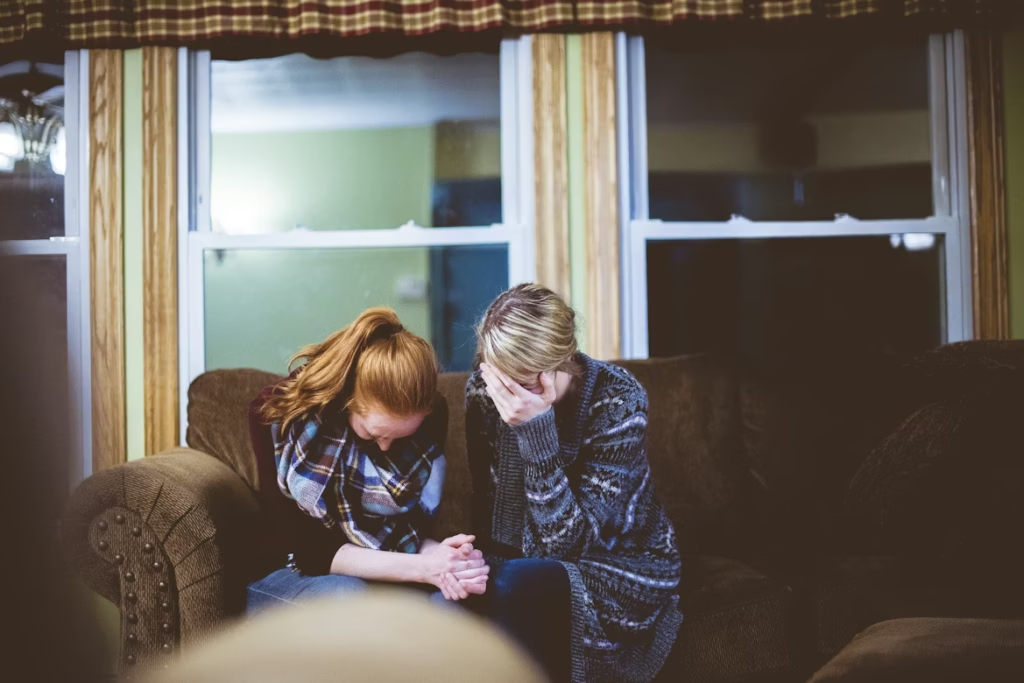
The brother’s account, posted in an AITA thread, described a pattern familiar to many in similar positions: his sister would lash out during disagreements, then reframe any pushback as an attack on her autism. He wrote that he finally told her to stop using her diagnosis as a blanket justification for hurtful behavior. The post also detailed financial friction. He said he regularly bought her lunch or small treats on hard days, but when he asked her to return the gesture months later, she cited a donut she’d purchased the previous week as proof she’d already reciprocated.
What made the post resonate wasn’t the specifics. It was the structure: a sibling who felt trapped between genuine compassion for a disability and genuine anger at being treated, in his view, as an emotional ATM. Commenters on a related AITAH thread largely judged the situation as “ESH” (everyone sucks here). A commenter named auroracorpus argued that the brother spoke about his sister’s disorders as though she should simply “get over them,” but also affirmed his right to set boundaries after years of feeling disrespected.
That split verdict captures the core difficulty. A diagnosis is real. The pain it causes a sibling is also real. And most families lack the vocabulary to hold both truths at once.
What the Research Says About Sibling Strain
The emotional weight these siblings describe is not just anecdotal. A 2003 study by Richard Hastings in the Journal of Autism and Developmental Disorders found that siblings of children with autism reported higher levels of behavioral difficulties and lower levels of prosocial behavior compared to normative samples, with the effect influenced by the degree of the autistic child’s behavioral problems and the mother’s stress level. More recent work by Carolyn Shivers and colleagues, published in 2019 in Research in Autism Spectrum Disorders, found that adult siblings of autistic individuals reported a complex mix of closeness and caregiving burden, with many describing a sense of obligation that intensified as parents aged.
The Autism Society of America explicitly acknowledges sibling needs in its family guidance, recommending that parents create space for neurotypical children to express frustration without guilt. Family therapists who specialize in autism-related dynamics often describe a pattern where one child is implicitly assigned the role of secondary caregiver. In clinical literature, this is sometimes called “parentification,” a term originally developed by Ivan Boszormenyi-Nagy to describe situations where a child takes on responsibilities that belong to the parent. When that role is never examined or relieved, resentment builds not just toward the autistic sibling but toward the family system that made the arrangement feel mandatory.
Codependency by Design
One Reddit poster put it bluntly. In a 2025 AITAH post about ending their relationship with an autistic sister, they wrote: “I’m realizing that I was taught to be codependent, to prioritize calm over my own safety and dignity.” They described a childhood in which asserting any boundary was treated as selfishness, and said that learning to set limits as an adult felt deeply unnatural.
That account aligns with what clinicians see in practice. When parents rely heavily on a neurotypical child to “just understand,” that child often internalizes the belief that their own needs are secondary. The decision to step back, or even to cut contact, then becomes less about punishing the autistic sibling and more about exiting a role that never allowed them to simply be a brother or sister. It is a distinction that gets lost in the moral framing most families default to: you either stand by your sibling, or you are a bad person.
“Explanation, Not Excuse”: A Phrase That Cuts Both Ways
Autistic self-advocates have long grappled with the line between explanation and excuse. In a 2023 discussion on r/AutismInWomen, participants debated the phrase “your diagnosis is an explanation, not an excuse.” Some argued it gets weaponized to dismiss real neurological limitations, as if willpower alone could override sensory overload or executive dysfunction. Others countered that repeated harm still has consequences for the people absorbing it, regardless of its origin.
One commenter offered an analogy: a person with paralysis who uses a wheelchair and needs someone to push them. The pushing causes physical strain. Is the diagnosis an explanation for needing help, or is it also not an excuse for the toll on the helper? The question has no tidy resolution, which is precisely the point. In a separate AITAH thread, an autistic commenter with ADHD acknowledged that emotional regulation is genuinely harder for neurodivergent people but insisted that difficulty does not grant a free pass to mistreat others. That dual stance, empathy for the struggle and accountability for the impact, is what many strained siblings say they wish their families had modeled from the start.
When Walking Away Is Self-Protection, Not Cruelty
For some siblings, the emotional cost eventually outweighs the hope that the relationship will improve. The accounts that surface online tend to share a common arc: years of accommodation, a slow erosion of the sibling’s own identity, and then a single conversation or incident that functions as a last straw. The sibling who walks away is almost always met with accusations of abandonment, from parents, from the autistic sibling, sometimes from themselves.
But walking away and abandonment are not the same thing. Boundary-setting, including the boundary of reduced or no contact, is a recognized component of healthy family functioning in clinical psychology. The Autism Society’s family resources encourage open dialogue about limits, and therapists who work with these families often note that a sibling who protects their own mental health is better positioned to offer meaningful support later, if and when the relationship can be renegotiated on more equal terms.
None of this means the autistic sibling is the villain. Autism involves real neurological differences that shape communication, emotional regulation, and social reciprocity in ways that are not chosen. But acknowledging that does not require the people around them to accept unlimited harm without recourse. The families that navigate this best tend to be the ones that reject the binary altogether: not “support your sibling no matter what” and not “cut them off,” but something harder and more honest. A relationship where both people’s needs are visible, where a diagnosis informs the conversation without ending it, and where love is allowed to have conditions.
More from Decluttering Mom: