


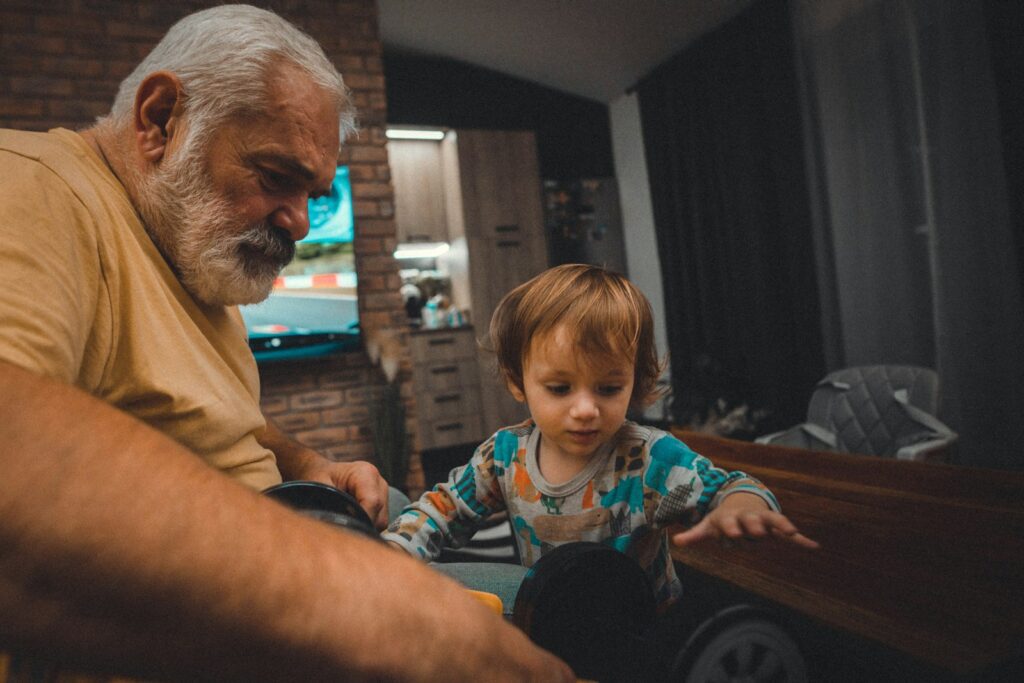
A 6-year-old walks through the front door after a weekend at Grandpa’s house, sets down a backpack, and asks: “Did Grandpa tell you not to cry?” The question lands like a grenade in a quiet kitchen. Whatever happened between the adults is no longer contained. The child has picked up on it, processed it through a 6-year-old’s logic, and brought it home for answers.
For the parent standing at the counter, the instinct might be to deflect: Oh, don’t worry about that. But child psychologists say deflection often backfires. Kids who sense dishonesty tend to fill the gaps with worse explanations than the truth. The better move, according to clinicians who work with young children and family conflict, is to answer honestly, briefly, and without recruiting the child as an ally.
Kids notice more than adults think

Parents tend to overestimate how much conflict they’ve hidden. A 2012 study published in Child Development found that children as young as two can detect hostility between caregivers, even when adults believe they’ve kept disagreements behind closed doors. The researchers noted that children respond not just to raised voices but to emotional withdrawal, cold silences, and shifts in body language.
That finding holds up in clinical practice. Dr. E. Mark Cummings, a developmental psychologist at the University of Notre Dame who has studied children’s responses to marital conflict for decades, has written that kids act as “emotional Geiger counters,” picking up on tension adults assume is invisible. A grandparent’s sharp remark about crying, even one delivered in a calm voice, registers.
According to guidance from The Wave Clinic, children who witness hostile conflict or emotional withdrawal between caregivers often respond with fear, confusion, and hypervigilance. They may not understand the content of the argument, but they feel the temperature change in the room and adjust their behavior accordingly.
What a question about Grandpa’s “no crying” rule really means
When a young child asks whether Grandpa told a parent not to cry, the question is rarely idle curiosity. At six, children are beginning to understand that different people enforce different rules, and they’re testing which rules are real. The child may have been told not to cry themselves, or may have overheard Grandpa scolding a parent for showing emotion, and now they want to know: Is crying wrong? Am I in trouble if I do it?
UNICEF’s parenting guidance on talking to children about difficult topics stresses that kids have a right to ask questions and receive truthful, age-appropriate answers. While that guidance was developed for conversations about large-scale conflict, the core principle applies to family tension too: secrecy tends to increase a child’s anxiety rather than reduce it. When adults refuse to acknowledge what a child has clearly observed, the child learns that their perceptions can’t be trusted.
For the parent in that kitchen, the child’s question is an opening. A simple, direct response works: “Yes, Grandpa doesn’t think people should cry. I disagree. In our family, crying is allowed.”
How much honesty is appropriate for a young child
Once the door is open, parents face a calibration problem: how much detail is enough? Too little, and the child feels dismissed. Too much, and the child becomes a container for adult grievances.
Psychotherapist Sheryl Ziegler, writing in Psychology Today, offers a useful filter: if a detail is something you’d only share with a close friend, it doesn’t belong in a conversation with your child. Kids need enough information to make sense of what they’ve witnessed, but they don’t need the full backstory of a decades-old family grudge.
Guidance from First Things First, a family advocacy organization, recommends two non-negotiable messages in any conversation with a child about adult conflict: the disagreement is not the child’s fault, and the adults involved will handle it themselves. That second point matters because children who feel responsible for fixing family problems often develop anxiety or people-pleasing behaviors that persist into adulthood.
A response that hits both marks might sound like: “Grandpa and I disagreed about something. That happens sometimes between grown-ups. It’s not about you, and you don’t need to fix it.”
Normalizing disagreement without forcing kids to pick sides
Family gatherings, holidays, and shared meals put children in the audience for adult disagreements they didn’t ask to witness. When a grandparent criticizes a parent in front of a child, the child absorbs information about both people at once: one person thinks crying is weak, the other is hurt by that judgment. The child now has to figure out where they stand, unless a parent steps in and removes that burden.
Parents magazine recommends framing disagreements as a normal part of relationships rather than a crisis. The key phrase, according to their reporting, is that people can disagree and still love each other. For a young child, that might sound like: “Grandpa and I see this differently. That doesn’t mean we don’t care about each other. And it definitely doesn’t mean anyone is mad at you.”
It also helps to acknowledge that not every family handles emotions the same way. Some grandparents grew up in households where crying was discouraged, and their stance reflects generational norms rather than malice. A parent can honor that context without endorsing the rule: “Grandpa grew up in a family where people didn’t cry much. Our family does things differently, and both ways come from how people were raised.”
That kind of framing gives the child a way to understand Grandpa without absorbing his rules as their own.
Naming harm without turning a grandparent into a villain
One of the quieter risks in a “no crying” household is that children start suppressing their own emotions to keep the peace. Research on emotional socialization in families, including work published in the Journal of Family Psychology, has found that children who are repeatedly told to stop crying or to toughen up are more likely to struggle with emotional regulation later. They learn that certain feelings are unacceptable, and they bury them.
Counselors who work with families under strain, including those at Co-Parenting App’s clinical team, recommend telling children directly and repeatedly that adult conflicts are not their fault. When a grandparent’s behavior is part of the issue, parents can add a specific reassurance: “If Grandpa ever says something that hurts your feelings, you can always come tell me. You won’t be in trouble.”
At the same time, clinicians at Space Between Counseling Services caution against pretending that hurtful words are harmless just because they come from someone the child loves. A parent can name the problem without demonizing the person: “What Grandpa said about crying wasn’t kind. In our home, it’s okay to cry when you’re sad or frustrated or even happy. Your feelings belong to you.”
That approach does three things at once: it validates what the child experienced, it sets a clear boundary for the household, and it avoids asking a 6-year-old to choose between a parent and a grandparent. The child doesn’t have to reject Grandpa. They just need to know that Grandpa’s rule doesn’t apply here.
More from Decluttering Mom: