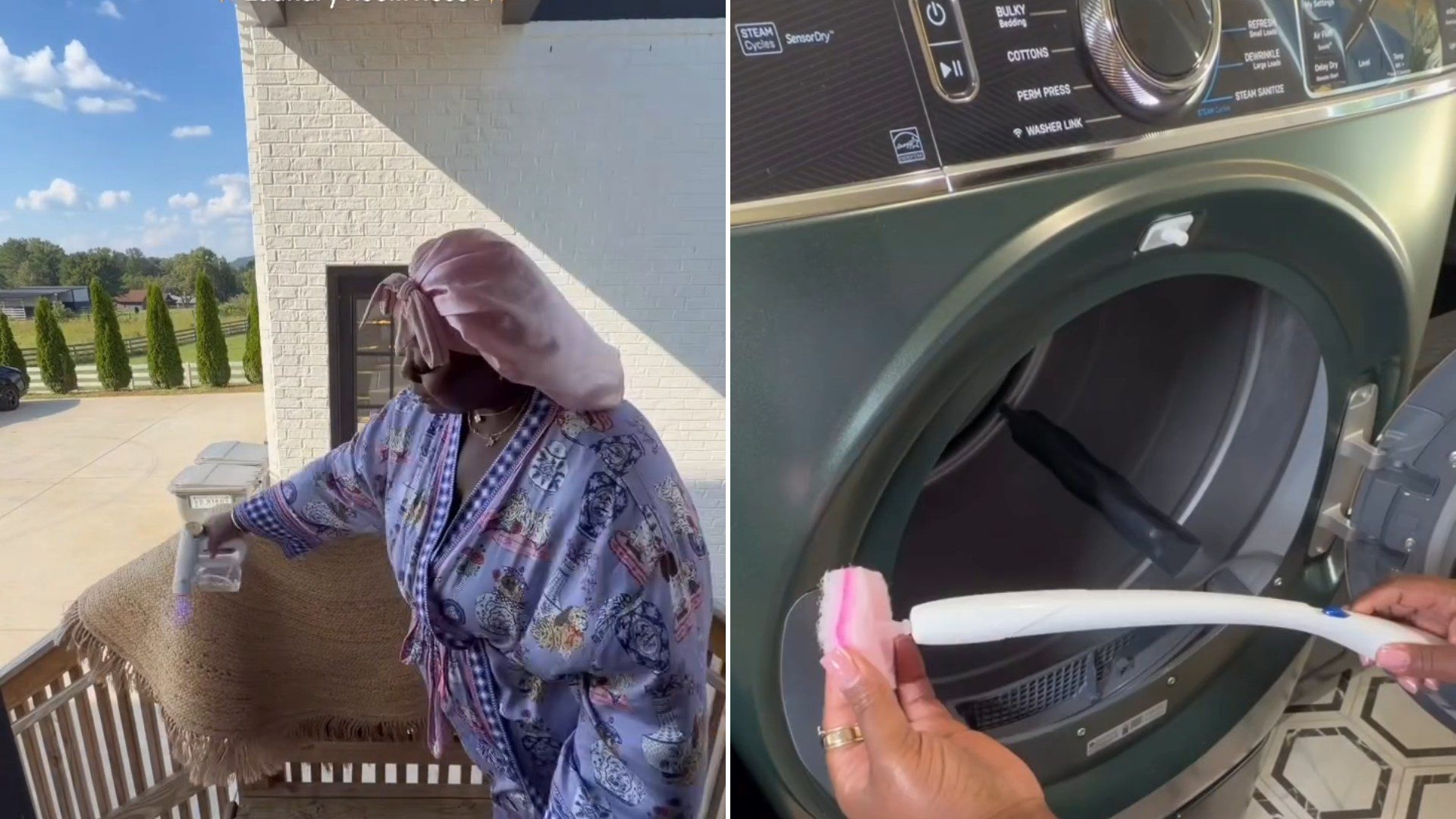
A laundry room deep-clean video posted by a professional home organizer has pulled in millions of views, according to her own Instagram reel, shared on an account with more than 5 million followers. The reel walks through a full teardown of the space: every shelf emptied, every surface wiped, every product sorted, before the room goes back together as a restocked, labeled system. It’s the kind of before-and-after that laundry rooms rarely get, since most households treat the space as a pass-through rather than a room worth a full reset. That’s likely part of why it’s resonating with millions of viewers: the laundry room is one of the most-used, least-maintained rooms in the average house, and seeing one taken all the way back to bare shelves is rare enough on its own to stop the scroll.
The full empty-out comes first. Before any cleaning happens, everything comes off the shelves and out of the cabinets: detergent bottles, dryer sheets, stain removers, spare hangers, whatever has quietly accumulated over months of being tossed in without a system. Seeing the room completely stripped tends to be the part of videos like this that gets the strongest reaction, since it shows how much builds up in a space nobody looks at closely.
Every surface gets wiped down before anything goes back. Lint, detergent residue and dust collect fast in a laundry room, especially around the machines and along shelf edges, and a genuine reset means cleaning those surfaces while they’re bare rather than working around whatever’s already sitting there. Skipping this step is the most common shortcut in a rushed cleanup, and it’s usually why a “cleaned” laundry room still looks dingy within days.
Products get sorted by category, not just returned to their old spots. Instead of putting items back wherever they came from, a reset like this groups similar supplies together, stain treatments in one bin, dryer accessories in another, cleaning rags in a third, so the room functions more like a small utility station than a catch-all shelf. Duplicate bottles tend to surface at this stage too; most households own two or three half-used containers of the same detergent simply because the empty one was buried instead of tossed.
Everything goes back in labeled containers. The restock stage is what makes a reset last. Matching bins and visible labels mean anyone in the house can find what they need and, just as important, put it back in the right spot instead of leaving it on the counter for someone else to deal with. A label also removes the guesswork that leads to clutter creeping back in: without one, a new product tends to just get set wherever there’s open space.
Vertical space usually gets used for the first time. A laundry room’s walls and the backs of cabinet doors are often empty until a reset like this puts them to work, with hooks, slim shelves or over-the-door racks absorbing items that used to sit on counters or floors. That shift alone can free up more usable surface area than any amount of decluttering the existing shelves.
The goal is a system, not just a clean room for one day. A laundry room that’s simply tidied reverts within a week; one that’s been sorted into a labeled system has a real shot at staying that way, because there’s now an obvious place for everything that gets used on a daily basis. Maintaining it going forward takes far less effort than the original reset, since putting something back in a labeled bin takes seconds compared to the hours a full teardown requires.
Small containers do more work than one big bin. A single large tub for “laundry supplies” tends to collapse back into clutter within weeks, since anything can get shoved in without a specific spot. Smaller, labeled containers sized to one category of item force a decision every time something gets put away, which is a big part of why the restocked version of a room like this tends to hold up longer than the original setup ever did.
Videos like this keep performing well because the laundry room sits in an odd spot in most homes: heavily used, rarely photographed, and almost never given the kind of dedicated organizing attention that closets or pantries get. A full reset makes visible what’s usually ignored, and that gap between how often a room is used and how rarely it’s actually maintained is exactly what keeps pulling in views.