


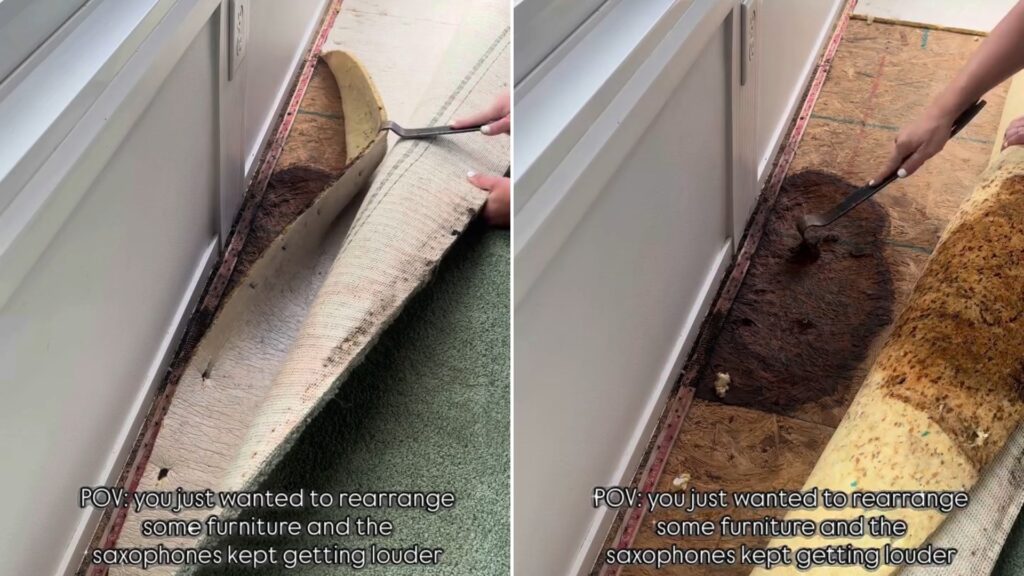
A homeowner pulled up decades-old carpet to start what was supposed to be a simple flooring update and instead found a large structural hole straight through the subfloor, one no prior inspection had ever caught, according to the homeowner’s own Instagram post.
The video shows the moment the carpet and padding came up, revealing the opening in the subfloor beneath. The damage had apparently gone unnoticed for years, hidden under the carpet layered on top of it, and only became visible once the flooring project began.
Key Points
- A large hole was found straight through the subfloor after the homeowner removed old carpet as part of a flooring update.
- The damage had reportedly gone undetected through at least one prior home inspection.
- The homeowner’s video, posted to an account with roughly 4,400 followers, documents the discovery in real time.
- A hole of that size in a subfloor can affect the structural stability of the room above it, depending on its location and the framing underneath.
What Homeowners Should Do
Subfloor damage is one of the easiest structural issues to miss during a standard inspection, since carpet, padding and furniture can all hide it from view. Anyone planning a flooring update in an older home should treat carpet removal as a chance to check the condition of what’s underneath, not just a cosmetic step.
- Have a contractor or structural professional assess a subfloor hole before continuing any renovation work in that area.
- Check for signs of water damage or rot around the edges of the hole, since subfloor failures often start with a moisture problem rather than a single impact.
- Confirm the framing below the subfloor is intact and not compromised before installing new flooring over the repaired area.
- Ask a home inspector directly whether flooring was lifted or only visually checked during a pre-purchase inspection, since a surface-level walkthrough can miss damage like this entirely.
- Avoid laying new flooring directly over an unrepaired hole, even temporarily, since weight from furniture or foot traffic can widen the damage before a proper fix is scheduled.
A standard home inspection generally covers what’s visible and accessible, which means carpeted floors are often checked by walking on them rather than pulling them back. That’s a normal limitation of a routine inspection, not necessarily a missed red flag, but it’s exactly why damage like this can sit undiscovered through a sale and years of ownership afterward.
Flooring projects are often treated as the easiest room-by-room update on a renovation list, which is part of why a find like this catches people off guard. What looks like a weekend carpet swap can turn into a structural repair the moment the old flooring finally comes up, and it’s a reminder that what’s underfoot matters as much as what’s visible.