


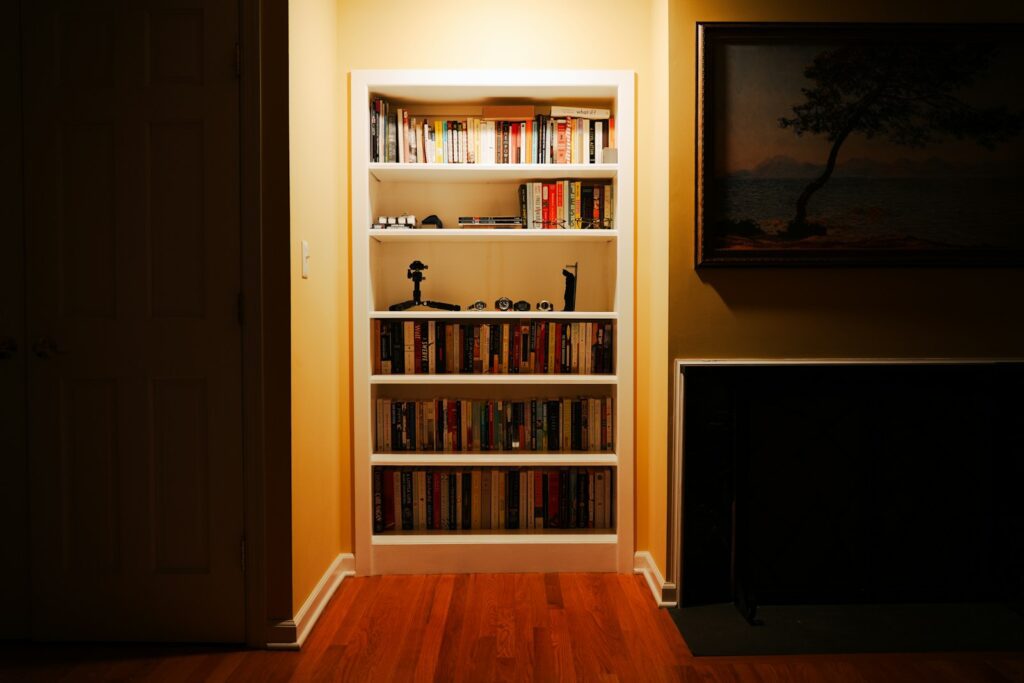
A husband secretly installed a fully working hidden door disguised as a bookshelf as a birthday surprise for his wife, and the reveal video — showing the moment the bookshelf swings open on a hinge she had no idea existed — has now been viewed widely after the company behind the door, Murphy Door, shared the installation on its own TikTok account. According to the company’s TikTok video, which posts to an audience of more than 321,000 followers, the footage doubles as a rare look at exactly how the hidden mechanism functions once the door is finished and loaded with books.
How a Hidden Bookshelf Door Actually Works
A working hidden door like this one isn’t just a bookshelf pushed in front of a doorway — it’s a full door slab, framed and hung on heavy-duty pivot hinges, with a shelving unit built directly onto the face of it. Because the hinge sits off-center rather than along a standard side edge, the entire shelf assembly, books included, swings as one unit when the door is triggered, rather than needing the shelves to be emptied or removed first. The books and shelf hardware add real weight, which is why these units typically rely on reinforced pivot hardware rather than the standard hinges used on an interior door — a standard hinge wouldn’t hold up to swinging that much load open and shut repeatedly.
Most designs also include a soft-close mechanism, since a heavy, book-loaded door swinging freely shut would otherwise slam. Some use a magnetic or mechanical latch to keep the door from being detected as anything other than a normal built-in shelf when it’s closed, which is part of what makes the reveal moment work — there’s no visible seam or hardware to give it away beforehand.

What Installing One Actually Involves
Unlike the slide-out cabinet inserts and small organizational products that dominate a lot of home-hack content, a hidden door is a genuine construction project. It typically replaces an existing doorway or is framed into a new opening, meaning it involves the same rough carpentry, leveling, and hardware installation as hanging any oversized door — just with the added step of building and balancing a shelving unit onto the face of it afterward. Kits in this general product category typically run from under a thousand dollars for a basic bookshelf-style door to several thousand for a larger, custom-finished unit, depending on size, wood species, and whether it’s a DIY kit or a fully built and installed door.
Because the door is load-bearing in a functional sense — it has to support its own weight plus everything stacked on it — precise installation matters more than it would for a purely decorative shelf. A door that’s even slightly out of level can drag, stick, or fail to latch cleanly, which is presumably part of why a company built specifically around this kind of hardware, rather than a general contractor, handled the build shown in the video.
Why the Surprise Format Works So Well for This Product
A hidden door is a hard product to sell through a static photo, since its entire function only becomes obvious in motion. Framing the installation as a birthday surprise for an unsuspecting spouse gives viewers the two things a product demo alone can’t: a genuine, unscripted reaction in the moment the mechanism is revealed, and a clear demonstration that the door still looks and functions like ordinary built-in shelving until it’s triggered. That combination — real surprise plus visible proof the illusion holds up — is a large part of why installation content like this tends to travel further than a standard product tour ever could.
The Appeal Beyond the Novelty
Strip away the surprise-reveal format and what’s left is a fairly practical idea: a way to add a concealed room, closet, or storage space to a home without a visible door interrupting the wall. That’s less a gimmick and more a design solution homeowners have used for legitimate reasons for years — hiding a home office, a pantry, or, as in this case, simply giving a room a doorway that reads as a bookshelf until someone who knows the trick swings it open.