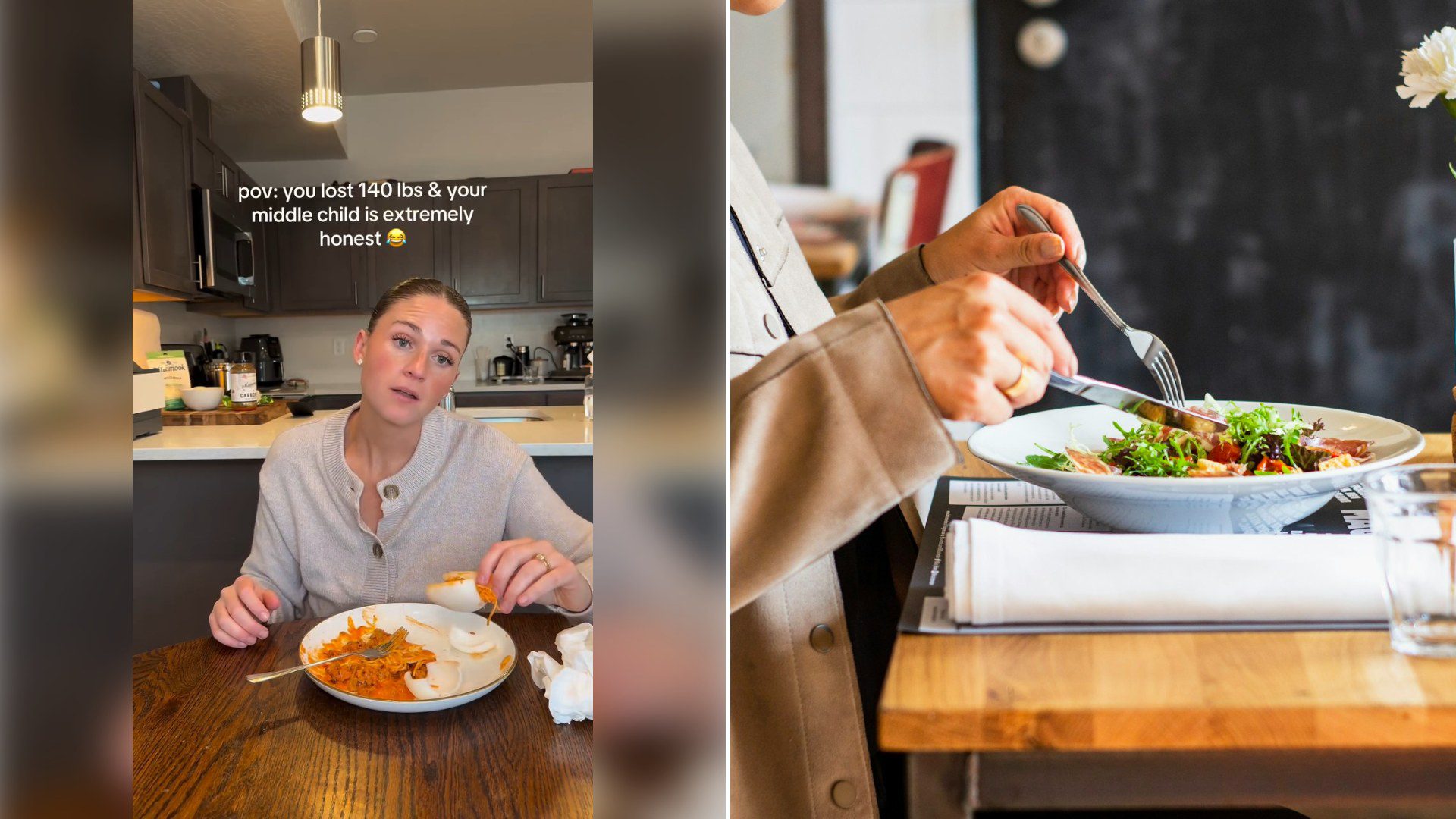
The plate in front of @lara.cage is piled with pasta in an orange sauce, and she is tearing off a piece of bread to dip into it when the conversation takes a turn. The text she placed across the top of the video sets the scene before a word is spoken: “pov: you lost 140 lbs & your middle child is extremely honest,” finished off with a laughing emoji.
She is sitting at a dark wood table in her kitchen with her hair pulled up in a bun, wearing a gray button neck top, a pendant light hanging overhead and a counter lined with small appliances behind her. The captions on screen carry the exchange. “And guess what?” comes first. She looks up from her plate and answers, “What?” Then the verdict arrives in two words: “You’re jiggly.”
Her reaction is the heart of the 16 second clip. She does not gasp, and she does not scold. She keeps the piece of bread in her hand, tilts her head and holds a long, level stare with her mouth closed. No caption appears for several seconds. It is the face of a parent deciding what to say next.
When she does speak, she starts by giving her child the point. “You’re not wrong,” she says, laying one hand flat on the table. A “But” follows, and then her head drops straight forward until only the top of her bun faces the camera. She stays there for a beat.
Then she lifts her head and finishes the thought with a steady look. “Look at me,” she says. “That could really hurt somebody’s feelings.” That is where the video ends, with the pasta still waiting.
She summed up the whole thing in her caption: “Just a jiggly mom trying to lock in to parenting,” followed by a goofy face, a laughing face and a salute. The joke shows she is not carrying the remark around as a wound. The “lock in” part describes exactly what the clip captures, which is a mom catching herself in the gap between an unfiltered comment and a moment that calls for some actual parenting.
The on screen text matters here too. She has lost 140 pounds, by her own account, and her child has had a front row seat to a body that changed a great deal. Kids notice things like that, and a child she describes as “extremely honest” is going to report the findings at the table. Notice the word she picked for her middle child. It is not rude or mean. It is honest. That framing shapes everything about how she answers.
For any parent who has been on the receiving end of a blunt review from a small person, her 16 seconds offer a workable script.
Start with the pause. The stretch of silence after “You’re jiggly” does real work. It keeps a first flash of hurt, or a burst of laughter, from becoming the response a child remembers. A few slow seconds are almost always available, and they are usually enough.
Tell the truth back. “You’re not wrong” is a disarming thing to say to a child who has just described a parent’s body. Kids trust their own eyes. Insisting that what they see is not there teaches them either to doubt themselves or that the subject is shameful. Agreeing plainly shows that a body can be described out loud without the room falling apart.
Then add the “but.” Being honest and being kind are two separate skills, and children usually pick up the first one long before the second. Her correction is not about the child being bad. It is about what words do when they land. She also says “somebody’s” feelings, not “my” feelings. That widens the lesson to the classmate, the grandparent or the stranger in the checkout line who may hear the next observation.
Ask for eye contact first. “Look at me” comes before the lesson, not after it. One sentence delivered face to face tends to stick better than a paragraph called across the kitchen.
Keep it short. Her entire correction is two brief sentences. There is no lecture and no punishment, and the meal goes on. A short, calm correction is easier for a child to take in than a long one, and it makes it more likely the child will keep talking openly at the table.
Save the laughing for later. Whatever happened while her head was down, her child gets a straight face when she looks back up. The joke comes afterward, in a caption written for other adults. A big laugh in the moment can teach a kid that the comment was a hit worth repeating.
Parents who want to go one step further can turn her line into a standing house rule. One simple version is that true things about another person’s body stay private, unless the person can fix it in a few seconds, like spinach in their teeth. That gives an honest child somewhere to put all that honesty.
By her own caption, she is still a jiggly mom, and she is fine with that. What she was not willing to let slide was the chance to teach her very honest middle child that a true thing and a kind thing are not always the same.
More from Decluttering Mom
- Little Girl Tries Not to Hurt Her Mom’s Feelings Over a Batch of Fresh Juice Until Mom Tastes It Herself, Agrees It Is Too Bitter and Doubles Over Laughing
- Little Boy Tells His Mom He Really Wants to Marry Her but Can’t Because She Married Daddy, Says It Makes Him Sad and Decides He Will Meet Someone Else When He Is in College
- The Parenting Tip From Therapy That Changed How She Talks to Her Toddler