


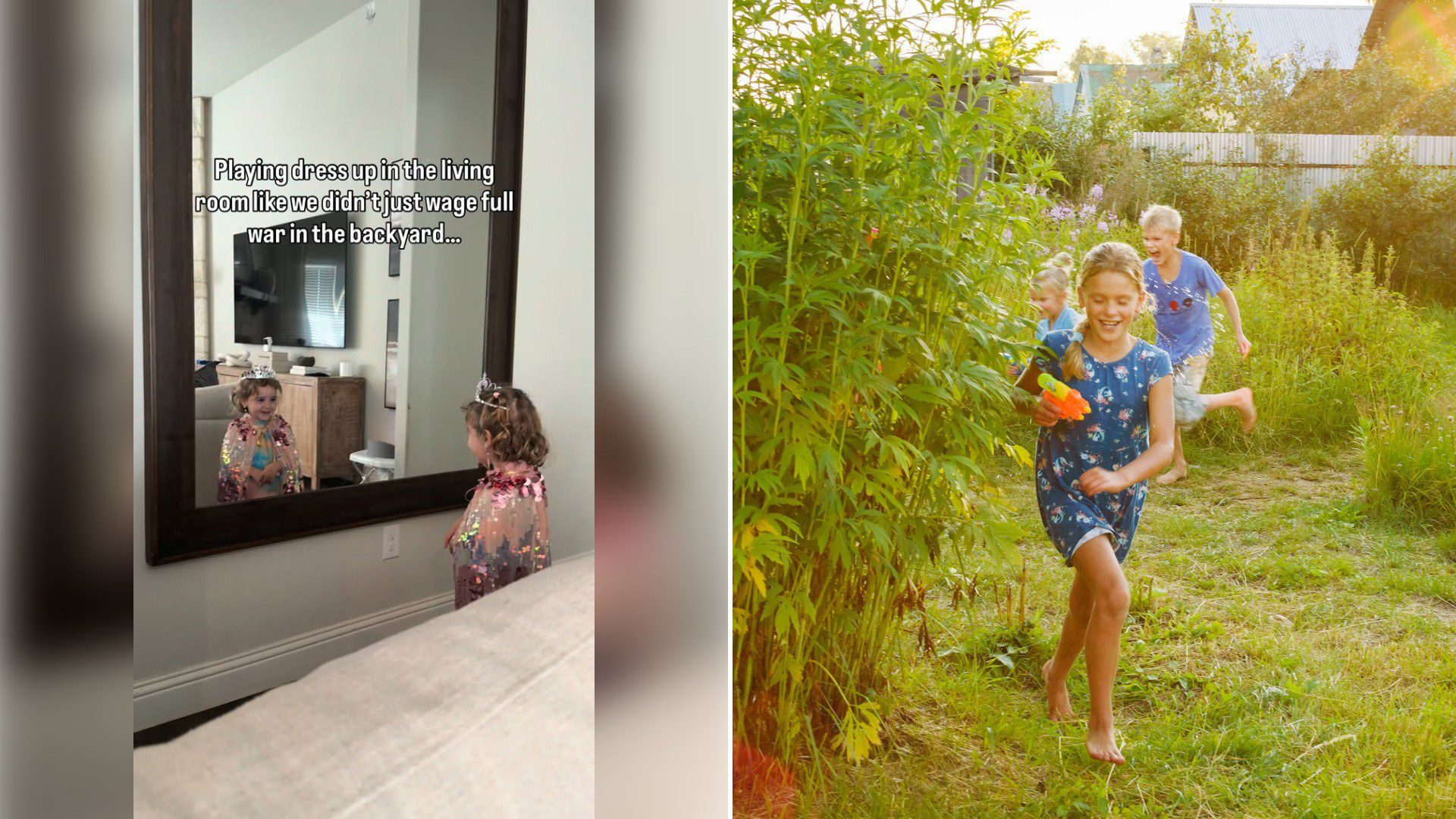
Ten seconds is all the family account itsthedunns needs to show two sides of one little girl. The reel opens indoors, where she stands in front of a big dark-framed mirror in a tiara and a pink sparkly dress, studying her own reflection. The text on screen explains why that is funny: “Playing dress up in the living room like we didn’t just wage full war in the backyard…”
Then the video shows the war. The picture cuts to a wide yard in low, golden sunlight. A boy in a red and white baseball jersey and black shorts crosses close in front of the camera, and out on the grass beyond him is the other half of the story: a small girl in light-colored play clothes, a dark bag hanging at her hip, carrying a large green and orange toy blaster across her chest as she walks the lawn.
The split is lopsided. The mirror scene takes up only the first three seconds or so, filmed from across the room over the back of a pale sofa, with a wall-mounted TV visible in the reflection. The backyard takes the rest. That footage is shot from behind a wooden rail, with a fence line and a row of houses in the distance, and the camera stays on the girl the whole time as she keeps moving with the blaster held up in both hands.
The caption is five words long and entirely approving: “I’m here for it, sister…” followed by a flexed arm, raised hands and sparkles.
The order of events is the detail that makes the clip. The on-screen line says the battle came first. The word “just” puts the backyard before the living room, so the tiara is what she chose to do after the fight was over. And the word “we” matters as well. Whoever wrote that line is counting themselves among the people who went to war.
There is nothing else to the reel. It has one line of text and two scenes, and nobody explains or comments on the switch. The person filming simply noticed that the child at the mirror and the child in the yard were the same child on the same day, and thought it was worth showing both.
For parents, the clip is a good prompt to look at how play is set up at home.
A child who wants a tiara and a blaster in the same afternoon should be able to reach both. If the dress-up clothes live in a bedroom closet and the outdoor toys are locked in the garage, every change of mood needs an adult. A basket of dress-up things in the living room and a bin for blasters by the back door let a child move between the two on her own, the way this girl does.
That bin by the door also solves the less charming side of the switch. A backyard battle followed straight away by dress-up in the living room means grass and dirt heading for the sofa. A simple rule at the door, where blasters go in the bin and shoes come off before anything sparkly goes on, keeps the outdoor game outside without ending the fun.
The caption is a model for what to say, which is very little. “I’m here for it” does not ask her to pick a side, and it does not label her as one kind of girl or another. Children hear those labels and start to edit themselves to fit. Cheering for both versions, in the same breath, leaves the whole range open.
The “we” in the text is the other takeaway. The grown-up who wrote it was in the battle too. Ten minutes in the yard with a blaster in hand buys a parent a lot of goodwill, and it makes the quieter game afterward feel like something shared and not something a child was sent inside to do.
The boy who walks through the frame is a reminder that this kind of play mixes ages and interests easily. A backyard game with simple rules and enough blasters to go around gives siblings, cousins or neighbors something to do together, and nobody has to agree on what they will play afterward.
It is also worth filming both halves. The mirror shot on its own is a sweet picture, and the yard on its own is a kid with a toy. Put side by side, they say something true about her that neither says alone, and that is the version a family will want to have later.