


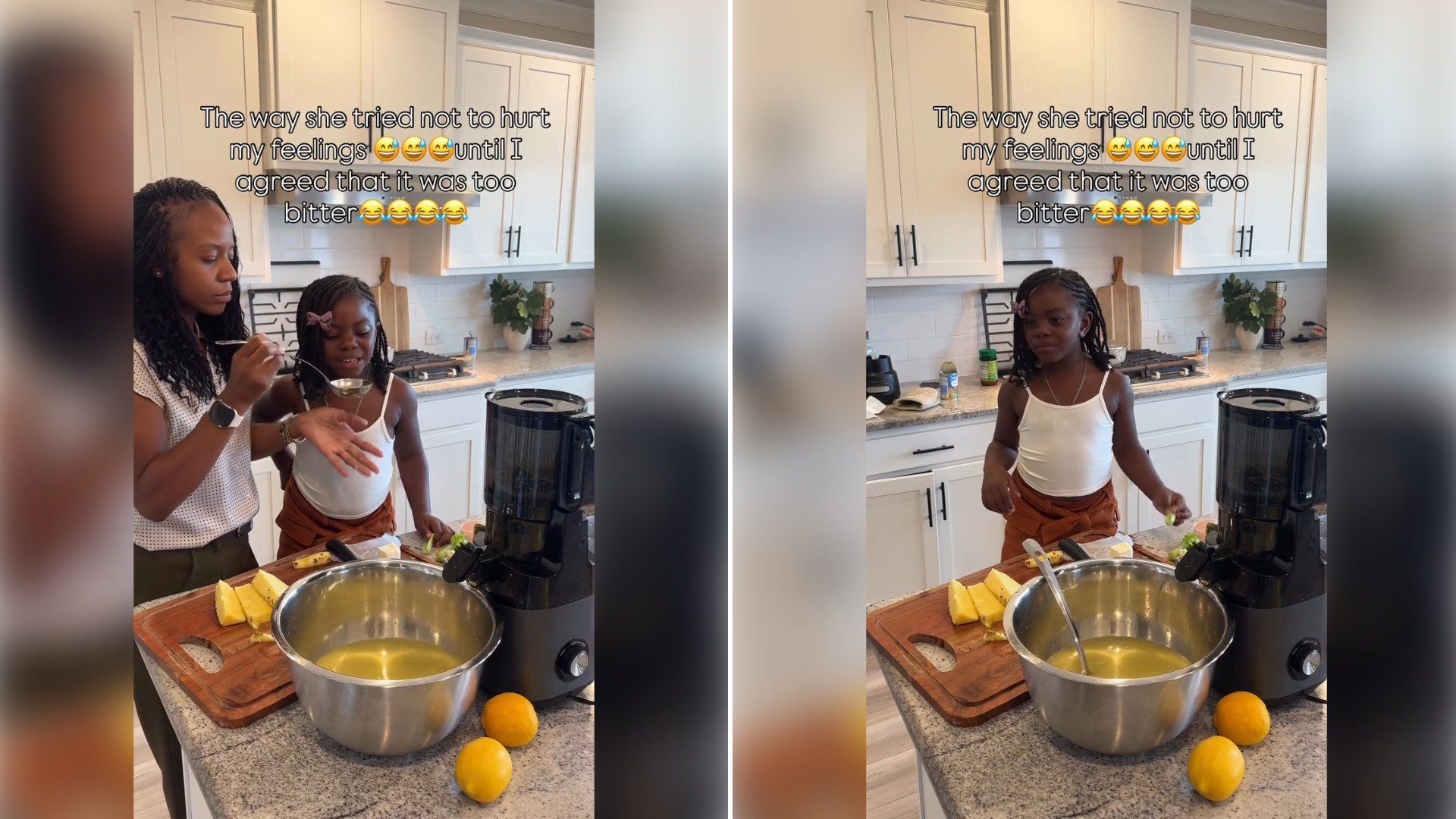
A creator posting under the handle imnotperfect_yet tried a homemade juice concoction her young daughter proudly mixed together — and captured, in real time, the little girl’s visible struggle not to hurt her mom’s feelings when it turned out to taste pretty bitter.
The caption notes that kids “usually tell the truth off rip,” which makes this moment stand out as an exception. Rather than immediately declaring it gross, the way most toddlers would without hesitation, she visibly hesitates, clearly working through whether to be honest or kind, before eventually admitting it was too bitter after all.
It’s a small, sweet glimpse of tact developing in real time — a skill most kids don’t have much of yet, and one that usually shows up first in exactly this kind of low-stakes, high-feeling situation. Learning to soften an honest reaction to protect someone’s feelings is a genuinely advanced social skill, and watching a kid attempt it, even clumsily, is oddly touching.
For a mom on the receiving end, the moment doubles as a small parenting win either way: proof that her daughter is proud enough of her own creation to want to defend it, and thoughtful enough to consider how the truth might land before she says it out loud.
Anyone who has ever choked down a child’s “special recipe” knows the drill: a cup of something suspicious, usually involving water, a squeezed fruit or two, and whatever seasoning happened to be within reach, presented with the pride of a Michelin-starred chef unveiling a signature dish. The taste rarely matters as much as the ceremony surrounding it, which is exactly why this small moment of hesitation carries so much weight — she wasn’t just protecting her mom’s feelings, she was protecting the whole production behind the drink.
Toddlers and young kids are famously, almost aggressively honest by default. Ask one whether a haircut looks good, whether dinner tastes fine, or whether a new outfit is cute, and the answer usually arrives instantly and without any diplomatic softening whatsoever. That bluntness is often treated as one of the charming hallmarks of early childhood, the thing adults miss once kids get old enough to start managing what they say out loud. Catching a kid in the earliest stages of losing that bluntness, replacing it with something closer to tact, is a small but genuine developmental milestone.
Psychologists who study social development point to roughly this age range as when kids start developing what’s sometimes called “white lie” competence — the ability to recognize that a technically false or softened statement might serve a kinder purpose than blunt honesty. It’s a surprisingly sophisticated cognitive task, requiring a child to track her own true reaction, guess at how a truthful answer might land on someone else, and then choose her words accordingly, all in the span of a few seconds while a spoonful of bitter juice is still sitting on her tongue.
It helps, too, that the stakes here are about as low as they get. Nobody is genuinely hurt if this particular juice recipe doesn’t become a household staple. That low-pressure setting is exactly the kind of place where kids tend to practice bigger social skills for the first time, working out the mechanics of kindness on something as small as a drink before they’ll ever need to apply the same instinct to something that actually matters.
There’s also something worth noting about how the mom handled her end of it. Rather than pushing for an immediate verdict or laughing off the hesitation, she let the moment play out naturally, giving her daughter the space to work through the decision at her own pace. That patience is arguably just as important to the clip as the daughter’s tact — a reminder that kids need room to practice these skills without being rushed through them.
By the time the admission finally comes, bitter and all, it lands less like criticism and more like an act of care, hard-won over several seconds of visible internal debate. That’s a lot of emotional nuance packed into a few seconds of home video, and it’s exactly the kind of small, unscripted moment that tends to stick with viewers long after flashier content has been forgotten.
It’s worth pointing out, too, how much this small scene depends on trust that’s already been built between the two of them. A child only hesitates to hurt someone’s feelings if she already cares about how that person feels — which means this moment, funny as it is, is really a byproduct of a secure, affectionate relationship, one where a kid has learned that her words can land softly or sharply and has started choosing accordingly.
Parents watching probably recognize a second layer to this too: the specific vulnerability of offering up something homemade for judgment, even something as small as juice mixed by a toddler. Adults feel that same flicker of nervousness handing over a dish they cooked or a project they made, waiting to see whether the reaction will be genuine enthusiasm or polite tolerance. Watching a child navigate that exact same social tightrope, at such a young age, over something so small, is oddly disarming.
It’s also a nice reminder that not every parenting clip worth sharing needs a dramatic hook or a tidy lesson. Sometimes the most interesting thing happening in a video is simply a few seconds of a kid’s face doing all the emotional work, torn between two instincts that most adults take years to balance gracefully. Catching that internal tug-of-war on camera, unscripted and unprompted, is its own quiet kind of reward for anyone who happened to be filming at the right moment.
Whether or not that particular juice blend ever gets made again in this household, the moment itself is the kind of thing worth holding onto — proof of a kid learning, in real time, that honesty and kindness don’t always have to be in competition with each other.