

Most of us have a closet that is packed so tightly we can barely slide a hanger along the rod. Minimalist @kristinecrouch has the opposite problem, and she loves it. She says she went from hundreds of clothing items to just 84, and her closet now has an echo because an entire section is empty.

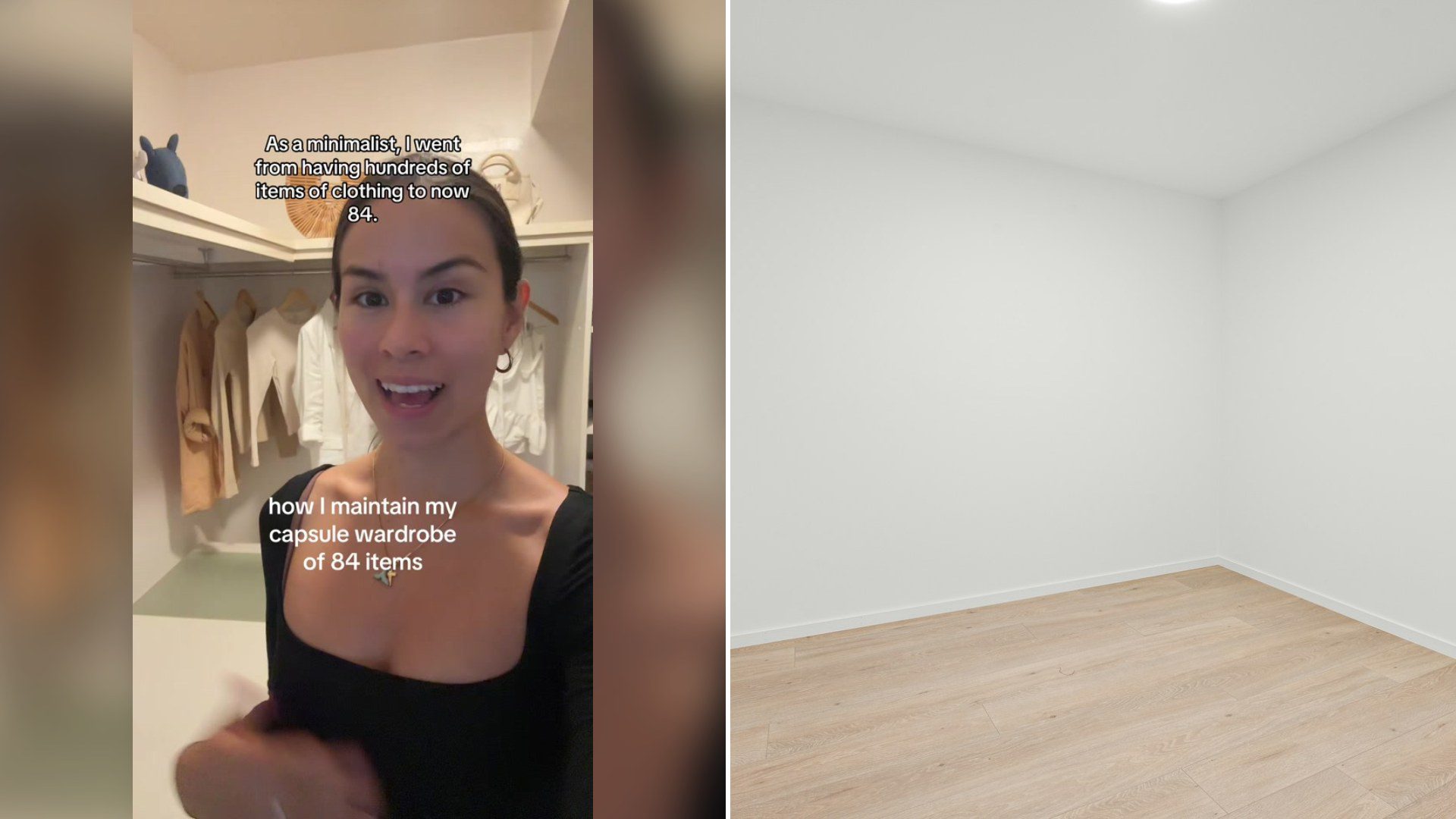
She walks through her closet and explains how she keeps her wardrobe at that number, why she finds it freeing and the habits that help her stay there. Take a look.
@kristinecrouch
From Hundreds of Items to 84
She explains that, as a minimalist, she went from having hundreds of items of clothing to the number she has now. At one point she had about 88, and the number has gone up and down over time. Today she is at 84.
The closet itself tells the story. There is an echo, she says, because an entire section is empty. Practicing minimalism has made her more comfortable with space, including space between the hangers and space in the closet. She says she has no plan to fill the empty section with more clothing.
Fewer Choices, Easier Mornings
One of the biggest benefits she describes is how much easier it is to get dressed. With fewer choices there is less decision fatigue. Because she sticks to a similar color palette, pieces mix and match seamlessly and effortlessly.
She acknowledges that some people find that boring. She says she loves it. For her, the closet is not a source of stress but a source of calm. Whenever she walks in, she feels serenity and peace, and she looks at the space almost like a piece of art.
It Is Not About the Number
It might sound like the point of her closet is the number 84, but she is clear that minimalism is not so much about the number to her. She does like to keep track of everything she owns, and she has found that having a cap helps. The count works as a gentle limit that encourages her to keep editing her wardrobe and the other things in her life.
Tracking what she owns also helps her audit what she is actually using. She wants to make sure no clothing sits in the back, untouched. If she notices she is not reaching for a certain piece as much as others, it prompts a question: is this worth keeping, or has it run its course? If it has, it is time to give it away, sell it or donate it.
Her Rule: Love It or Fix It
She says that, for her, everything is a favorite. That essentially means she loves everything she wears. She does not keep clothing that makes her think, “I wish this was a little more like this,” or “I like this part of the outfit but not that part.” If she is not willing to change or fix such a piece, it has to go.
That is a useful test for any closet. Think of the blouse that never quite fits right at the shoulders, or the pants that need hemming and have been waiting for two years. If you are not going to take it to the tailor, it is not really part of your wardrobe.
Ideas You Can Borrow Without Going Fully Minimalist
You do not need to own exactly 84 items, or any particular number, to enjoy a calmer closet. Here are some ideas inspired by her approach that you can adapt to your own life and budget.
Keep a rough count
Even if you never write down a number, a quick tally of what hangs in your closet and sits in your drawers can be eye opening. A simple limit, whatever you pick, helps you notice when you are about to buy something new that does not fit.
Choose a color family you love
When most of your clothes work together, you can build many outfits from fewer pieces. Neutrals with a couple of favorite accent colors are a classic choice, but the right palette is the one that makes you feel like yourself.
Audit with the hanger trick
Turn all your hangers backward. When you wear something, hang it back the right way. After a season, anything still facing backward has not been worn and is a candidate to donate or sell. It is a simple, low effort way to do the same kind of audit she describes.
Fix, tailor or release
Make a small pile of items that need repair. Set a date, and take the pile to a tailor or do the mending yourself. Anything not fixed by that date goes in the donation bag.
Let some space stay empty
An empty section of a closet does not need to be filled. As she says, space between hangers is something she has grown comfortable with. Extra room makes it easier to see what you own and to put things away without a fight.
Where Do the Extra Clothes Go?
She mentions giving clothes away, selling them or donating them, and each has its place. Good condition pieces may be worth listing online or taking to a consignment shop. Pieces with some wear can go to a donation center or a local charity. Items that are worn out beyond use can be recycled as rags or through a textile recycling program if one is available near you.
The Takeaway
Her closet is a good reminder that a wardrobe works best when you love what is in it. You do not have to copy her number. You only have to ask whether each piece earns its place. Take thirty minutes this week to go through one rod or one drawer, keep what you truly love and see how much lighter getting dressed becomes.