


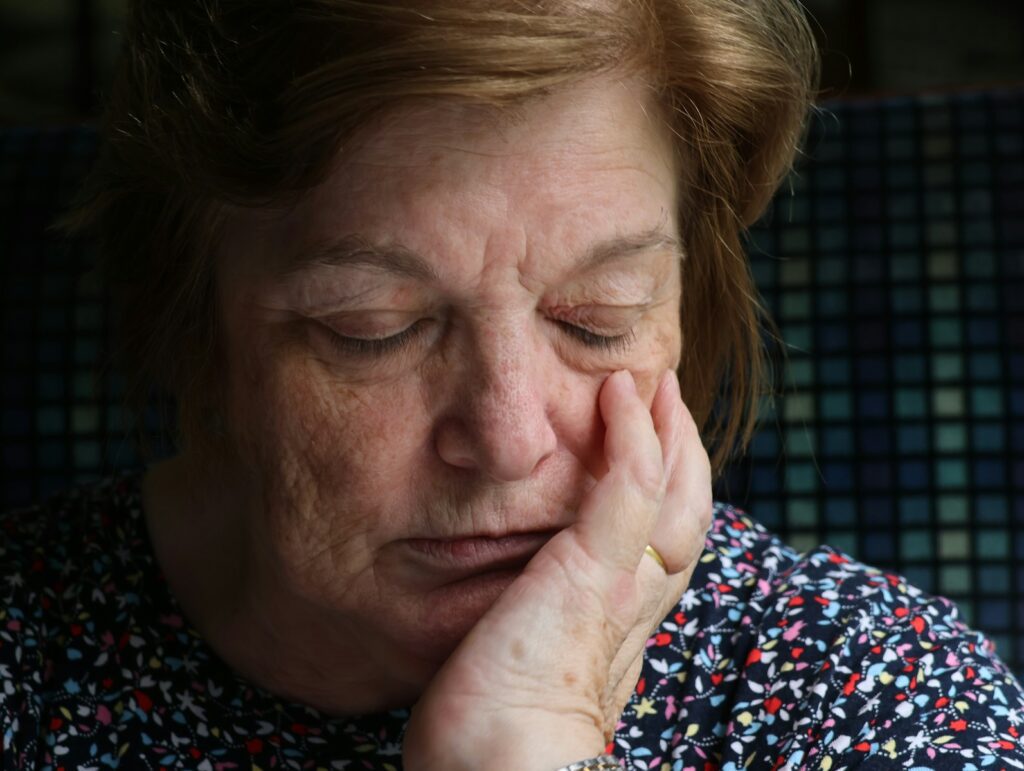
The situation is specific, but the pattern is not. Researchers at Cornell University estimate that about 27% of American adults are estranged from a close family member, and that the rupture most often surfaces — or worsens — when an aging parent or grandparent needs care. The collision between unresolved family wounds and the daily demands of dementia caregiving is one of the least discussed and most destructive dynamics in elder care.
Why dementia turns family conflict into a medical problem


Dementia does not just erode memory. It can lock a person into a single distressing thought and make it nearly impossible for them to let go. Clinicians call this perseveration, and the Alzheimer’s Association notes that anxiety and agitation affect up to 70% of people with dementia at some point during the disease. When the distressing thought involves family conflict, reassurance from one relative rarely works, because the person may forget the reassurance minutes later while the anxiety remains.
A related condition called anosognosia — the inability to recognize one’s own cognitive decline — can make the situation harder to manage. A grandmother who does not understand that her brain is misfiring may genuinely believe that if her grandsons would just visit and act normal, the dread would stop. She is not being manipulative. She is working with the only explanation her damaged brain can construct.
For the caregiver in the room, this creates a grinding emotional load. A National Alliance for Caregiving report found that family caregivers of people with dementia report significantly higher rates of depression, anxiety, and physical health problems than caregivers of people with other conditions. When that caregiver is also managing sibling conflict, the stress compounds.
Why “just three days” felt like a grenade, not a favor
To the mother in this family, asking her sons to visit their grandmother and pretend things were fine sounded like a small, practical request. To the brothers, it sounded like something else entirely: a demand to perform closeness they had deliberately walked away from, in a setting where any slip would be visible to a vulnerable person they still loved.
Research on family estrangement suggests their reaction, while painful for everyone, is not unusual. Karl Pillemer, a sociologist at Cornell and author of Fault Lines: Fractured Families and How to Mend Them, has found that estrangement is almost never a snap decision. Most people who cut off a family member describe a long accumulation of boundary violations, and many report that even brief contact can trigger weeks of anxiety, insomnia, or depression. Pillemer’s work also shows that pressure from other relatives to reconcile — especially guilt-based pressure tied to a sick family member — tends to deepen the rift rather than close it.
That does not mean the brothers’ refusal is cost-free. The grandmother’s distress is real and medically significant. Chronic anxiety in dementia patients is associated with faster cognitive decline, according to a 2018 study published in the American Journal of Geriatric Psychiatry. The mother is not wrong that something needs to change. She may just be wrong about what that something is.
Calming the panic without forcing a reunion
Geriatric care specialists generally advise against trying to correct a dementia patient’s fixed beliefs head-on. Instead, they recommend strategies that lower distress in the moment without requiring the rest of the family to stage a performance.
The Alzheimer’s Association’s caregiver guidance emphasizes several approaches:
- Validate the emotion, not the narrative. Instead of explaining that the boys are estranged for good reasons, a caregiver can say, “I can see you’re worried about the boys. That sounds really hard. Let’s have some tea and look at these photos of the garden.”
- Redirect gently. Engaging the person in a sensory activity — music, a familiar snack, a short walk — can interrupt the anxiety loop more effectively than any argument.
- Keep the environment calm. Lowering noise, maintaining routines, and speaking slowly all reduce baseline agitation, which makes fixation episodes less frequent and less intense.
- Consult the care team. When panic attacks are frequent and severe, a geriatric psychiatrist can evaluate whether medication or a structured behavioral plan is appropriate. This is a medical symptom, not just a family problem.
For the mother caught in the middle, there may also be value in working with a family therapist who specializes in aging and estrangement — not to force reconciliation, but to help each person define what they can and cannot offer. Pillemer’s research found that families who used a neutral third party were more likely to reach a sustainable arrangement, even if that arrangement fell short of full contact.
The person in the middle pays the highest price
What often gets lost in these disputes is the toll on the person doing the actual caregiving. In most American families, that person is a woman — a daughter or granddaughter — and she is statistically likely to be managing the elder’s medical appointments, medications, and emotional crises while also fielding anger from siblings who are not present. A 2020 AARP caregiving report found that 61% of family caregivers are women, and that female caregivers spend 50% more time on caregiving tasks than male caregivers.
When the brothers in this family went silent on their mother for making the request, they added another layer of isolation to someone who was already stretched thin. Whether or not the request was wise, the silence is its own kind of harm — and it is the grandmother’s primary caregiver who absorbs it.
There is no clean resolution here. The grandmother’s fear is real but rooted in a brain that can no longer process reassurance. The brothers’ boundaries are real but come at a cost to people they did not intend to hurt. And the mother in the middle is left holding all of it, which is the most common and least acknowledged outcome in families dealing with dementia and estrangement at the same time.
If there is a way forward, it probably starts with smaller, less loaded gestures — a short video call rather than a three-day visit, a card rather than a confrontation — and with the understanding that managing a dementia patient’s anxiety is a clinical task, not a family loyalty test.
More from Decluttering Mom: