


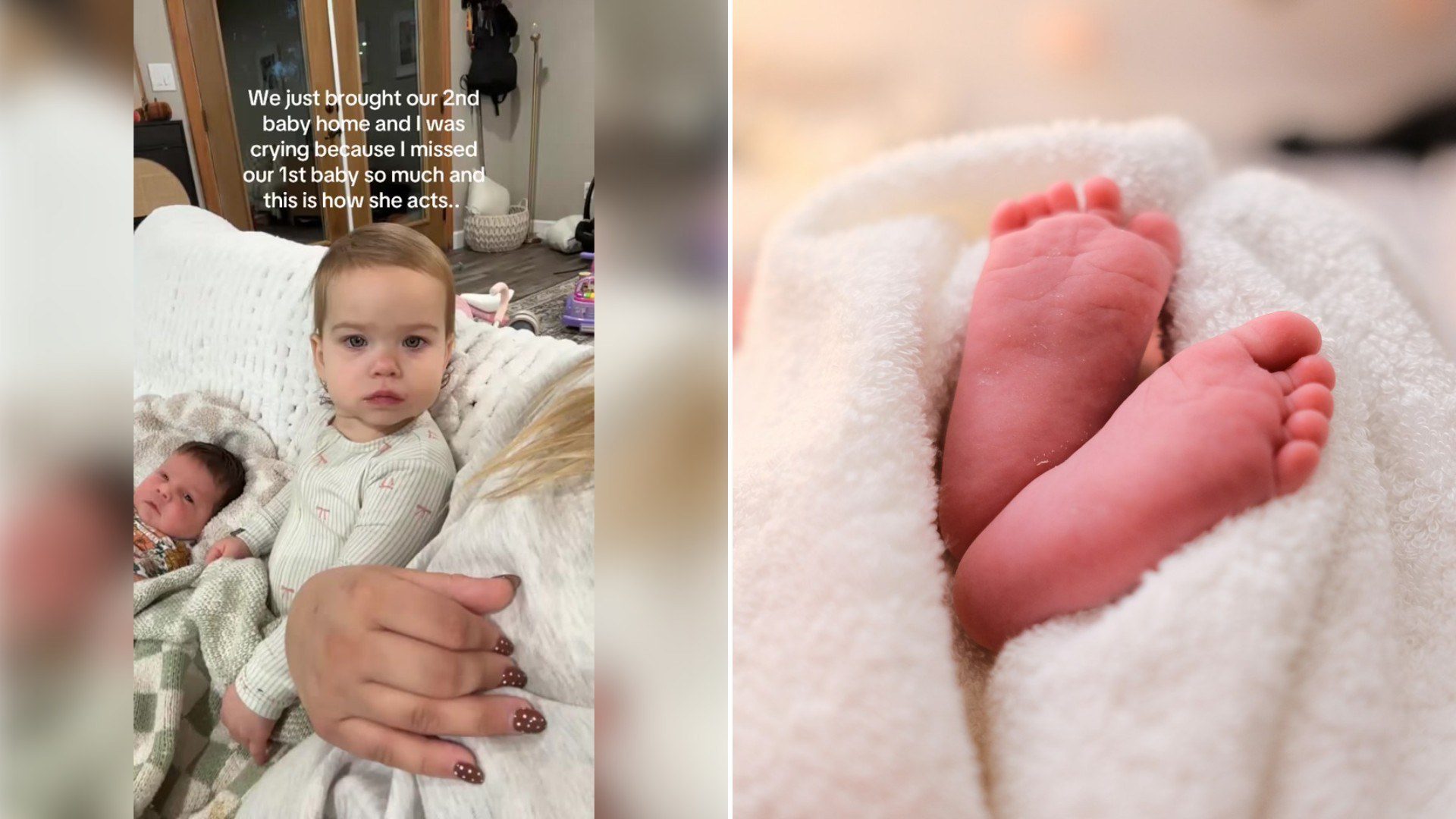
A creator posting under the handle katyawalt recorded herself genuinely crying over how much she missed how things were before bringing her newborn home — and then captured her toddler’s completely unbothered, side-eyeing reaction sitting right next to the baby, unmoved by any of it.
@katyawalt Do not let her catch you recording yourself crying 😭 #fyp #2under2 #toddlersoftiktok
The contrast is the entire video: real, raw emotion on one side, total toddler indifference on the other. Nothing about the footage is staged — it’s an honest, unscripted reaction captured in the middle of an actual hard moment during the early days with two kids.
Missing life before a new baby doesn’t mean not wanting the baby; it’s a specific, common kind of grief for a version of family life that’s gone for good, even while adjusting to a version that’s arguably better in other ways. It’s a feeling a lot of parents carry quietly, in part because it can feel complicated or even guilty to say out loud.
What makes this particular video land is that the toddler’s deadpan response does more to normalize the moment than any caption could — life, and the toddler sitting right there, moves on regardless of how the adult in the room is feeling, and somehow that’s oddly comforting too.
There’s a particular kind of courage in recording a moment like this at all, rather than waiting until the feeling passes and only sharing a tidier, after-the-fact version of it. Most parents experience some version of grief for their old life after a second child arrives — quieter mornings, more one-on-one time, the simple ease of managing a single kid’s needs instead of two competing sets of them — but very few actually film themselves crying about it in real time and choose to let other people see it. That willingness to show the unfiltered middle of a hard feeling, rather than just the resolved aftermath, is part of what makes the clip resonate so widely.
The specific grief being described here is easy to misread from the outside as regret about the baby itself, when it’s really something more nuanced: mourning a version of family life that necessarily ends the moment a second child arrives, while simultaneously loving the new child completely. Both things can be true at once without contradiction — missing the old rhythm and wanting the new baby are not competing feelings, even though they can feel confusing to hold simultaneously in the middle of an exhausted, hormonal postpartum stretch.
Toddlers, for their part, have an almost comedic gift for staying completely unmoved by adult emotional turmoil happening right next to them. A toddler sitting beside a crying parent isn’t being cold or unkind; she simply hasn’t yet developed the social calibration to recognize that a big reaction is expected of her in this moment, and so she doesn’t perform one. That absence of performance is exactly what makes her reaction so funny against the backdrop of a genuinely emotional scene — she’s not comforting, not concerned, just there, existing in whatever her own small world happens to be focused on at that second.
There’s something almost therapeutic about that toddler indifference, even though it’s clearly not intended as comfort. A parent deep in a hard emotional moment can sometimes find more relief in a total lack of dramatic response than in an outpouring of concern, since the absence of a big reaction implicitly signals that everything is, in fact, fine — the world keeps turning, the toddler keeps being a toddler, and the crying parent is left to work through the feeling without anyone treating it as an emergency.
What makes content like this valuable beyond its comedic value is the quiet permission it gives other parents to admit they feel the exact same way. The adjustment period after a second child is famously under-discussed compared to the adjustment after a first, in part because a parent going through it a second time is assumed to already know what they’re doing. Watching someone else openly grieve the life that existed before a sibling arrived, without any shame attached to the admission, offers a kind of validation that’s hard to come by elsewhere.
By the end of the clip, nothing about the situation has actually changed — the baby is still new, the toddler is still unbothered, and the feeling being cried about hasn’t resolved itself in any tidy way. But that lack of resolution is honest in a way a neater ending wouldn’t be: these feelings don’t wrap up in the length of a single video, they just exist alongside everything else a parent is juggling, slowly softening over time as the new normal eventually starts to feel like the only normal there ever was.
There’s also value in noticing how much of this adjustment period plays out in isolation, precisely because it’s the kind of feeling that doesn’t translate well into a quick check-in with a friend or family member. “I love my new baby, and I also miss my old life” is a hard sentence to say out loud without immediately qualifying it, worried it might sound ungrateful. Seeing someone else say it plainly, without hedging, tends to do more to normalize that particular tangle of feelings than any amount of well-meaning reassurance from people who haven’t recently lived through the same transition themselves.