


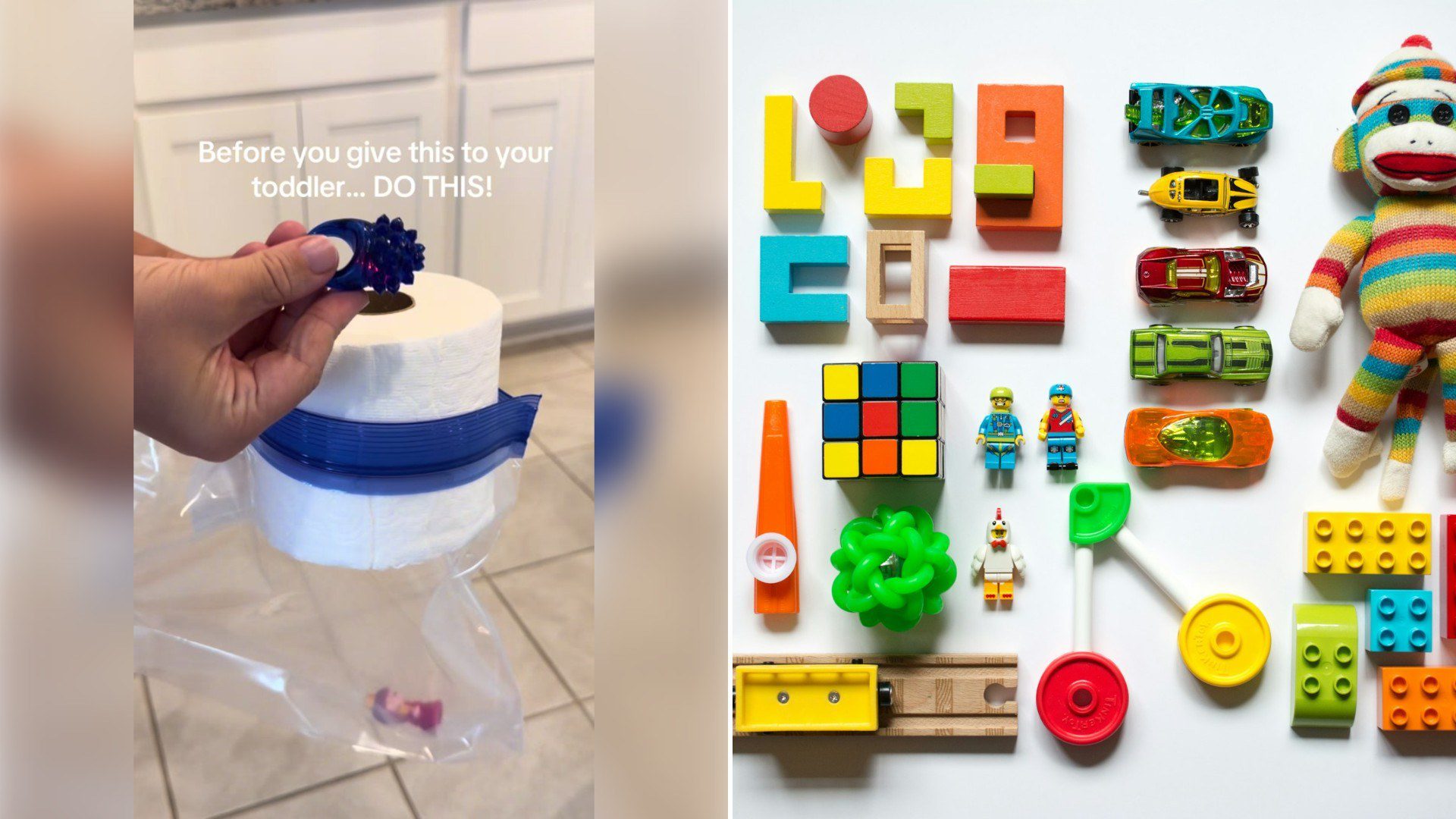
A creator posting under the handle milania_mi_mi demonstrated her own version of a choking-hazard safety check, using a ziploc bag with a toilet paper roll stuck in the opening to quickly test whether a small toy piece is small enough to pose a real risk to a toddler.
@milania_mi_mi Before giving your little one a new toy, check the small parts! 👀 If a small piece can fit completely inside a toilet paper roll, treat it as a potential choking hazard for young children. 🚨 Such a simple check that every parent should know! ❤️ SAVE this for later and share it with another parent! #kidssafety #safetyhacks #safety #parenthack #momtip
♫ The Safety Dance – Extended Dance Version – Men Without Hats
Shown with her own hands and her own toy collection, the test is fast and requires nothing most households don’t already have on hand. If a piece slides through the roll, it gets set aside; if it doesn’t, it’s considered safe from that particular risk. It’s a personal safety habit rather than anything sponsored or product-driven.
The toilet-paper-roll test has circulated in different forms for years among parents and pediatric safety resources, largely because it’s cheap, fast, and reasonably close to a toddler’s airway diameter, making it a useful rough screen even though it isn’t a substitute for reading actual age recommendations on toy packaging.
For parents with toy bins that mix age ranges — hand-me-downs, older sibling toys, party favors — running a quick pass like this one periodically is a low-effort way to catch something that might otherwise slip past a quick visual check.
Choking remains one of the more persistent, low-visibility dangers of early childhood, precisely because it doesn’t announce itself the way other hazards do. A sharp corner or an unsecured piece of furniture is visibly risky; a small toy piece that happens to be exactly the wrong size looks completely ordinary sitting in a toy bin, indistinguishable from a hundred other harmless pieces around it. That invisibility is exactly why a quick, repeatable physical test matters so much more than trying to eyeball every item and guess at its risk.
The toilet-paper-roll standard works as well as it does because it approximates something genuinely useful: the rough diameter of a young child’s throat, which is roughly what the U.S. Consumer Product Safety Commission’s own small-parts testing cylinder is designed to mimic in a more formal, regulated way. A household version using a cardboard tube isn’t a certified safety tool, but it’s a remarkably close, free stand-in that most parents can put to use immediately, with items already lying around the house, rather than needing to order a specialized testing cylinder and wait for it to arrive.
What makes this kind of safety check especially relevant is how often small parts enter a household through channels that bypass the usual age-labeling safeguards entirely. A toy bought new, with a label clearly printed on the box, has already been vetted by a manufacturer against relevant age guidelines. A toy passed down from an older cousin, picked up secondhand at a yard sale, or handed out as a party favor rarely comes with any label at all, which means a parent is often working with zero information about whether a given piece was ever designed with a younger sibling’s safety in mind.
Multi-kid households face a particularly tricky version of this problem, since toys designed for an eight-year-old often contain pieces that would be genuinely dangerous for a toddler sibling crawling around the same living room. Keeping every small-parts toy perfectly separated by age isn’t realistic in most homes with kids spanning several years apart, which makes an occasional sweep — checking whatever’s ended up within a toddler’s reach against a simple physical test — a much more practical approach than trying to police every toy boundary perfectly at all times.
There’s also real value in how quickly this test can be repeated, since a household’s toy inventory is rarely static. New toys arrive from birthdays, from grandparents, from the bottom of a goodie bag after a classmate’s party, and each new arrival is one more item that hasn’t yet been screened against the rest of the collection. A test this fast and low-effort is realistic to repeat regularly, in a way that a more elaborate safety audit simply wouldn’t be for most busy households.
It’s worth being clear-eyed about what a test like this can and can’t tell a parent. Passing the toilet-paper-roll check means a piece is unlikely to become fully lodged in a toddler’s airway based on size alone; it says nothing about other risks like sharp edges, button batteries, magnets, or small parts that detach from a larger toy unexpectedly. Treating this test as one layer of a broader safety habit, rather than a complete solution on its own, is the more accurate way to think about what it actually accomplishes.
For parents who haven’t run this kind of check before, the appeal of a video like this one is how immediately actionable it is. There’s no product to buy, no elaborate system to set up — just a cardboard tube that’s probably already sitting in a bathroom trash bin, ready to be put to use in the next five minutes on whatever toy happens to be within reach. Few safety practices offer that combination of genuine usefulness and near-zero barrier to actually doing it.
By the end of the clip, the message is simple and easy to carry forward: when in doubt about a small toy piece, grab the nearest toilet paper roll before handing it over to a toddler. It’s the kind of small, habitual precaution that costs nothing and takes seconds, which is exactly the profile of a safety practice that’s realistic enough for a tired parent to actually keep doing, week after week, rather than abandoning after the first busy afternoon.