


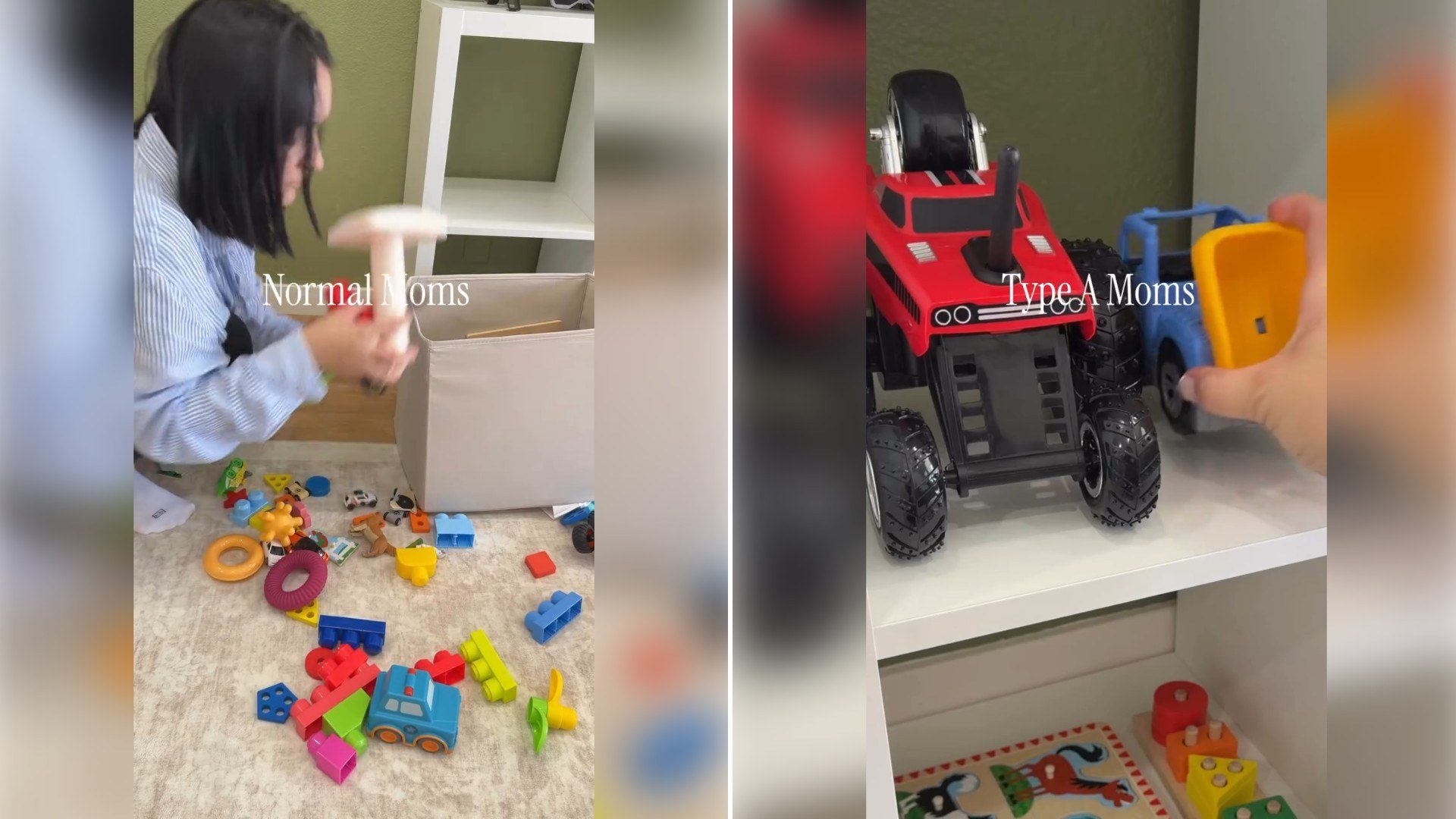
A creator posting under the handle by.alenaugc demonstrated two contrasting cleanup styles side by side, playing both roles herself: a fast, toss-everything-in-a-bin approach labeled “Normal Moms,” followed by a slower, far more meticulous, fully categorized approach labeled “Type A Moms.”
Because the same creator performs both styles herself, the comparison lands as a genuine behavioral observation rather than a scripted, multi-character skit — less “here are two types of people” and more “here are two modes I personally switch between depending on the day.”
Most parents will recognize themselves somewhere on that spectrum, and plenty will admit to using both approaches depending on energy levels, time constraints, or simply how the rest of the day is going. Neither style is presented as objectively better, just as two real, relatable defaults.
What makes the comparison entertaining is the specificity of each caricature — not just “fast” versus “slow,” but recognizable habits, like the categorizer sorting by size, color, or type, that a lot of naturally organized parents will see themselves in a little too clearly.
There’s something almost anthropological about watching one person perform both ends of a spectrum back to back, since it removes the usual excuse of “well, that’s just how she is” that comes with comparing two different people. When the same creator plays the bin-tosser and the categorizer in the same clip, it makes an implicit case that these aren’t fixed personality types at all, just two different settings a parent can toggle between depending on the day, the energy level, and how much patience is left in the tank by the time cleanup rolls around.
The “Normal Moms” approach, tossing everything into a bin with maximum speed and minimum sorting, gets an unfairly bad reputation in a lot of organizing content, as though efficiency and thoroughness always exist as a trade-off with tidiness. In practice, the bin-toss method is often the exact right call at the end of a long day, when the actual goal isn’t a beautifully sorted playroom but simply a floor that’s safe to walk across and a couch that’s clear enough to collapse onto. Not every cleanup needs to be a project.
The “Type A Moms” approach, on the other end, sorting by size, color, or type, tends to get coded as slightly obsessive in comparisons like this one, but there’s a real functional payoff hiding underneath the caricature. A fully categorized toy system means a kid can actually find the specific toy they’re looking for without dumping out three other bins first, and it means a parent doesn’t have to referee the daily archaeology dig that an undivided toy pile eventually turns into.
What makes this particular format land so well is that it doesn’t actually pick a winner. A lesser version of this content might frame one approach as correct and the other as a cautionary tale, but presenting both as valid, interchangeable defaults is closer to how most parents actually operate day to day. The version of you that meticulously sorts by color on a rested Saturday morning and the version of you that shoves everything into the nearest bin on a Tuesday at 7 p.m. are, functionally, the same person just running on different amounts of bandwidth.
There’s also a quieter observation buried in a comparison like this one about how cleanup style tends to track energy far more than it tracks values. A parent who genuinely believes in organized toy storage, who owns the labeled bins and has a system they’re proud of, will still default to the bin-toss method on the nights when everyone is exhausted and the system feels like one more task rather than a shortcut. The categorized system isn’t abandoned out of laziness on those nights; it’s simply not the priority that particular evening, and that’s a perfectly reasonable trade to make.
Toy cleanup specifically tends to surface this tension more than almost any other household task, mostly because toys accumulate in a way that few other categories of household items do. Clothes get worn and laundered in a fairly predictable cycle. Dishes get used and washed daily. Toys, on the other hand, multiply steadily through birthdays, holidays, and the occasional impulse purchase, until the sheer volume of individual pieces makes any cleanup method feel at least a little bit inadequate to the scale of the job.
Watching a side-by-side comparison like this one also offers a kind of quiet permission that a lot of parents didn’t realize they were looking for. There’s a persistent, low-grade cultural pressure toward the meticulously organized version of parenting, fueled largely by a steady stream of picture-perfect playroom content online. Seeing the fast, imperfect bin-toss method presented with just as much validity as the detailed sorting method pushes back against the idea that only one of these is the “real” or acceptable way to handle the end of playtime.
There’s a practical case to be made, too, for switching between the two approaches deliberately rather than picking one permanently. A household that always bin-tosses will eventually accumulate enough chaos that toys become genuinely hard to locate, which defeats a good chunk of the point of owning them in the first place. A household that always insists on full categorization every single time will burn out on the sheer daily time cost of maintaining that system, especially once a toddler is actively working against the sorting in real time. Alternating between the two, fast most days, thorough occasionally, tends to be more sustainable than committing fully to either extreme.
The comedic exaggeration in a clip like this, played by the same person switching characters, works because most viewers have genuinely lived both roles rather than just recognizing them from the outside. That’s different from a lot of parenting comparison content, which tends to divide people into camps as though everyone falls neatly into one category or the other, permanently. This format instead suggests that the categories were never really about who a parent is, just about which day it happens to be.
By the time both cleanup styles have been performed back to back, the joke has done more than get a laugh — it’s quietly validated an entire range of ordinary parenting behavior that often gets treated as inconsistency rather than what it actually is: a reasonable response to a day that doesn’t always leave the same amount of energy behind for the same task.