


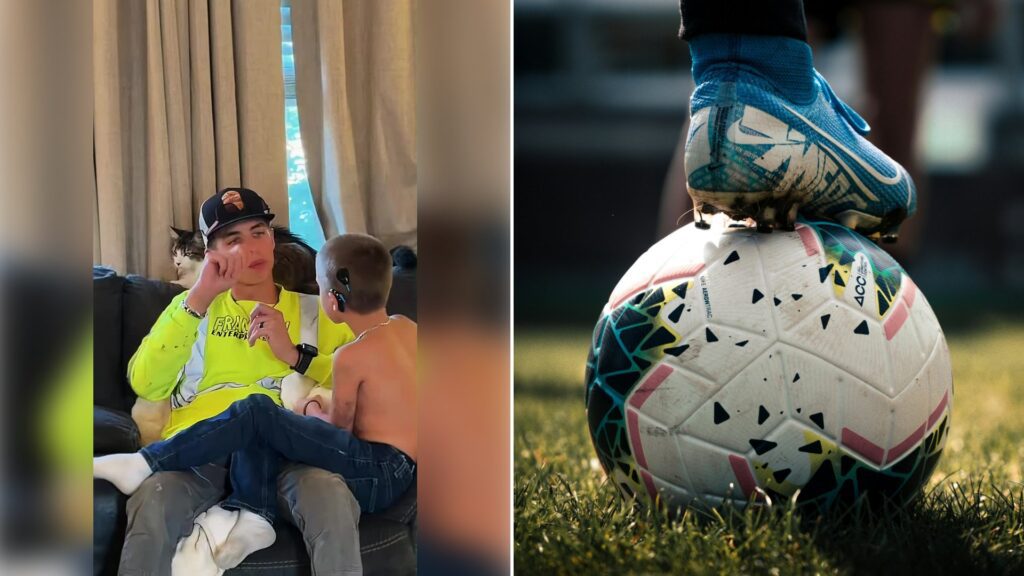
“Stop. Look at me in my eyes when I’m talking to you.” That is the first caption on screen in a TikTok compilation posted by @fuhzy909, captioned simply “Father son conversations.” A dad in a neon yellow work shirt sits on the couch with his young son on his lap, a hearing device visible behind the boy’s ear, and he speaks and signs at the same time while captions spell out his words.
The topic is kissing. “Remember that kissing is not okay,” he begins, and then he hands the boy a plan for the next time it comes up. If a girl tries to kiss him, the dad says, “you tell them no thanks. But we can hug instead. Okay?” The caption sums the rule up as no kiss, with a hug swapped in.
He does not treat it as a one time lecture. The caption at the end of his segment says that as the boy grows, he and dad “will talk about again and again and again.” In between, a mom in a pink tank top signs the same message from the kitchen, holding up two fingers while the caption repeats “no thanks, but we can hug instead.”
The video then moves through more pieces of the family’s life. One clip carries red text reading “We were in the middle of filming when my toddler had a major meltdown.” The mom sits at a table next to a toddler in a striped shirt, signing and saying “Calm down” over and over. At one point the caption reads “Your emotions are too loud,” and a few frames later the toddler is eating a red candy.
Another segment is labeled “Onesided dinner table Sign Language with my Deaf son.” The mom sits in a red booth and signs her half of a dinner conversation straight at the camera, which stands in for her son across the table. The talk is ordinary family business: “Sit on your butt,” a plan for Mama to come to school “tomorrow for reading time,” and a back and forth over whether a drink has red 40 in it.
The Soccer Game and the Lines
The last segment is the one with a story. Sitting on a bed in a lavender top, the mom signs as she talks, and she explains that “last week on Sunday” at her son’s soccer game “he had a hard day. He cried three or four times because it was his turn to sit out for three minutes.”
She lays out what the parents did, in order. First, she says, they told him to stop crying, because “everyone on your team has to sit out.” Second, they told him that if he kept crying he would not play, because “this is not his first sport” and “that’s not a good teammate.”
Then came a step she did not see happen. She says she did not notice until they were getting ready to leave, but after the game her husband had pulled the boy aside, talked to him, and had him run lines. On screen text spells out the message: “If you’re going to be a bad teammate You’re going to learn to be a good one from the bench.” In her retelling, the point was simple: you are not going to cry because it is your turn to sit out and take a break, and “you’re not gonna cry because your teammate got a medal.” Text near the end adds, “He was the first on his team to get a medal this season.”
She closes with her own verdict on her husband’s call: “I loved that my husband chose to make him run lines. I just wish I thought of it first.”
Why the Eye Contact Comes First
Families like this one are the norm rather than the exception. According to the National Institute on Deafness and Other Communication Disorders, 9 out of 10 children who are born deaf are born to parents who hear, and hearing parents who choose sign language for their child often learn it along with the child. The same agency advises parents to expose a deaf or hard of hearing child to language, spoken or signed, as soon as possible.
The NIDCD also notes that American Sign Language is a language completely separate from English, with its own grammar, and that facial expressions carry meaning. ASL users ask a question, for example, by raising their eyebrows, widening their eyes and tilting their bodies forward. That makes the dad’s opening line more than a discipline habit. If the boy is looking away, he is missing part of the sentence.
For children who also read speech, the Centers for Disease Control and Prevention tells parents to talk in a normal way, look directly at the child’s face and make sure the child is watching. The CDC adds that exaggerated mouth movements and a loud voice can make speech reading very hard, so a calmer voice is also the clearer one.
Borrowing This Family’s Moves at Home
Get attention before the message. The dad stops, waits for eye contact, then talks. With any child, deaf or hearing, a correction delivered to the back of a head rarely lands. Kneel or sit at eye level and start once they are looking at you.
Replace the behavior instead of only banning it. “No thanks” plus “we can hug instead” gives a young child a script for the exact moment. Write down two or three of these swaps for the behaviors you are working on so both parents use the same words.
Plan to repeat it. The dad says out loud that the two of them will have this talk again and again. Pick a calm time each week to revisit the rule rather than waiting for the next incident.
Tie the consequence to the moment. At the soccer game the parents named the rule (everyone sits out), named the consequence (keep crying and you do not play), and the dad followed through with something that fit the sport. Agree on the step with your partner beforehand so one parent is not undoing the other on the sideline.
Keep everyone in the table talk. The one sided dinner clip shows how much of family life is small talk about school visits and snacks. If one child signs or relies on lip reading, face them when you speak, and pass along what other people at the table just said so they are not left out of the conversation.
More from Decluttering Mom
- Deaf Mother Calmly Disciplines Her Son for Not Liking to Lose, Then Uses Sign Language to Lay Out His Options and Expectations Very Clearly
- Dad Fielding His Son’s Questions About How Mating Works With Humans Gets Asked if He Did That With Mom and Leaves the Boy Hiding His Face in Both Hands by Answering a Bunch of Times
- Mom Who Lost 140 Pounds Hears You’re Jiggly From Her Extremely Honest Middle Child Over a Plate of Pasta and Answers You’re Not Wrong Before Teaching a Lesson on Feelings