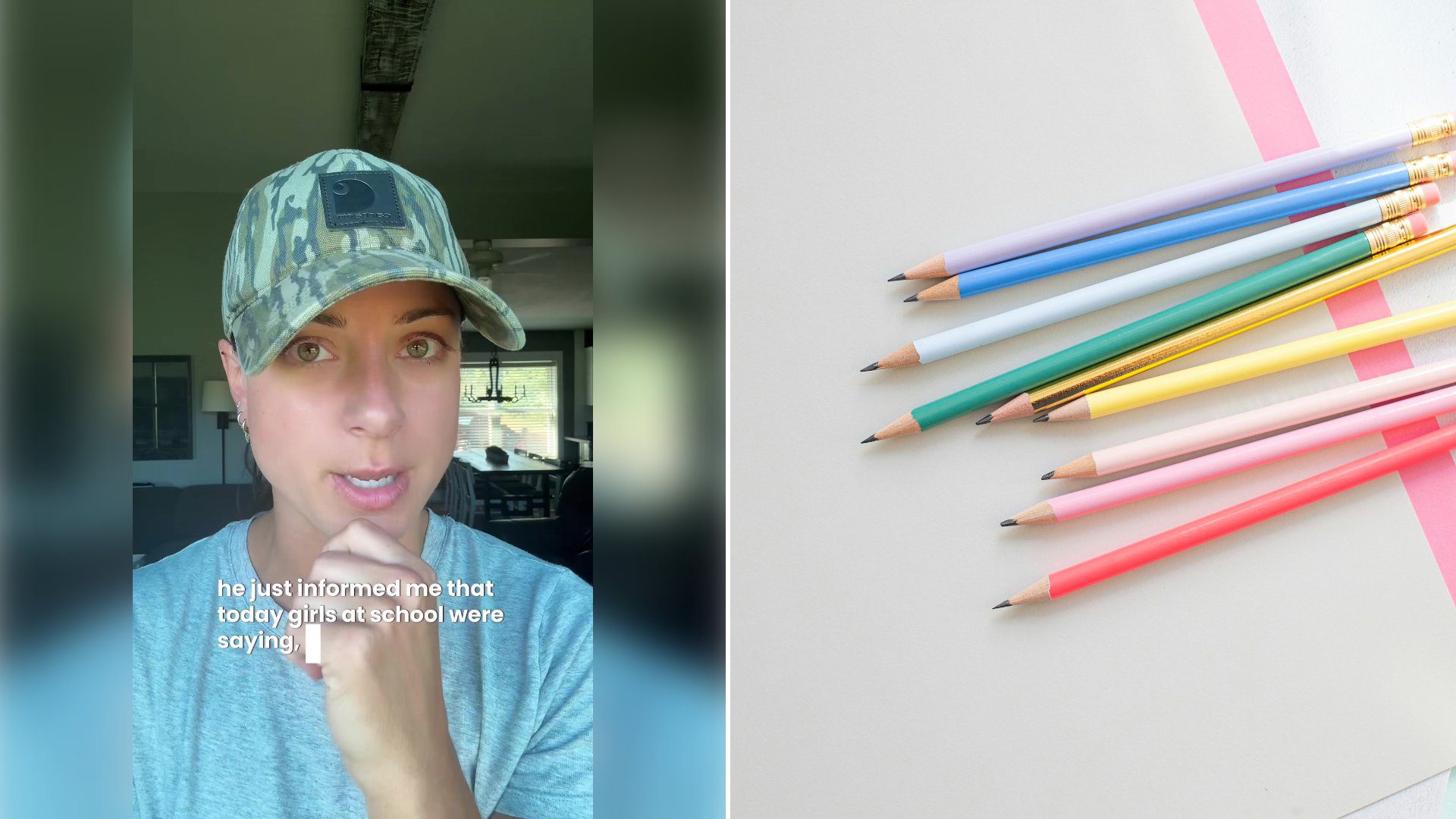
“Apparently it’s no longer boys go to Jupiter to get more stupider,” she says, one finger on her chin under the brim of a camo ball cap. The update comes from her son, who she describes as “seven year old, or almost seven year old,” and who had a new playground rhyme to report.
The 15 second TikTok from @happilyhillary, posted on September 11, 2026, is a quick, deadpan relay of what he told her after school. “He just informed me that today girls at school were saying, boys are weak, chuck them in the creek.”
She looks off to the side, purses her lips and lifts both hands in a shrug before giving her verdict. “So we’ve evolved a little bit,” she says, “but same sentiment is there, right?”
Her caption tips a hat to the adults who have to handle it during the school day: “Bet that’s fun to navigate as an elementary teacher.” The video does not say whether the rhyme bothered her son or whether he just found it worth repeating, and she treats it with a raised eyebrow rather than alarm.
When Your Child Brings Home a Rhyme Like This
Start the way she did, by listening. Her son volunteered what the girls at school were saying, which is the conversation most parents want to keep open. StopBullying.gov, the federal site run by the U.S. Department of Health and Human Services, recommends thoughtful talks with your child every day and suggests open ended questions such as “What was the best and worst thing that happened to you today?” and “What would you change about today?” It advises keeping those talks “casual and curious.”
Ask how it felt, not only what was said. A seven year old repeating a rhyme might be amused, annoyed or hurt, and the same words can land differently on different days. A simple follow up such as “Did that bother you, or was it kind of funny?” tells you which one you are dealing with.
Know where teasing ends and bullying begins. StopBullying.gov defines bullying as “unwanted, aggressive behavior among school aged children that involves a real or perceived power imbalance,” behavior that is “repeated, or has the potential to be repeated, over time.” It lists teasing, name calling and taunting as forms of verbal bullying. A rhyme shouted once at recess and a rhyme aimed at the same child every day are not the same thing, and the second one is worth a call to the teacher.
If your child seems quiet about something, the same federal site suggests a low pressure opening: “I’m here if there’s something you want to talk about.” If your child saw someone else being targeted, it suggests asking, “Do you want to talk about different ways you can handle it if it happens again?”
Flip it around at home. If your son can come home and report what the girls said, it is fair to ask whether the boys have a rhyme of their own. The joke in her video is that the “sentiment” survives even when the words change, and the simplest way to break that is to point out to your own kid that both versions do the same job.
Give the teacher a heads up when it matters. Her caption lands on the teachers for a reason. A short, specific note, such as the exact words, when it was said and whether it is happening repeatedly, gives an elementary teacher something concrete to work with without turning one playground rhyme into a formal complaint.
More from Decluttering Mom
- Mom Says Her 5 Year Old Came Home From Kindergarten Claiming a Classmate Left Her Boyfriend for Him Because He Smelled Really Good, So Now He Wears Cologne Every Morning
- Dad Fielding His Son’s Questions About How Mating Works With Humans Gets Asked if He Did That With Mom and Leaves the Boy Hiding His Face in Both Hands by Answering a Bunch of Times
- Kids Really Do Say Whatever Comes to Mind 🫠🤣