


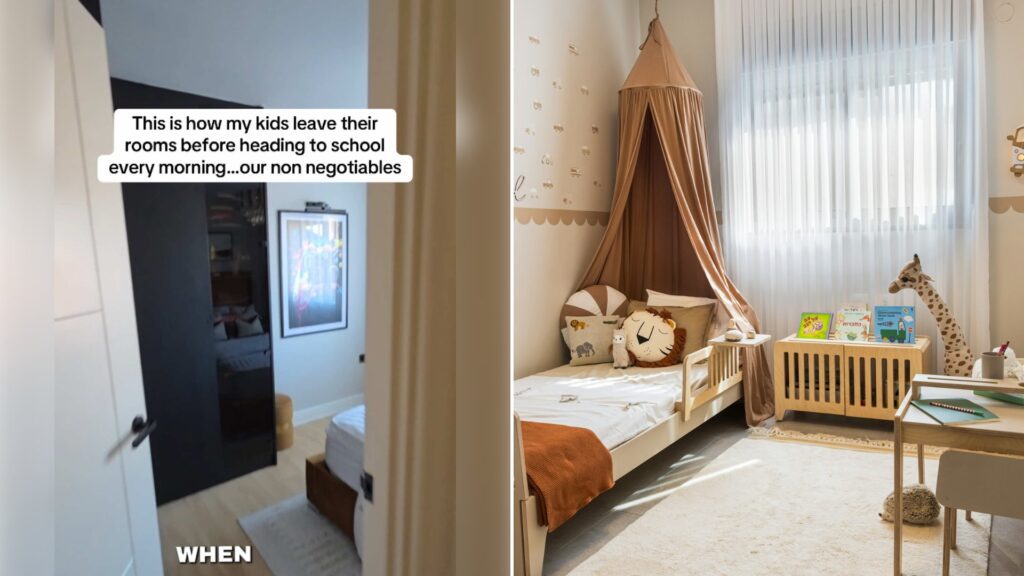
A video from the account athomewithdidi walks through a doorway into a tidy, made-up bedroom, with on-screen text reading “This is how my kids leave their rooms before heading to school every morning… our non negotiables.” The creator, who identifies as a designer working mostly from home, explains the reasoning in her caption: “Knowing that everyone’s bed is made, the windows are open and there’s no stale air in the rooms is one of those little things that makes me so happy,” adding that the system works because she built her children’s rooms with enough storage to make tidying genuinely easy for them, not just demanded of them. “You’re creating an environment that your children grow up in and get used to,” she writes. “A calm, organised space can make such a difference to how they feel, focus and get things done.” The video pulled in 123,200 likes, 2,785 comments, 11,900 saves, and 15,800 shares.
@athomewithdidi This is how my kids leave their rooms before heading to school every morning…our non negotiables
The creator’s instinct that a fixed, non-negotiable morning sequence makes mornings calmer rather than more stressful has real backing in how researchers describe executive function in children. Guidance on building healthy routines notes that a predictable sequence removes the need for a child to repeatedly decide what to do next, bed first, then windows, then the next task, and that reduced decision-making load is specifically what makes it easier for kids to start and finish tasks without constant prompting from a parent. For a child, “what am I supposed to do right now” is itself a small cognitive task, and a fixed routine answers that question automatically every single morning.
That same guidance connects routine directly to emotional regulation, not just efficiency. Children who move through a consistent, low-pressure sequence each morning carry less mental load into the rest of their day, and routines of this kind are described as functioning like an external source of calm that, over time, helps children build their own internal regulation skills rather than depending on a parent to manage every transition for them. A morning that starts with a clear, familiar task list, rather than ambiguity or last-minute scrambling, sets a different emotional tone heading into school than a chaotic one does.
The detail the creator adds about designing the rooms themselves to make tidying achievable, rather than just assigning the expectation, matters as much as the rule itself. A non-negotiable that a child can actually accomplish independently, because the storage and layout make it realistic, builds a different kind of competence than a rule that requires constant parental help to complete. That distinction is part of what separates a routine that builds a child’s independence over time from one that just adds another daily point of friction between parent and kid.
More from Decluttering Mom
- Mom of Two Opens Her Three Car Garage on a Doom Pile of Boxes, Finds Diapers From a Subscription Still Running and a Sauna Boxed for a Year, Then Clears Enough to Park Inside
- Homeowner Whose Husband Said He Could Not See the Garage Floor Hauls Out Four Years of Stuff, Patches and Paints One Wall White, Then Hangs Bikes, Helmets and a Vacuum on Rails
- Woman Says She Came Home From a Cleaning Service Visit to a Gas Burner Left On With No Flame, Then Found Her Purse, Tax Documents and Real Silverware in Two Garbage Bags Downstairs