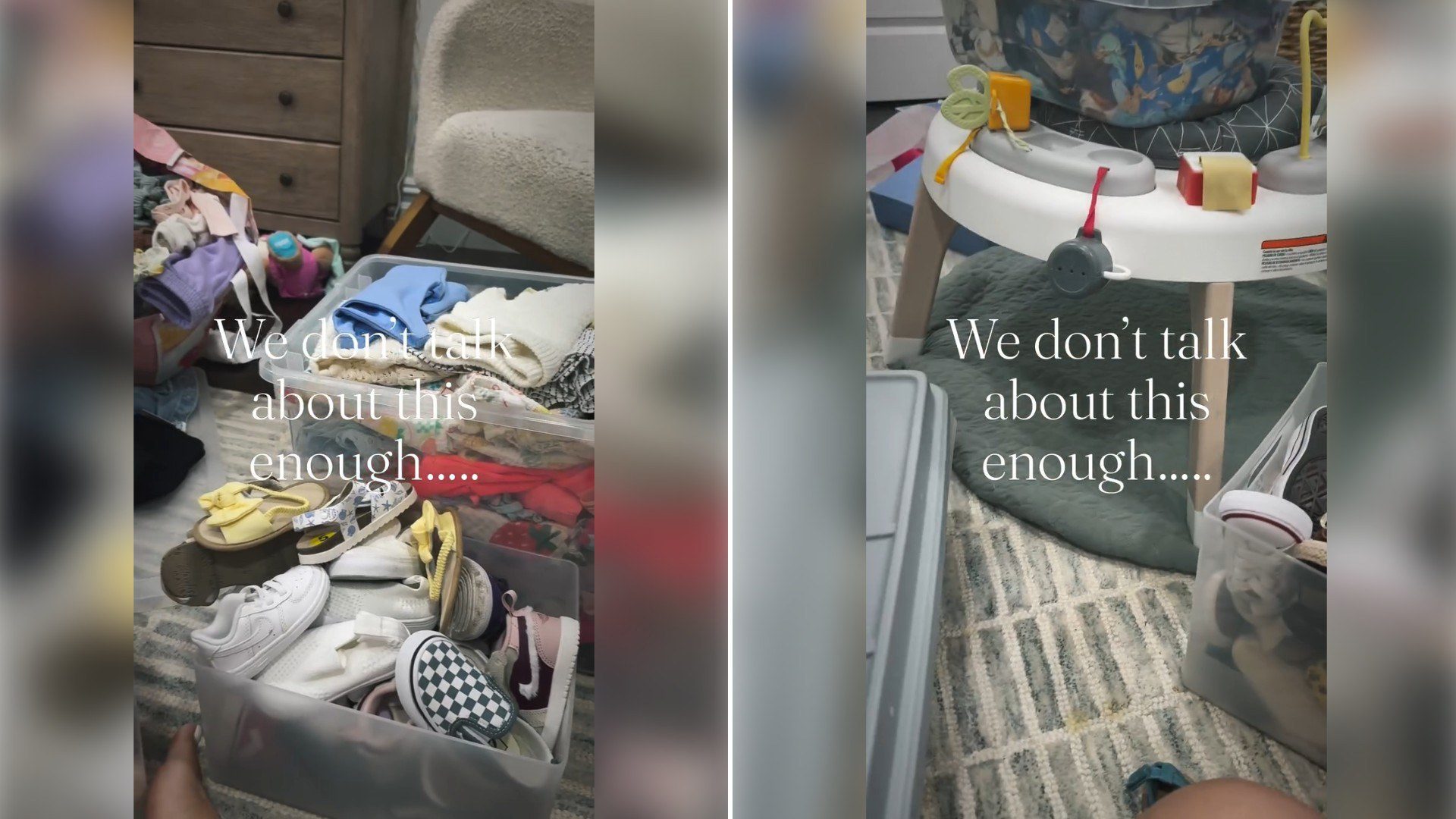
Eight seconds is all it takes. A camera sweeps across a bedroom floor that has vanished under children’s clothing and shoes. In the foreground, a clear plastic bin holds a jumble of small sneakers and sandals, with a checkered slip-on resting on top. Behind it, a heap of tiny tops and pants in pink, lilac and blue spills over a second container, and a stack of folded pieces waits beside it. White text floats over the whole scene, telling viewers that this is something we don’t talk about enough.
The camera keeps moving. Another bin of shoes comes into view, then a stuffed reusable grocery bag, then a baby activity seat parked on a green blanket. Finally the shot lands on a closed storage tote. A hand lifts the lid, and underneath is one more layer of little shoes, packed in tight. The clip stops there, with the tote open and nothing put away.
The creator, @the_mortgage_mama, saved the story for her caption. “No one talks about this part of motherhood,” she wrote, and then she spelled out what the part is: the piles, the bins, and the clothes spread across the floor while she works out what fits, what gets stored, what gets donated, and what she can’t bring herself to let go of yet.
She says the job always seems to land on Mom, and her reason is a practical one. A size tag tells you very little. In her telling, a dad sees 2T on a label and assumes the item fits, while she is the one who knows that one brand’s 2T runs small, that a pair of 18 month leggings still works, and that some 12 month sweatpants from one specific brand are somehow exactly right. She keeps the same running record for shoes that pinch and pajamas with a month left in them.
Then the caption turns. Sorting clothes, she writes, is really about closing chapters, again and again. A parent ends up quietly boxing the proof of who a child used to be while trying to keep pace with who that child is becoming. Some pieces stay for reasons that have nothing to do with fit, like an outfit worn on a day she never wants to forget.
This round feels different to her, and she explains why. She keeps building a pile of things to save in case there is another baby, even though she suspects her family is complete and says she is not ready to say that out loud. Her answer for now is to hold on to more bins than she needs, and she jokes that the honest total is closer to an entire storage unit.
The post packs a lot of working knowledge into a few lines, and anyone facing the same floor can borrow from it.
Start with her main point about sizes. Her examples run from 12 months to 4T, all in play at the same time. That is a good argument for sorting by fit and ignoring the tag. Pull one pair of pants and one shirt that fit well right now and use them as templates. Lay each questionable piece on top of the template and the decision takes seconds, with no need to wrestle a toddler into twenty outfits.
Next, get that knowledge out of one person’s head. If only one parent knows which brand runs small, that parent will be doing this sort forever, and every shopping trip too. A shared note on a phone works. So does a strip of masking tape inside the dresser drawer that lists the brands to size up. Either one lets someone else pack the next bin or buy the next pair of pajamas without a quiz.
Label what goes into storage by how it actually fit. A tote marked with the size as worn, the season, and the date it was packed can be read from across a garage. The video ends with a lid coming off so the contents can be checked, which is the step a good label removes.
Shoes deserve a minute of their own. In her bins they are piled loose, and loose pairs separate. Tying laces together or looping a rubber band around each pair before it goes in keeps a future search from turning into a dig. Shoes that pinch now can leave the house today, since no one will be glad to find them later.
Give keepsakes a separate, smaller home. The outfit from the unforgettable day is a different kind of object from a stack of hand-me-down leggings, and mixing the two is how a storage pile grows without limit. One box per child, with a fixed size, forces a choice about which pieces carry the memory. When the box is full, something has to come out before something new goes in.
The hardest pile is the one she names herself, the things kept in case another baby comes. Her caption shows how easily the clothes and the bigger question get tangled together. They can be pulled apart. Deciding how many totes to keep is a storage question, and it can be answered with a number and a date: this many bins, looked at again in a year. Inside that limit, keep the pieces in the best condition and the basics that work in any season. Stained items and anything tied to one specific season can go to another family now.
None of this makes the job smaller. It does make it possible to hand part of it to someone else, and it keeps the saved pile from spreading across the whole room. Her own conclusion is a modest one. She does not claim to have it figured out. For now, the extra bins stay.