


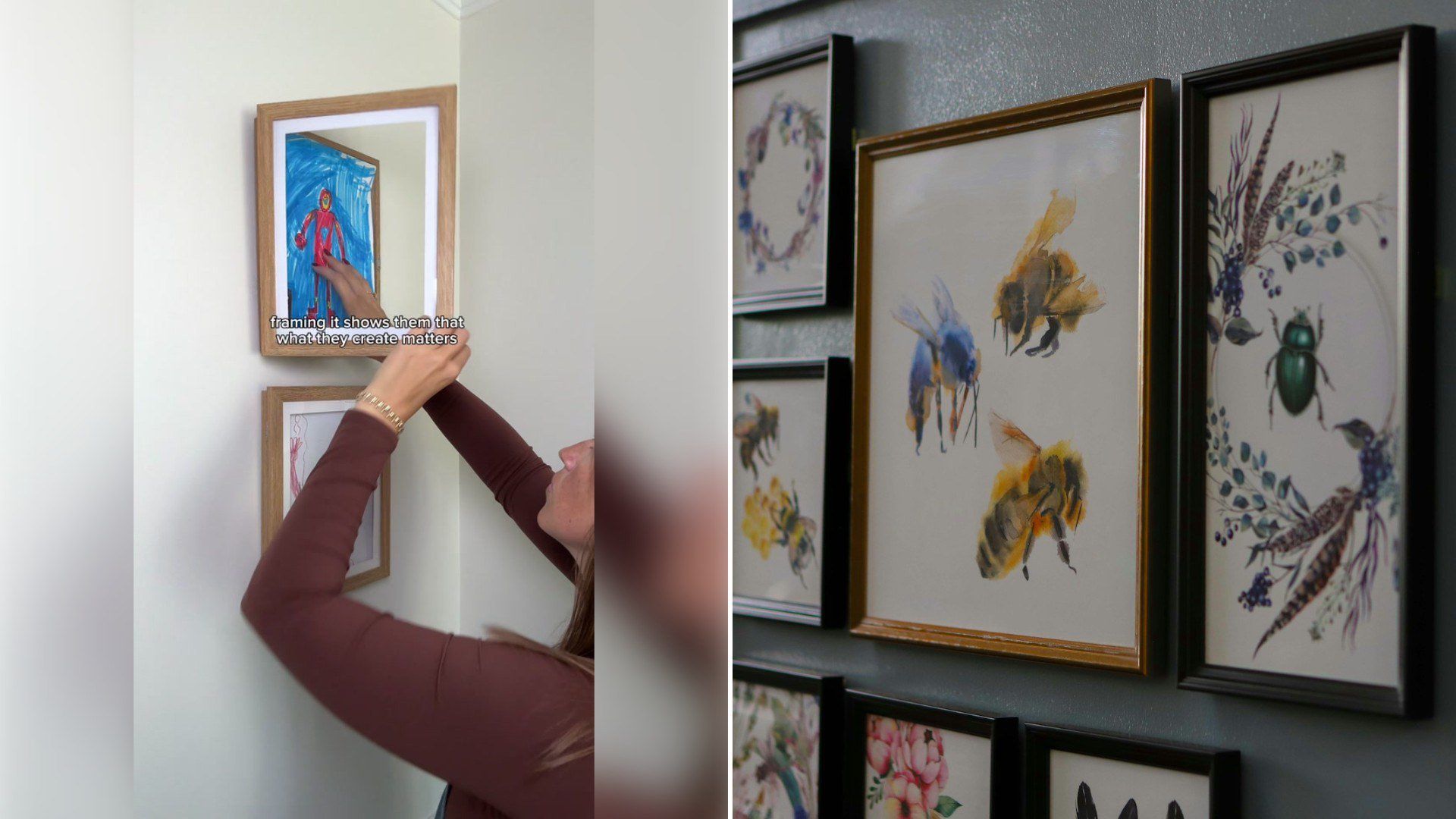
A mom who posts on TikTok as ashleehardin needed only 11 seconds to show how her kids’ artwork gets from the table to the wall. Two light wood frames hang one above the other on a cream wall beside the doorway to her kitchen, each holding a child’s drawing behind a white mat. One line of text stays on the screen the whole time she works: “framing it shows them that what they create matters.”
She walks up in denim overalls and a brown long-sleeved top and, instead of lifting a frame off its hook, pulls the front of the lower one open like a cabinet door. The frame is hinged along one side. Inside, the drawing is held flat against the back by two black elastic straps. She slides it out, tucks a new one under the straps, a red marker figure with both arms thrown up in the air, and presses the front closed again.
@ashleehardin
The upper frame gets the same treatment. With its front swung open, the camera catches what sits behind the piece on display, which is more paper, including a school worksheet, stacked under the same two straps. The frame is a storage box as well as a display. She lays a new drawing on top of the stack, a red figure against a solid blue background, shuts the front and steps back. The final shot is the wall with two new pieces up and nothing else changed.
Her caption gives the reason and the method in one sentence: “It boosts the kiddos confidence and magnetic frames make it so easy to change out!” The video carries a “MAGNETIC FRAMES” label, and she tagged it #kidsartframe, #momhack, #toddlerart, #kidsart and #toddlermom.
The detail that makes the clip worth a second look is that the frames never leave the wall. With an ordinary frame, changing the picture means taking it down, flipping it over on a table, bending back the tabs, lifting out the backing, lining up the paper and hanging the whole thing straight again. That is enough of a chore that most kids’ drawings never make it into a frame at all. They go on the fridge under a magnet or into a pile on the counter. In her video, each swap takes a few seconds, and that is the whole point. A display that is easy to update is one that actually gets updated.
The stack behind the front piece solves a second problem. Every new drawing that goes up means an old one comes down, and the old one needs somewhere to go. In her frames, it stays right where it was, one layer back. There is no separate bin to dig out and no decision to make on the spot about what to keep. The sorting can happen later, when the stack gets thick, and by then it is easier to see which pieces are the keepers.
It also helps that there are only two frames. A fridge door or a corkboard can absorb paper until it is covered, and at that point no single drawing stands out. Two frames set a limit. Whatever is newest or most loved gets the spot, and everything else waits its turn behind it. For a parent who feels buried in construction paper, that built-in limit does a lot of the organizing on its own.
Where she hung them is part of it too. The frames are in a hallway corner next to the kitchen doorway, at adult eye level, on a wall that already looks finished, with white trim below and nothing else competing for attention. It is a spot the family walks past all day, and it treats the drawings the same way the house treats any other art. The white mats do some quiet work as well. A marker drawing on printer paper looks more deliberate with a clean border around it.
That is the idea behind the line she put on the screen. A child who sees a drawing go into a real frame on a real wall gets a clear message about how the work was received, and gets it again every time a new one goes up. She describes the result as a confidence boost, and the routine in the video is small enough to repeat every week.
For anyone who wants to copy the setup, the features to look for are the ones visible in her clip. The front opens while the frame stays on the wall, the inside is deep enough to hold a stack, and something inside, straps in her case, keeps the paper from sliding. Start with one or two frames in a place the kids pass often, and let them choose which piece goes on top. The swap takes about as long as it takes to say “that one,” and the wall is done until the next masterpiece comes home.