


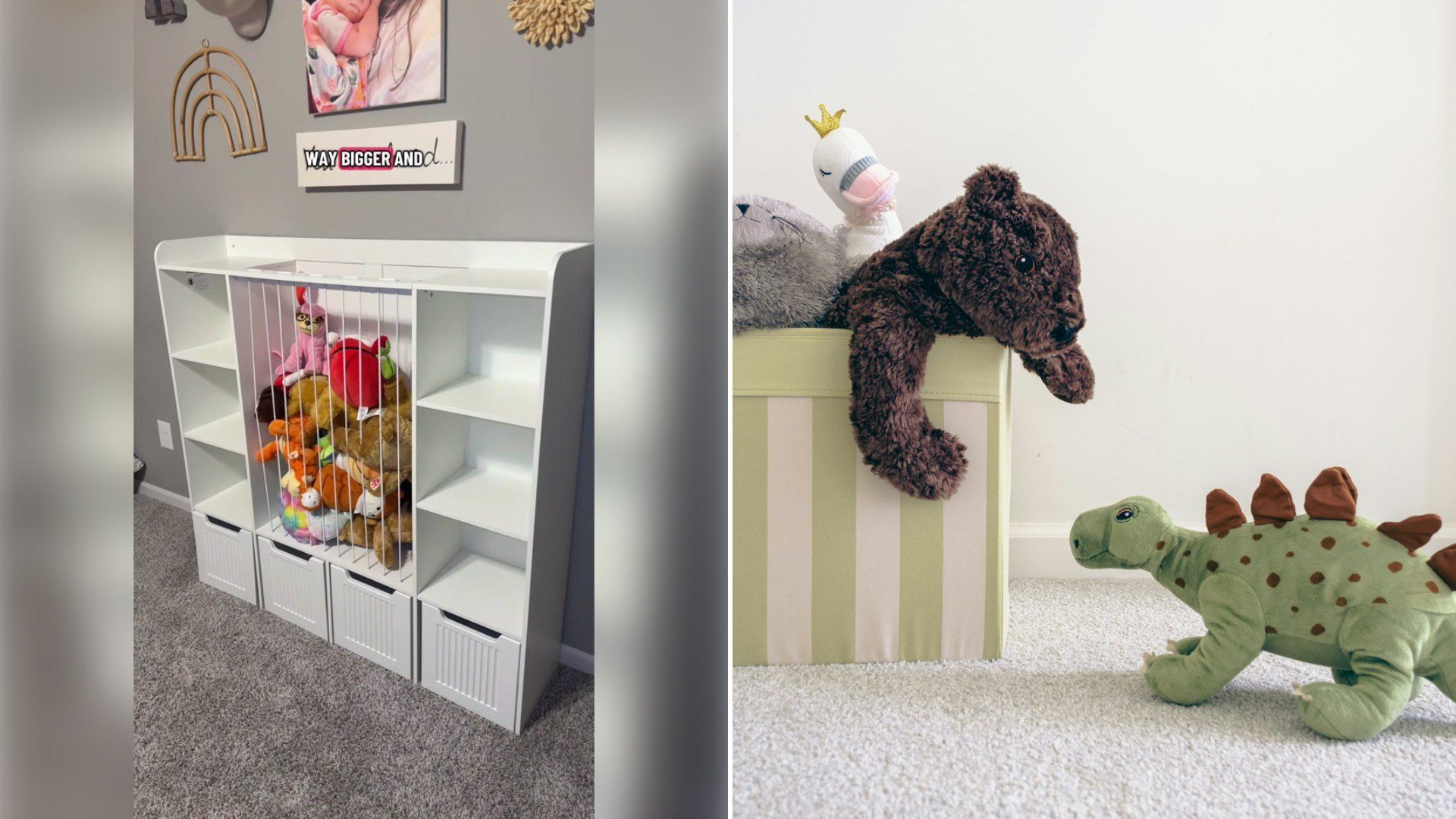
A creator posting under the handle jreck23 shared a real, personal review of a stuffed animal storage shelf she recently bought for her child’s room, filling it up on camera and noting it turned out bigger and noticeably better built than she expected going in.
@jreck23 #momhack #bedroomorganization #organization #organizedhome #kidsroom
Her child is shown actually interacting with the shelf once it’s set up, which does more to sell the product than any description could — a stuffed animal storage solution only really proves itself once a kid is willing to use it as intended, rather than leaving toys scattered on the floor anyway.
Stuffed animal overflow is one of those clutter categories that tends to sneak up on parents gradually, one gift or claw-machine win at a time, until there’s no clear system in place at all. A dedicated shelf that a kid actually engages with solves the storage problem and gives the toys themselves a proper “home,” which tends to make cleanup less of a fight.
While this reads as a genuine personal product-use story rather than a paid placement, it functions similarly to a product review, and parents interested in something comparable would do well to look for the same qualities she highlighted: solid build quality and enough real capacity to actually make a dent in the pile.
Stuffed animals occupy a strange category of clutter that doesn’t behave quite like other toys. A kid will happily part with a broken plastic gadget or a puzzle missing three pieces, but stuffed animals tend to accumulate an emotional weight that makes them almost impossible to purge, regardless of how many a household actually has room for. That means the realistic solution for most families isn’t reducing the collection — it’s finding storage that can actually absorb the volume without turning a bedroom floor into an obstacle course.
The detail about the shelf turning out bigger than expected matters more than it might seem at first glance, since sizing is one of the most common ways storage purchases fail in practice. A bin or shelf that looks adequate in a product photo often turns out to hold a fraction of what a family actually needs, leaving half the stuffed animals with nowhere to go regardless of how good the intended system looks on paper. Going in expecting something modest and getting something genuinely spacious is the rare pleasant surprise in a category where disappointment is the more common outcome.
Build quality is the other detail worth dwelling on, mostly because kids’ storage furniture has a well-earned reputation for being flimsy — particle board that sags under weight, brackets that strip out after a few months of actual use, shelving that looks fine in a showroom and buckles once it’s holding real weight day after day. A shelf sturdy enough to hold up to genuine daily use, rather than just looking nice for a single photo, tends to matter more in the long run than almost any other feature, since a flimsy piece of furniture that fails within a year isn’t actually solving the storage problem at all.
The moment where the kid actually engages with the shelf is really the whole review distilled into a single clip. Parents can buy all manner of clever-looking storage solutions, only to find a kid ignores the new system entirely and keeps dropping stuffed animals wherever gravity takes them. A kid willingly interacting with a new shelf, treating it as the obvious home for their toys rather than an imposed rule to resist, is the strongest possible endorsement a storage product can get — stronger than any spec sheet or marketing copy.
There’s also something valuable in this kind of unpaid, genuinely personal product experience compared to the more polished sponsored content that dominates a lot of organizing spaces online. A parent who bought something with her own money, tested it with her own kid, and is sharing the honest results — good surprise included — tends to carry more credibility than a scripted ad, precisely because there’s no incentive to oversell the product beyond what actually happened.
For parents whose own stuffed animal situation has spiraled past any reasonable system, the takeaway here isn’t really about this specific shelf so much as the underlying principle: investing in genuinely adequate capacity and solid construction upfront tends to save a lot of frustration compared to buying something cheaper and smaller that ends up needing replacement within a year anyway. The extra money spent on quality now is often cheaper than buying the wrong thing twice.
By the end of the video, the shelf is full, the room looks noticeably tidier, and the whole process took what looks like a fairly small amount of effort for a fairly significant payoff. That kind of low-effort, high-impact organizing win is exactly the sort of thing that tends to resonate with other parents scrolling past, mentally filing away the idea for the next time their own stuffed animal pile reaches critical mass.
There’s also a broader lesson here about how much research actually goes into even the small purchases that get folded into an ordinary parenting day. Picking out a stuffed animal shelf sounds like a minor decision, but it still involves weighing size against the room’s available space, reading reviews for hints about durability, and guessing whether a particular design will actually appeal to a kid who has very specific and sometimes unpredictable opinions about furniture. None of that effort is visible in the final thirty-second clip, but it’s the invisible groundwork behind almost every organizing win that looks effortless on camera.