


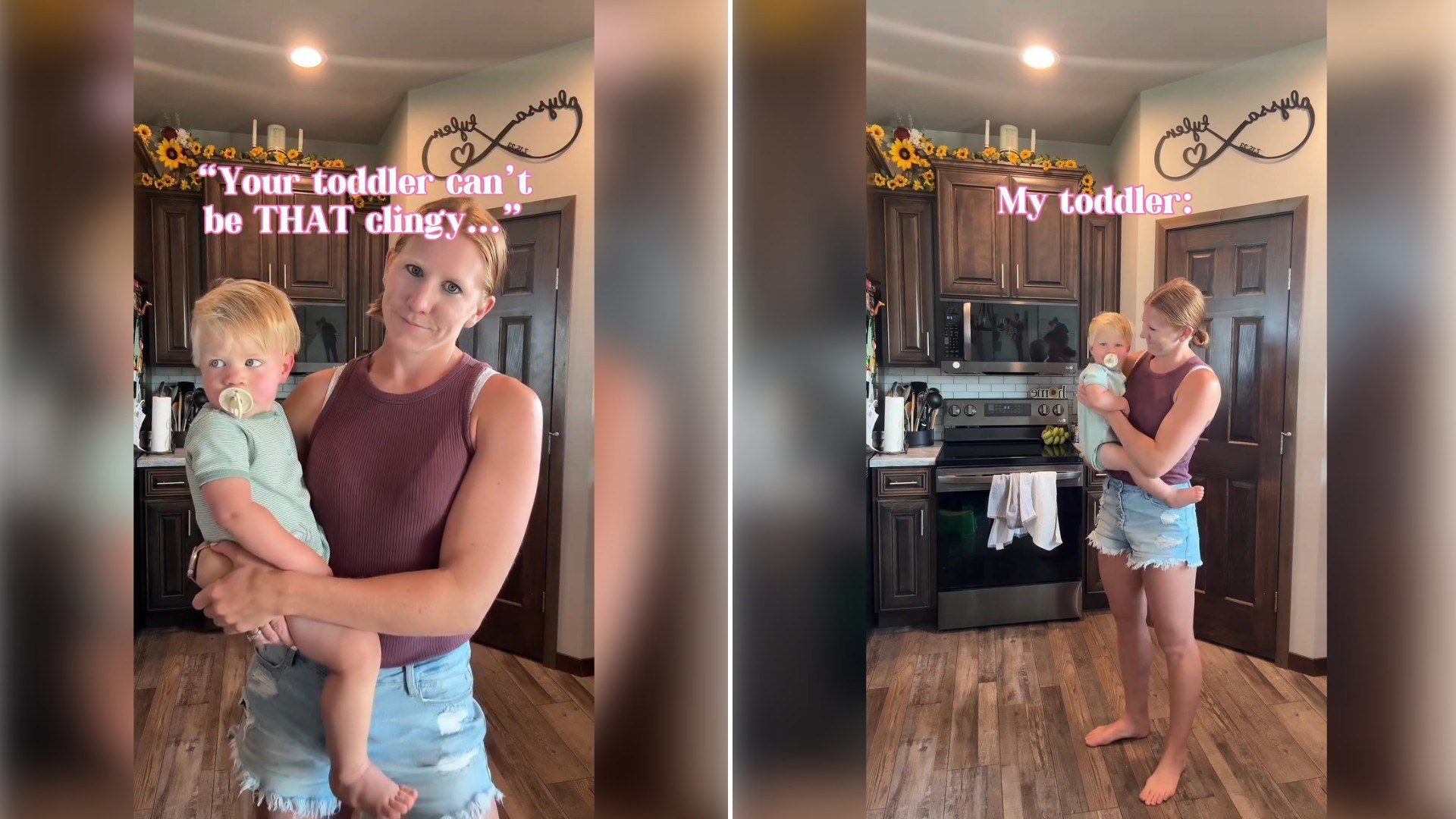
The text at the top of the reel is a line plenty of parents have heard, set in quotation marks: “Your toddler can’t be THAT clingy…” Under it, _lifewithlyss stands barefoot in her kitchen in a tank top and denim shorts with her toddler on her hip, giving the camera a flat, tired look. He has a pacifier in his mouth and is tucked in against her side.
A few seconds in, the text switches to “My toddler:” and she shows what she means. She bends at the waist and lowers him toward the floor, the way anyone would to set a child on his feet. He does not take the offer. He stays latched to her arms with his knees bent, hanging there while she is folded nearly in half, and she has no choice but to straighten up with him still attached.
She gives it a moment, shifts him back onto her hip, and tries again. Same bend, same result. He rides down toward the wood floor and right back up without ever standing on it. By the end of the 18-second clip she is upright and close to the camera, holding him in both arms and smiling at him while he looks off to the side, pacifier still in place.
Those two lines of text are the only words on screen, and the clip does not need more. It is one continuous take from a fixed camera in an ordinary kitchen: dark wood cabinets, a dish towel hanging from the oven door, a garland of sunflowers running along the top of the cupboards. There is no setup and no reveal. The entire joke is a small child declining, twice, to be put down.
The caption fills in what the video leaves out. “He really said ‘no thanks mom,'” she writes, and then she gives him an out: “in his defense he had just woken up from his nap.” The next sentence is where the post stops being only a joke. “But some day, he’s not going to want me to hold him anymore so I will soak this up for as long as I can.” She signs off with a question for anyone reading: “Can any other toddler moms relate?”
That caption holds both halves of the situation at once. It is funny that a child this small can win a standoff with an adult by doing nothing except staying put. It is also plainly inconvenient. She is standing in front of a stove with both arms occupied, and the look she gives the camera in the opening seconds says as much. Her answer is to treat the inconvenience as temporary and the holding as the part worth keeping.
The nap detail is the most useful thing she shares. She does not present the clinging as a mystery or a problem with her son. She ties it to a specific moment in his day, the minutes right after waking up. A parent who sees the same pattern at the same time every afternoon can plan around it. Expect the first stretch after a nap to be a holding stretch, and do not schedule the job that needs two free hands for that window. Ten minutes on the couch together may well be quicker than repeated attempts to set a child down who has already said no.
How she handles the refusal is worth noticing too. She does not pry him loose, and she does not let go and hope he lands on his feet. She lowers him, he declines, and she brings him back up. Then she offers the floor again a few seconds later. Treating “down” as an offer he can turn down, and simply asking again later, keeps the moment from becoming a fight.
For the times when something really cannot wait, there are a few workable middle options. A child on one hip leaves one hand free for small tasks. Sitting down on the floor with him gets him to ground level without asking him to let go. And if a second adult is home, the wake-up window is a good time to hand over whatever was happening at the stove.
The quoted line at the top of her reel, “Your toddler can’t be THAT clingy,” is the kind of remark parents hear from people who have not watched it happen. Her response is not to argue. She shows 18 seconds of exactly how clingy he can be and lets that stand. Parents on the receiving end of the same comment do not owe anyone a defense of their child either.
She has already decided how she wants to remember this stage. The day he stops wanting to be picked up is coming, she writes, and until then she plans to “soak this up for as long as I can.”