


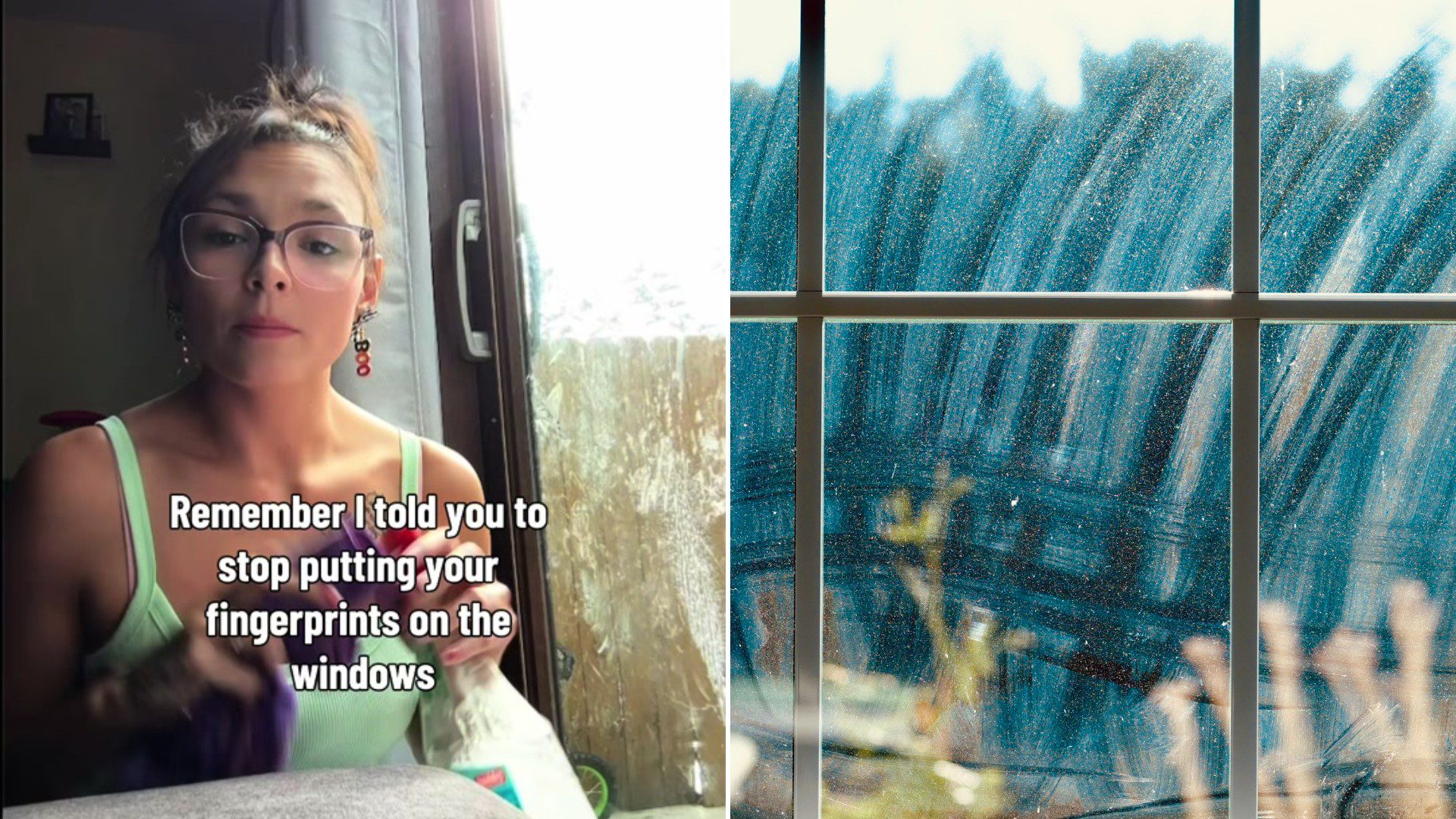
A mom with a spray bottle in one hand and a purple cloth in the other is wiping fingerprints off a glass door, and the text over the video is something she has plainly said before: “Remember I told you to stop putting your fingerprints on the windows.” Eight seconds later, the video turns that sentence on its head.
TikTok creator @kyratitus posted the 35-second clip with a one-word caption, “This.”, followed by the hashtags #momsoftiktok, #raisingkids, #momlife and #gentleparenting. It is built from footage of her own home cut against a recording of a speech, and she lets the speech do the talking.
@kyratitus
The opening shot is the chore itself. She is in glasses and a green tank top with her hair up in a bun, looking at the camera for a moment before she leans in and scrubs the glass. Then the picture switches to an older man in a dark suit and patterned tie, speaking from a podium. “If you’re still in the process of raising children,” he begins, and the video goes back to her house to illustrate the rest of the sentence one phrase at a time.
“The tiny fingerprints that show up on almost every newly clean surface” plays over a glass door covered in smudges, then a mirror on the wall, then a wooden dining table with a runner down the middle. “The toys scattered about the house” gets a shot of bright plastic toys lying on the carpet. “The piles and piles of laundry to be tackled” gets a wire basket so full that clothes are spilling over the sides.
The speaker returns to finish the thought. All of it, he says, “will disappear all too soon.”
The last images are not of mess at all. Children in swimsuits and goggles stand at the edge of an outdoor pool under a blue sky. Then two little ones run down a hallway toward the camera, one carrying a blue ball and the other grinning with arms out. Her on-screen text carries the end of the line across those shots: “And that you will to your surprise” and then “Miss that profoundly.” The final frame keeps just one word on screen: “Profoundly.”
The order of the shots is what gives the clip its weight. The first thing she shows is herself doing exactly what the speech describes, wiping a newly smudged surface and reminding someone not to do it again. Everything after that answers her own opening line. The fingerprints, the toys and the laundry are presented as proof that the children in the final shots are still small and still at home.
That does not make the video an argument against cleaning. She is still holding the cloth. What it offers is a different way to feel about the jobs that come back every day, and there are practical ways to act on that without letting the house go.
One is to sort mess into two kinds. Some of it has to be dealt with promptly, like dishes, food on the floor and anything that is a hazard. Some of it is only evidence that children were here: handprints low on a glass door, toys on the carpet, a smudged mirror. The second kind can wait for a set time instead of being chased all day, and waiting for it removes most of the frustration of wiping the same pane three times before lunch.
A single reset helps with that. Pick one point in the day, often after dinner or before bed, when toys go back into one basket and the low glass gets a quick wipe. Children can do part of it themselves. A child who has just been told to stop touching the windows can also be handed the cloth.
Laundry responds to the same thinking. A load started every morning, or fixed days for each person’s clothes, keeps the basket from turning into the overflowing pile in her video, and small children can match socks and carry their own stacks.
It is also worth keeping a record before wiping it away. A handprint on a window marks how high a child could reach that month. A photo of it takes a second, and it holds on to the thing the speech says will be missed.
Her caption did not add any of that. It was one word, pointing at someone else’s sentence, from a mom who was in the middle of cleaning the window when she shared it.