


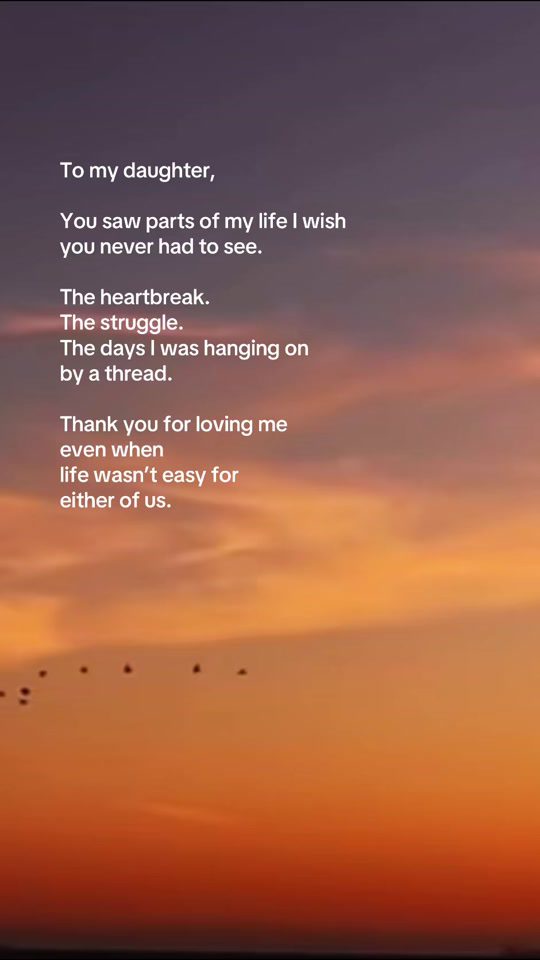
The TikTok account @mom.daughter.moments posted a video that is ten seconds long and has no one in it. There is no face and no voice. A flock of birds crosses a sunset sky above the sea in slow motion, and a short letter from a mother to her daughter sits on the left side of the screen the entire time.
The letter reads, in full: “To my daughter, You saw parts of my life I wish you never had to see. The heartbreak. The struggle. The days I was hanging on by a thread. Thank you for loving me even when life wasn’t easy for either of us.”
@mom.daughter.moments
That is everything the video says. The words, about forty of them, stay on screen from the first second to the last over an instrumental track. The sky behind them is orange, gold and purple, and the birds are small dark shapes near the horizon. The caption under the post reads “Best compliment you can give me,” followed by the tags #MomAndDaughter, #MotherDaughter, #GirlMom, #DaughterLove and #MomLife. The video itself does not say what the compliment is and does not describe anything the daughter said. Its whole message is the mother’s thanks.
The letter gives no details. It does not say what happened, when it happened or how old the daughter was. It names three things, “The heartbreak,” “The struggle” and “The days I was hanging on by a thread,” and leaves each one at that.
What it does say is arranged with some care. It begins with an admission: “You saw parts of my life I wish you never had to see.” The regret in that sentence is about what the daughter witnessed. Nothing in it is about anything the daughter did. Next it names the hard things plainly, one short line each. Then it turns, and the last sentence is gratitude: “Thank you for loving me even when life wasn’t easy.” The final four words widen it to include the child. Life was not easy “for either of us.”
That last phrase is the part a parent might overlook when writing something like this. The letter does not treat the hard years as only the mother’s story. It says the daughter went through them too.
For a parent who has had a rough stretch with a child watching, the letter is short enough to use as a pattern, and each piece of it points to something practical.
Start from what the child already knows. The letter opens with “You saw.” It does not pretend the daughter missed what was going on in her own home. A child who lived through a difficult period does not need to be told it happened. Hearing a parent say so out loud is the new information.
Name it without telling all of it. “The heartbreak” and “The struggle” are enough for the daughter to know which days her mother means. The letter stops there. A parent can do the same and match the amount of detail to the age of the child, which for a young child may be no detail at all.
Keep the weight on the adult’s side. The mother says she wishes her daughter never had to see those parts of her life. That places the responsibility for them with the parent. A child hearing this should come away knowing the hard times were not hers to fix.
Thank the child for something she actually gave. The letter thanks the daughter for one thing, loving her mother. It is specific, and it is something a child of any age can recognize in herself.
Say that it was hard for her too. “For either of us” takes four words. It tells the child her own bad days during that time were noticed.
Keep it short. This letter fits on one phone screen and can be read in ten seconds. That length works on a card, in a note left on a pillow, or in a text to a daughter who is grown and living somewhere else. A parent who has been putting off this conversation because it seems too big can see here that it does not have to be long.
The video does not show whether the daughter it is addressed to ever read it, or what she said back. It ends where the letter ends, with the birds still crossing the sky and the last line still on the screen: “Thank you for loving me even when life wasn’t easy for either of us.”