


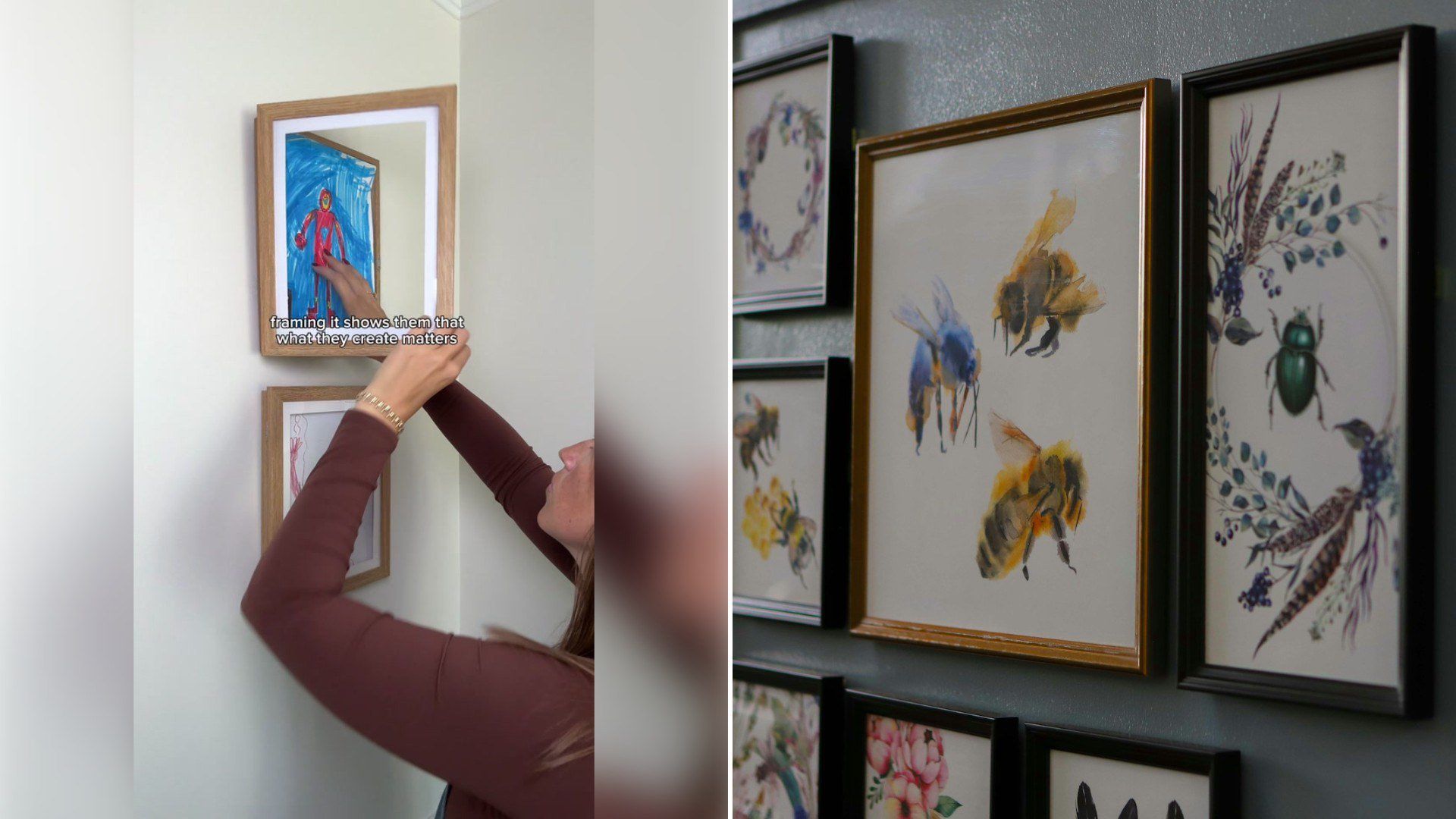
Every parent of a school-age or preschool-age child eventually runs into the same slow-building problem: a mounting pile of kids’ artwork with no good system for displaying or rotating it. A mom posting under the handle ashleehardin recently offered a genuinely clever fix, showcasing a picture frame hack that makes swapping out her child’s latest creations effortless, using specialized magnetic frames built specifically for that purpose.
Her video walks through exactly how the frames work, demonstrating how quickly and easily new artwork can be swapped in without the usual hassle of removing tape, tearing paper, or wrestling with a traditional frame’s backing and glass. The caption highlights not just the practical convenience but an emotional upside as well, noting that displaying the artwork boosts her kids’ confidence, and that the magnetic frames make the whole process remarkably easy — tagged with #kidsartframe, #momhack, #toddlerart, and #toddlermom.
@ashleehardin It boosts the kiddos confidence and magnetic frames make it so easy to change out! #kidsartframe #momhack #toddlerart #kidsart #toddlermom
The video resonated widely, pulling in approximately 2.6 million views from an account with about 19,400 followers — a substantial jump in reach that suggests plenty of parents have been quietly searching for exactly this kind of solution to their own overflowing artwork piles.
The kids’ artwork problem is one of the more emotionally loaded organizational challenges parents face, mostly because it isn’t just clutter — it’s clutter tangled up with genuine pride and sentiment. Throwing away a child’s drawing can feel surprisingly fraught, even when the sheer volume of daily artwork makes keeping everything completely unrealistic. That emotional weight is exactly why a display-and-rotate system, rather than a keep-everything-forever approach, tends to be the more sustainable long-term solution for most families.
A magnetic, easy-swap frame system solves a specific pain point in that process: it lowers the friction of actually displaying new artwork regularly, which in turn makes it easier to rotate out and eventually let go of older pieces without guilt, since the current favorite is already proudly on display. It also, as the caption notes, genuinely does something meaningful for a young child’s sense of pride — seeing their own work prominently displayed at home reinforces the value of the effort they put into it, independent of the artistic result itself.
For parents looking to build a similar system without necessarily investing in specialized frames, the underlying principle can be replicated with what’s already on hand: designating one or two rotating display spots, whether a frame, a clipped string of twine, or a dedicated section of the fridge, and treating it as a living rotation rather than a permanent archive. Photographing favorite pieces before they’re recycled offers a simple middle ground for parents who want to preserve the memory without preserving every physical page.
In the end, what makes ashleehardin’s hack so appealing isn’t just the mechanics of the frame itself — it’s the way it solves a small, ongoing source of household friction while simultaneously giving a child’s creative effort the visible recognition it deserves, without requiring a parent to become a full-time art archivist in the process.
Early childhood educators have long pointed to the display of a child’s creative work as a meaningful, low-cost way to reinforce effort and self-esteem, distinct from praising outcome or talent specifically. The message a child receives from seeing their drawing on the wall isn’t necessarily “this is a great drawing” so much as “what you made matters enough to keep and show,” a distinction that matters a great deal for how kids internalize encouragement over time.
The broader kids’-artwork storage problem has also spawned an entire cottage industry of specialized products, book-style binders, digital scanning apps, and rotating frame systems among them, reflecting just how universally parents struggle to balance sentimentality against the sheer physical volume of paper a young child can generate in a single school year.
For parents without access to specialized frames, a simple two-tier system — a small rotating display for current favorites and a slim archive box for anything worth keeping long-term — tends to capture most of the same benefits, giving a child’s current work visible pride of place while still preserving a curated set of favorites for the future.
It’s also worth noting that a rotating art display, done consistently, ends up functioning as a kind of ongoing timeline of a child’s development, with each new piece reflecting new skills, new interests, and new ways of seeing the world. Parents who keep even a loose photographic archive of what’s been displayed over the years often find it becomes one of the more meaningful keepsakes of early childhood, far more so than any single physical drawing kept in a box.
There’s also a reminder here that small, low-effort systems tend to outlast more elaborate ones precisely because they require so little ongoing willpower to maintain. A magnetic frame that takes seconds to update is far more likely to still be in regular use a year later than an elaborate scrapbooking system that demands real time and attention a busy parent rarely has to spare.
In the meantime, the simple act of showing a child that their work is worth displaying tends to matter more than whatever storage method eventually gets used to manage the overflow.