


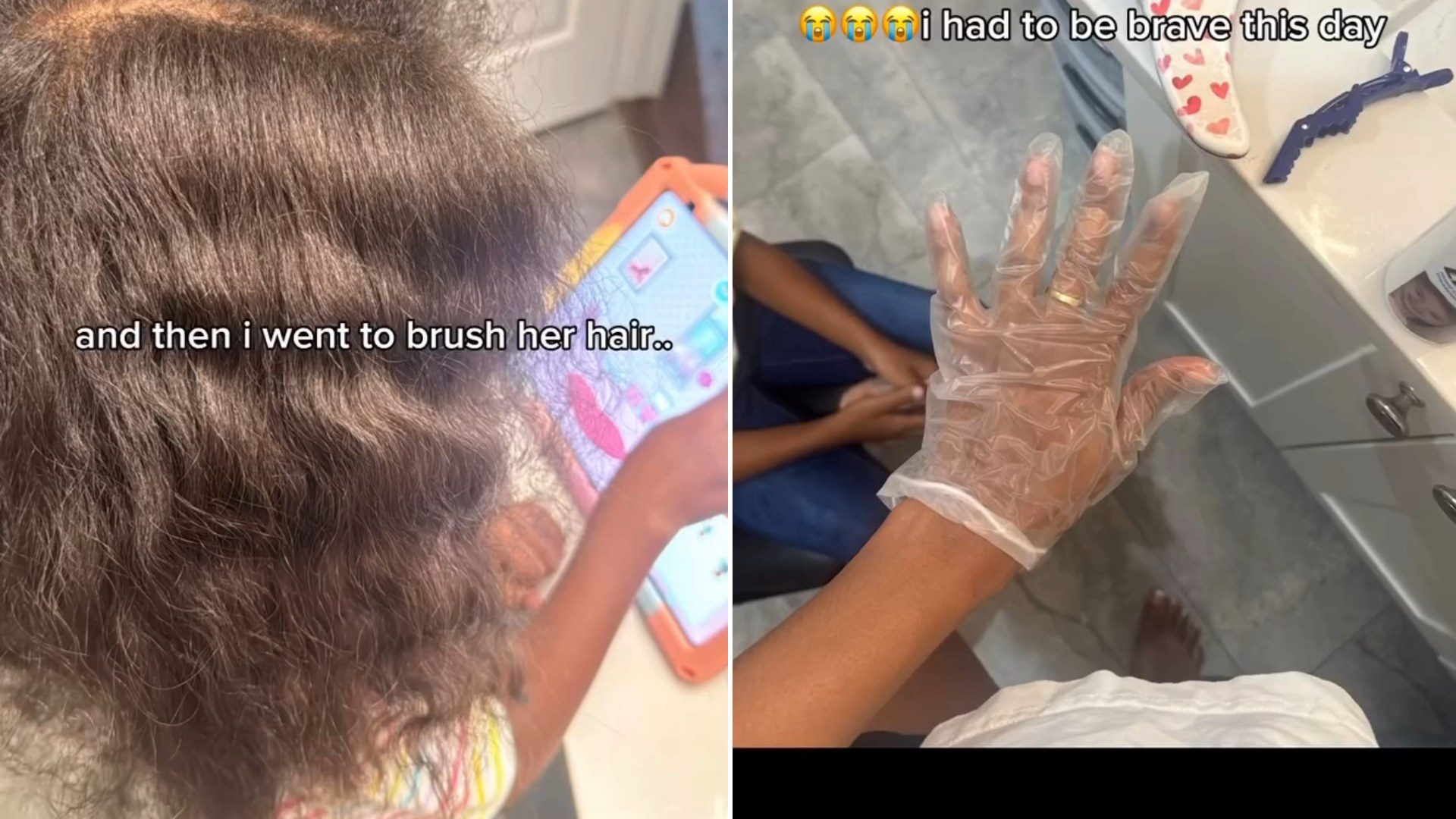
A mother on Instagram is getting attention for a video that starts with a familiar parenting nightmare and turns into a small public service announcement. In the clip, she documents the moment she discovered her daughter had a lice infestation, then walks viewers through the gross, stressful process of combing it out strand by strand.
According to her caption, the footage is actually from the previous year, not a fresh discovery, but she chose to share it now to make a point that stuck with her long after the ordeal was over: Black people get lice too. “Black people DO indeed get lice,” she wrote, alongside a wide-eyed emoji that captures exactly how most parents feel the moment they spot the first tiny bug moving through their child’s hair.
The video shows the unglamorous reality of a lice infestation in real time. There is the initial disbelief, the frantic parting of hair strand by strand under bright light, and the slow, tedious work of combing out both the live bugs and their eggs, known as nits. Anyone who has done it knows the process is not quick. It can take hours spread across multiple sittings, with a fine-toothed metal comb dragged through small sections of hair over and over until a parent is reasonably confident the infestation is under control.
What made the video resonate beyond the usual audience of frazzled parents was the myth she set out to correct. There is a persistent and inaccurate belief that Black people, and Black children in particular, do not get head lice because of hair texture. It is a myth that has circulated for years, repeated so often in casual conversation and even in some school settings that it has taken on a life of its own. The mother’s video pushes directly against that assumption, using her own daughter’s very real, very visible infestation as proof that the idea is simply false.
Lice do not discriminate by race. They are tiny parasitic insects that live on the scalp and feed on blood, and they can infest any type of hair, curly, coily, straight, or wavy. What varies is not whether an infestation can happen, but sometimes how it is treated and detected, since methods designed with straight hair in mind do not always translate cleanly to other hair types. That mismatch is part of why myths like this one have persisted, and why representation in this kind of content matters. When a parent only ever sees lice removal demonstrated on one hair texture, it becomes easy to wrongly assume the problem itself is texture-specific.
The video’s popularity suggests plenty of people needed to hear it. It comes at the intersection of two things the internet loves: the visceral, slightly horrifying spectacle of a lice removal video, and a myth-busting moment that reframes something people thought they understood. Comment sections on lice content tend to be a mix of sympathy, shared horror stories, and product recommendations, and posts that also correct a misconception tend to draw an even wider audience, since they get shared not just by parents who relate, but by people correcting others in their own circles.
For the mother behind the account, the video captures a moment plenty of parents dread but rarely see depicted online in a way that reflects their own family. Head lice infestations are common in school-age children generally, spreading easily through the close head-to-head contact that happens on playgrounds, during sleepovers, and in classrooms. Once discovered, treatment usually calls for a specialized comb, patience, and repeat sessions, since a single pass rarely removes every nit before it hatches.
What Parents Should Know About Head Lice
Head lice can affect children of any race, ethnicity, or hair type, and infestation is not a reflection of hygiene. If your child comes home scratching their scalp, a thorough check under bright light, ideally with a magnifying glass and a fine-toothed nit comb, is the best first step. Treatment options range from over-the-counter medicated shampoos to manual comb-outs, and many families find a combination works best, since nits can survive an initial treatment and hatch days later. Repeat checks over the following one to two weeks help catch anything missed the first time. Washing bedding and recently worn hats or headphones in hot water, and avoiding head-to-head contact during an active infestation, can help prevent it from spreading to siblings or classmates. Most importantly, don’t let embarrassment delay treatment: lice are extremely common, and the sooner an infestation is addressed, the faster it’s resolved.