


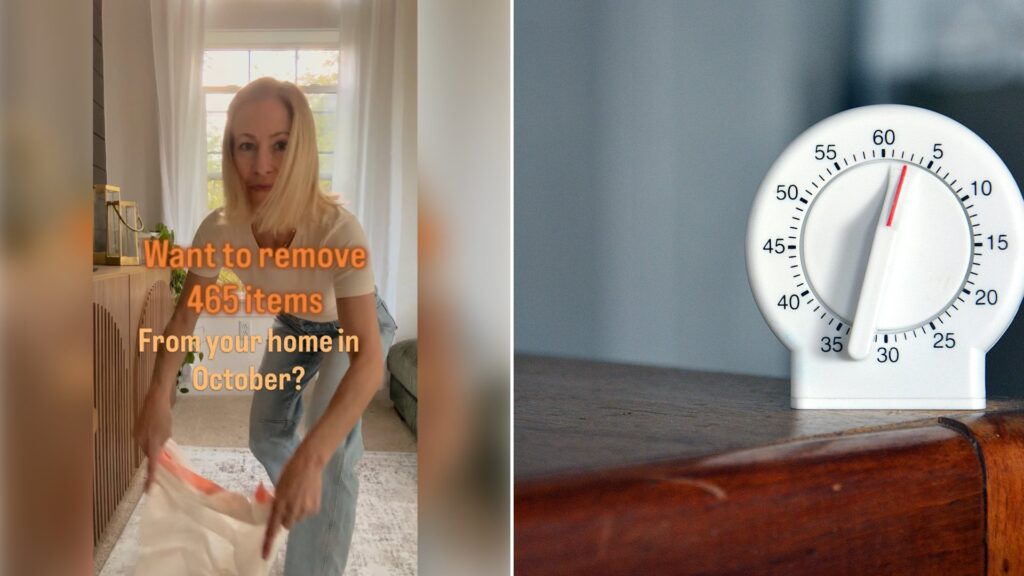
A video from the account home.uncluttered opens with a promise aimed squarely at anyone who has ever opened a closet and immediately closed it again: “If you have ADHD or limited time or limited energy, this is the easiest decluttering method possible.” The instructions that follow are almost suspiciously simple. Set a timer for 15 minutes. Try to find 15 things to remove from the house. Stop when either the 15 items are found or the timer goes off, whichever comes first. The creator adds that doing this every single day in October would add up to 465 items gone by the end of the month, and offers a free guide to the method to anyone who comments “Method.”
The method is built around two constraints working together: a hard time limit and a small, fixed target. That combination is not an accident. Professional organizer Dr. Regina Lark has described a similar approach she calls “time training,” where clients commit to a short, defined block of decluttering time rather than an open-ended “clean the whole house” goal, because an open-ended goal is exactly the kind of task that triggers avoidance in people who already feel overwhelmed by their space. A 15-minute ceiling keeps the task small enough that starting doesn’t require motivation, only a timer.
That matters because the hardest part of decluttering is rarely the physical act of carrying something to a donation box. It’s getting started in the first place. Behavioral researchers who study habit formation, including Stanford’s BJ Fogg, have found that tiny, low-friction actions are far more likely to turn into a repeated habit than large, ambitious ones, because the brain doesn’t treat a 15-minute task as a threat the way it treats “finally deal with the garage.” Shrinking the commitment shrinks the resistance to doing it at all, and a habit that actually gets repeated beats a bigger plan that gets abandoned after day two.
The math behind the October challenge is also the quiet appeal of the whole method. Fifteen items a day sounds modest, almost too modest to bother with, until it’s multiplied by 31 days and turns into 465 things out of the house by Halloween, all without ever requiring a single dedicated weekend of hauling bags to the car. Organizing writers have pushed similar “20 minutes a day” and “10-minute declutter” frameworks for exactly this reason: a small, boring, repeatable action beats a big dramatic purge that only happens once a year, because the small action is the one people will actually still be doing in week three.
There’s also a mental health angle worth naming directly. Clinical psychologists who write about clutter point out that the state of a person’s physical space and the state of their mind tend to feed each other, and that visible, chronic clutter can act as a low-grade, constant reminder of undone tasks, which is draining in a way that’s easy to underestimate. A 15-minute sweep doesn’t erase that feeling in one sitting, but it does give a person a small, concrete win they can point to every day, which is a very different experience than staring at an entire house that needs fixing all at once.
If 15 items in 15 minutes sounds doable, the method travels well beyond a single room. A kitchen junk drawer can usually give up 15 expired coupons, dead pens, and mystery keys in under two minutes. A bathroom cabinet can part with 15 half-used bottles and expired medications almost as fast. The point isn’t to finish the house in one session, it’s to never let the session feel big enough to skip. For anyone who has started a decluttering project in January and abandoned it by February, a timer and a number this small might be the only format with any real shot at still running in December.
More from Decluttering Mom
- Mom Who Thrifted Her Toddler’s Entire Christmas Says She Started in August With One Dollhouse Set and Shows the Play Kitchen, Dolls and Dress Up Shoes That Ended Up Under Her Tree
- Mom of Three Counts Out Loud as She Pulls 100 Things From Her Playroom While Her Big Kids Are Out, Keeps Both Toy Shopping Carts for Her Baby and Decides the Couch Is Going
- Homeowner Whose Husband Said He Could Not See the Garage Floor Hauls Out Four Years of Stuff, Patches and Paints One Wall White, Then Hangs Bikes, Helmets and a Vacuum on Rails