


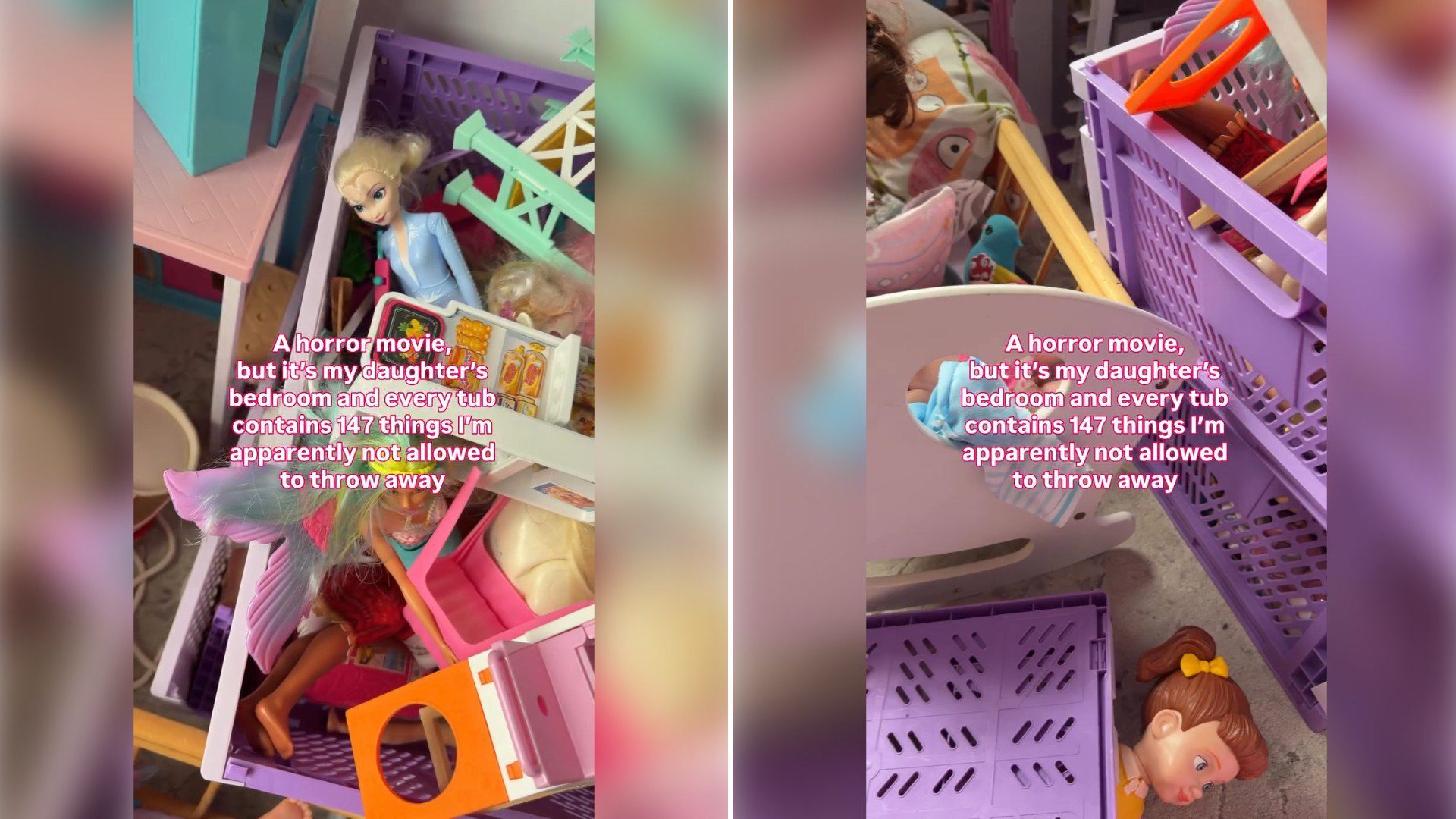
There’s a moment every parent of a young child eventually faces: opening a bedroom door and being genuinely, physically startled by what’s on the other side. For one mother, that moment came in the form of her daughter’s room, buried under a collection of clutter so extensive and so chaotic that the only fair comparison, in her mind, was a horror movie. Not a metaphorical one, either — the framing, the pacing, the sheer disbelief in her voice as she surveyed the wreckage all leaned fully into that genre, turning an otherwise ordinary parenting frustration into genuinely entertaining content.
The video walks through the scene with a kind of theatrical dread, treating each newly discovered pile of toys, clothes, and miscellaneous kid belongings like a jump scare waiting to happen. It’s a format that works precisely because it exaggerates something every parent has felt at least once: the specific horror of opening a door you were avoiding, only to find the mess has multiplied in ways that seem almost physically impossible for one small child to have generated alone.
Her caption captured the disbelief perfectly: “What in the hoarding is this?! #aussiemums #mumlife #perthmums #girlmum #barbie.” The specificity of those hashtags — rooted in her local community of Australian mothers — makes the video’s massive reach even more striking. It pulled in roughly 1.7 million views from an account with only about 6,200 followers, an almost unbelievable multiplier that speaks to just how universally recognizable this particular flavor of parenting chaos really is, regardless of where in the world you’re watching from.
As @its_kyliew demonstrated in her post, kids’ bedroom clutter has a way of accumulating almost invisibly. It rarely happens all at once; instead, it builds gradually, one forgotten toy or half-finished craft project at a time, until a parent finally steps back and realizes the floor hasn’t been visible in weeks. That slow creep is part of what makes the “reveal” style of content so effective — the shock isn’t really about the mess itself, but about how quickly and quietly it managed to get that bad without anyone fully clocking it in real time.
There’s also a comedic effect that comes from committing fully to the horror-movie framing rather than treating the reveal as a simple, matter-of-fact complaint. Leaning into the genre’s tropes — the dread, the slow pan, the disbelief — elevates an ordinary parenting frustration into something closer to entertainment, giving viewers a reason to laugh along rather than simply scroll past another clip of a messy room.
This kind of clutter is also, in many ways, developmentally normal rather than a sign of parental failure, which is likely part of why the video resonated with so many viewers instead of drawing judgment. Young children, especially those still building executive function skills, don’t naturally prioritize tidying the way adults do. Toys get pulled out for one purpose, abandoned mid-play, and left exactly where they fall, often layered on top of whatever was left there the day before. For girls in particular, collections tied to specific play themes — dolls, craft supplies, dress-up items — tend to multiply fast, especially around gift-heavy occasions like birthdays or holidays, compounding the mess in ways that can feel sudden even when it’s been building for months.
For parents facing their own version of this horror-movie bedroom, professional organizers tend to recommend a few strategies that go beyond simply doing one massive cleanout and hoping it sticks. Sorting by category rather than location — gathering every stuffed animal in the house before deciding what stays, rather than tackling room by room — tends to make the sheer volume of belongings easier to see and manage. Involving the child in the process, even in small ways like choosing which toys to donate, also tends to build better long-term habits than a parent quietly clearing the room while the child is at school. And setting a genuinely sustainable toy rotation, where only a fraction of a child’s total belongings are accessible at any given time while the rest stay stored away, can prevent the kind of overwhelming buildup that leads to horror-movie-level reveals in the first place.
It’s also worth noting how much the specific hashtags attached to the post reveal about why it traveled so widely despite targeting a fairly local community of mothers. Content rooted in a hyper-specific regional identity, like the Australian mum groups referenced here, often ends up resonating far beyond that original audience precisely because the underlying experience — in this case, a child’s bedroom spiraling into chaos — has almost nothing to do with geography. It’s a reminder that the most universal content is often the most specific, not the most generic.
There’s also real value in simply laughing about it, the way this video does so effectively. Parenting content that treats clutter with humor rather than shame tends to resonate far more broadly, in part because it acknowledges a truth most parents already know deep down: no amount of organizing systems fully prevents a child’s room from occasionally spiraling into chaos. The goal isn’t a permanently spotless bedroom — that’s an unrealistic standard for most households with young kids. It’s catching the mess before it fully crosses into “horror movie” territory, and when it inevitably does anyway, having the good humor to film it, caption it well, and let the rest of the internet laugh right along with you.